Alfajores with Dulce de Leche and Coconut
Cornflour-tender shortbread rounds sandwiching thick dulce de leche, edges rolled in toasted coconut
Contents
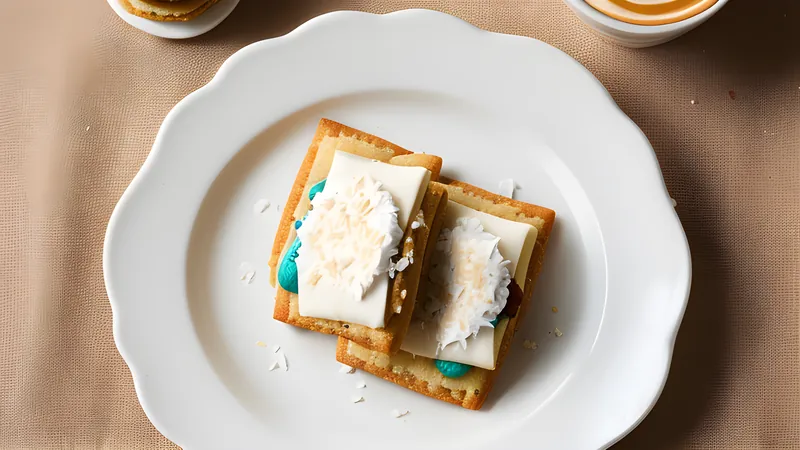
↓ Jump to recipeAlfajores are Argentina’s defining sandwich cookie: two disks of a pale, almost impossibly tender shortbread, held together with a thick layer of dulce de leche. The tenderness comes from cornflour standing in for most of the wheat flour, which strips out gluten and gives a crumb that shatters into something closer to sand than to a conventional biscuit. My addition is the edge: instead of leaving the dulce de leche bare, I roll it in toasted desiccated coconut, a variation you’ll find in bakeries across Argentina and Uruguay, and one that adds both crunch and a faintly nutty sweetness against the caramel.
Alfajores with Dulce de Leche and Coconut
Ingredients
- 150g unsalted butter, softened
- 100g icing sugar, sifted
- 2 egg yolks
- 1 tbsp brandy or dark rum
- 1 tsp vanilla extract
- Zest of 1 lemon
- 200g cornflour (cornstarch)
- 100g plain flour
- 1 tsp baking powder
- 1/4 tsp fine salt
- 400g tinned dulce de leche (or 1 x 397g tin sweetened condensed milk, boiled unopened for 3 hours, cooled)
- 150g desiccated coconut, lightly toasted
Method
- Cream the softened butter and icing sugar together until pale and light, about 2-3 minutes.
- Beat in the egg yolks one at a time, then the brandy, vanilla and lemon zest.
- Sift together the cornflour, plain flour, baking powder and salt.
- Add the dry ingredients to the butter mixture and mix on low speed just until a soft, slightly sticky dough forms. Do not overmix.
- Turn the dough onto a lightly floured surface, shape into a disc, wrap and chill for at least 1 hour, or up to 24 hours.
- Preheat the oven to 160C fan (180C conventional, Gas 4) and line two baking trays with parchment.
- Roll the chilled dough to 5mm thickness between two sheets of baking parchment, to avoid working extra flour into it.
- Cut into rounds with a 5cm cutter and transfer to the lined trays, spacing 2cm apart.
- Bake for 10-12 minutes, until the biscuits are set and pale, with no colour on top and only the faintest gold at the very edge. Do not let them brown.
- Cool completely on the tray before handling; they are fragile while warm.
- Spread a generous tablespoon of dulce de leche on the flat side of half the biscuits and sandwich with the remaining halves, pressing gently until the filling just meets the edge.
- Roll the exposed dulce de leche edge of each sandwich in the toasted desiccated coconut, pressing gently so it adheres all the way round.
A biscuit that travelled from Al-Andalus to the Rio de la Plata
The word alfajor comes from the Arabic al-hasú, meaning “the filling” or “the stuffing,” and traces back to Moorish Spain, where honey-and-nut-filled sweets of a similar name were made under Al-Andalus rule between the 8th and 15th centuries. Spanish colonisers carried the name and the general concept of a filled confection across the Atlantic, and it took root and diverged wildly across Latin America: Peruvian alfajores are often triple-stacked with fine, crumbly layers; Spanish alfajores from Medina Sidonia remain closer to the honeyed original, a dense spiced nougat bar rather than a sandwich cookie at all.
The Argentine and Uruguayan version, the one most people picture today, crystallised in the late 19th and early 20th centuries alongside the industrial production of dulce de leche, itself a product Argentina claims (alongside a long-running rivalry with Uruguay over the same claim) as a national dish. Legend places dulce de leche’s accidental invention around 1829, when a servant of General Juan Manuel de Rosas is said to have left milk and sugar over heat too long and returned to find it transformed into a thick caramel rather than burnt, though sweetened, reduced milk preparations appear in food history well before that specific story, so treat it as folklore rather than fact. What’s certain is that by the mid-20th century, dulce de leche and the alfajor had become inseparable, and today Argentina produces and eats staggering quantities of both; some estimates put average annual alfajor consumption in Argentina at well over half a billion units.
Every region of Argentina claims its own version, and the differences are real rather than cosmetic. Alfajores cordobeses, from Córdoba province, are often coated in a stark white sugar glaze rather than left plain or dipped in chocolate. Alfajores santafesinos, from Santa Fe, stack many thin, almost wafer-like layers of dough with dulce de leche between each one, closer in spirit to the Peruvian style than to the thick single sandwich made here. The version that eventually went industrial and international, sold in petrol stations and airports from Ushuaia to Miami, is largely the Mar del Plata style popularised by the brand Havanna, founded there in 1948 and now synonymous with the alfajor the way a particular biscuit brand might be synonymous with a shortbread elsewhere. This coconut-rolled version sits closer to the home-baked tradition than the mass-produced one, since chocolate-dipping requires tempering equipment most bakeries reserve for their commercial lines, while a coconut edge is something any home cook can finish by hand.
Why cornflour is the key to this biscuit’s tenderness
Most shortbread and biscuit doughs rely on wheat flour for at least some structure, and gluten, the elastic protein network that forms when wheat flour meets liquid and is worked, is exactly what you don’t want here. This dough uses roughly twice as much cornflour as wheat flour, and cornflour has essentially no gluten-forming protein at all; it is pure starch. With so little gluten available to form a network, the baked biscuit can’t hold together with any chew or snap. Instead it sets into a soft, powdery crumb that dissolves almost immediately on the tongue, the texture alfajores are prized for and the reason they’re sometimes described as melting rather than being bitten.
This is also why the mixing method matters more than it would in an ordinary biscuit dough. Overmixing wheat flour develops gluten and toughens a dough; overmixing this dough does less structural damage in that sense, since there’s so little gluten to develop, but it does warm the butter too much and can make the dough greasy and hard to roll, so mixing just until combined is still the rule, for a different underlying reason. The egg yolks (no whites) add richness and a little binding protein without introducing extra gluten, and the small hit of brandy or rum, largely for aroma, also tenderises slightly by interfering with what little gluten does form. Lemon zest plays a similar supporting role: its oils lift the richness of the butter and dulce de leche without adding any competing flavour of their own, which is why orange zest, discussed below, works as a substitute but a stronger citrus like lime would throw the balance off.
Colour is the most reliable doneness cue here, more telling than touch or a skewer test, because these biscuits should never brown. Wheat-heavy biscuits rely on Maillard browning for flavour, but this dough’s identity depends on staying pale and delicate; any real colour reads as burnt cornflour and turns bitter rather than toasty. Pull them from the oven when they’re set, firm enough to hold shape, but still essentially blond, with at most a whisper of gold right at the very edge.
The recipe, step by step
Cream butter and icing sugar until pale, beat in yolks one at a time, then brandy, vanilla and lemon zest. Sift the cornflour, plain flour, baking powder and salt together and mix in on low speed just until a soft dough forms; it will feel closer to a soft playdough than a firm biscuit dough. Chill at least an hour so it’s firm enough to roll. Roll to 5mm between parchment sheets rather than on a floured board, since extra flour worked in here dilutes the very effect you’re after. Cut into 5cm rounds and bake at 160C fan for 10-12 minutes, watching for pale set rather than colour. Cool completely, since warm biscuits are too fragile to move without crumbling, then sandwich generously with dulce de leche and roll the caramel-exposed edge in toasted coconut, pressing gently so it sticks all the way round.
Tips, substitutions, storage
If you can’t find tinned dulce de leche, the boiled-tin method works reliably: submerge an unopened tin of sweetened condensed milk fully in a large pot of water, simmer for 3 hours (topping up water so the tin stays covered throughout, since an exposed tin can be a genuine safety risk), then cool completely before opening. Toast the desiccated coconut in a dry frying pan over medium-low heat, stirring constantly, for 3-4 minutes until golden; it burns fast once it starts to colour, so don’t walk away. Tip it onto a cold plate the moment it’s toasted, since the residual heat of the pan will keep darkening it even off the stove, and a pale, even gold gives a sweeter, more rounded flavour than the bitter edge of over-toasted flakes. Assembled alfajores keep in an airtight tin at room temperature for 4-5 days, and the texture actually improves slightly after a day as the dulce de leche softens the inner faces of the biscuits. Unfilled biscuits freeze well for up to a month; fill and coat only after thawing.
Humidity is the dough’s real enemy, both before and after baking. Cornflour is hygroscopic, so on a damp day the raw dough can turn tacky and hard to roll even after a full hour’s chilling; if that happens, work with a shorter, colder stretch of dough at a time rather than fighting the whole disc at once, and keep the rest in the fridge. The same goes for storage: alfajores left uncovered, or kept in a tin that isn’t properly sealed, will soften and lose their sandy crumb within a day, since the biscuit readily pulls moisture from the dulce de leche and from the air alike. A tightly lidded tin, and a layer of greaseproof paper between rows so the coconut doesn’t rub off onto the biscuit above, keeps them at their best. If your desiccated coconut has been open in the cupboard for months, taste a pinch before toasting; coconut’s oils turn rancid faster than most people expect, and no amount of toasting will mask that flavour once it’s set in.
Variations
A version dipped entirely in melted dark chocolate rather than coconut-rolled is common across Argentina and sold as alfajores de chocolate; if you’d rather do that, skip the coconut toasting stage entirely, chill the filled sandwiches for 20 minutes so the dulce de leche firms up, then dip each one halfway into tempered dark chocolate and set on parchment to cure. A plain nevado finish, a straightforward dusting or thin glaze of icing sugar over the bare biscuit tops, is the simplest option of all and the one most likely to appear in a home kitchen rather than a bakery, since it needs no tempering or toasting at all. For a citrus-forward take, swap the lemon zest for orange, which pairs particularly well against the coconut, or add a few drops of orange blossom water to the dough alongside the vanilla for a more floral, Middle Eastern-leaning echo of the biscuit’s Al-Andalus roots. These make a fitting finish alongside chimichurri-dressed grilled meats for a full Argentine spread, or serve them next to a tres leches cake if you want two of Latin America’s great milk-and-caramel desserts on the same table.
Related Content