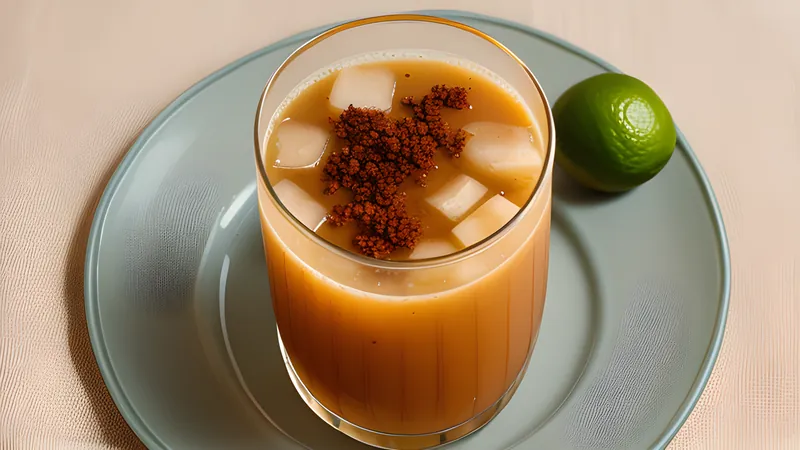
Agua de Tamarindo
A sweet-sour Mexican cooler built from a real tamarind block, simmered and sieved by hand.
Contents
↓ Jump to recipeAgua de tamarindo tastes like the inside of a tamarind pod concentrated into a glass — sour, dark, faintly caramelised, and only as sweet as you decide to make it. Most versions sold outside Mexico lean hard on bottled concentrate and taste more of sugar than fruit. This one starts from an actual block of tamarind pulp, the kind sold wrapped in cellophane with the seeds still in it, and does the extraction properly, so the drink carries tamarind’s real depth — closer to date and tart plum than to anything artificially fruity.
Agua de Tamarindo
Ingredients
- 250g tamarind pulp block (with seeds and fibre), or 150g seedless tamarind paste/concentrate
- 1.5 litres water, divided
- 150g caster sugar, or to taste
- A small pinch of fine salt
- Ice, to serve
- Lime wedges, to serve (optional)
Method
- If using a tamarind block, break it into rough chunks and put it in a saucepan with 500ml of the water. Bring to a simmer and cook for 10 minutes, stirring and breaking up the pulp with a wooden spoon, until it has softened into a thick, dark, seedy mush.
- Remove from the heat and let the mixture cool for 5 minutes, then push it through a fine sieve set over a bowl, pressing hard with the back of a spoon to force all the pulp through and leave only fibre, skin and seeds behind. Scrape the underside of the sieve too — a surprising amount of pulp clings there.
- If using seedless paste or concentrate instead, skip the simmering: whisk the paste directly into 500ml of hot (not boiling) water until fully dissolved and smooth.
- Transfer the sieved tamarind liquid to a large jug. Add the sugar and salt to the still-warm liquid and stir until completely dissolved.
- Add the remaining 1 litre of water and stir well. Taste — tamarind's sourness varies a great deal batch to batch, so adjust sugar in tablespoon increments until the sweet-sour balance tastes right to you, then chill for at least 1 hour.
- Serve over plenty of ice, with a lime wedge on the side of the glass if you want an extra sour edge.
Where it comes from, and why tamarind travelled so far
Tamarind isn’t native to the Americas. The tree, Tamarindus indica, originates in tropical Africa and was carried across the Indian Ocean to South Asia so long ago that India is now the world’s largest producer and the fruit reads as thoroughly Indian in most food histories. Spanish traders brought tamarind to Mexico via the Manila galleon trade — the 250-year shipping route that connected Acapulco to Manila from 1565 to 1815, ferrying silver west and Asian goods, spices and crops east across the Pacific. Tamarind took to Mexico’s climate well, particularly along the Pacific coast and in Veracruz, and by the colonial period it had become as embedded in Mexican cooking as any native ingredient — used in candies, in the sauce for pollo en salsa de tamarindo, and, most visibly, in aguas frescas, the family of unfermented fruit-and-water coolers sold from enormous glass barrels — vitroleros — at markets across the country.
The aguas frescas tradition itself is thought to predate the conquest, with Aztec markets recorded selling fruit and flower waters sweetened with agave nectar long before cane sugar arrived with the Spanish. Tamarind slotted into an existing format rather than inventing a new one, and it earns its place at the front of most aguas frescas stands alongside horchata and hibiscus water because its sourness cuts so well against Mexican street food’s richer, spicier register — a glass of it alongside tacos does the same job a squeeze of lime does, just in liquid form and by the pint.
In Oaxaca and Veracruz, tamarind shows up as sweets as much as drink. Pulparindo, the extremely popular spicy-sour tamarind pulp bar coated in chilli and salt and made by the De la Rosa company since the 1980s, draws on exactly the same flavour axis as this drink, just concentrated into something you unwrap rather than pour. Street vendors selling agua de tamarindo line it up alongside the other classic aguas frescas — jamaica, horchata, often a green one like pepino or limón con chía — in a row of glass vitroleros, arranged so customers can see the colour gradient from palest horchata to near-black tamarindo before choosing.
Block versus concentrate — and why it’s worth the extra ten minutes
Almost every recipe for this drink outside Mexico defaults to bottled tamarind concentrate, and it’s worth being honest about why: it’s fast, shelf-stable, and reliably sour. But it’s also usually cut with preservatives and sometimes pre-sweetened, and the flavour is flatter — concentrate is made by boiling tamarind pulp down hard and passing it through industrial processing, which drives off some of the more delicate fruity top notes that a gentler, home simmer preserves.
Working from a real block is genuinely not much harder, and understanding why the steps matter makes it foolproof. A tamarind block is the fruit’s pulp, still surrounding its hard black seeds and threaded with fibrous strands from the pod’s interior wall — none of which taste good, and none of which will dissolve. Simmering the block in water for ten minutes softens the pulp enough that it separates from the seeds and fibre when agitated, turning from a solid brick into a loose, dark, jammy mush. The sieving step afterwards is the part people rush, and it’s the part that makes the difference: pushing the softened pulp hard through a fine sieve, and specifically scraping the underside of the sieve where a surprising quantity of pulp collects rather than dripping through, is what separates a thin, disappointing drink from a genuinely rich one. Skip that scraping step and you can lose close to a third of the usable pulp to waste.
Seedless tamarind paste, sold in tubs rather than blocks, is a reasonable middle ground — it’s still whole tamarind rather than a manufactured concentrate, just with the seeds and fibre already removed at the processing stage, so you can skip straight to dissolving it in hot water. It’s slightly less characterful than doing the full block extraction yourself, but a fair trade for speed on a weeknight.
A couple of things commonly go wrong with a homemade batch. Adding the sugar while the strained liquid is still too hot can make the finished drink taste flat and one-note, since some of tamarind’s more volatile fruity top notes cook off further at high heat; let the liquid drop to warm, not boiling-hot, before you sweeten it, and the tang stays brighter. Under-extracting is the single most common failure and the reason bought agua de tamarindo often tastes watery and dull — you should end up with a thick, dark, almost black paste caught in the sieve before you add the rest of the water, not a thin brown liquid dripping through with little resistance. If your finished drink tastes weak despite following the method carefully, the tamarind block itself was very likely old or dried out; ageing blocks lose potency and need a longer simmer and harder pressing to give up the same amount of pulp.
The recipe
Makes 1.5 litres (about 6 glasses). Prep 15 minutes, cook 20 minutes, then chill.
Ingredients
- 250g tamarind pulp block, or 150g seedless tamarind paste
- 1.5 litres water, divided
- 150g caster sugar, or to taste
- A small pinch of salt
- Ice and lime wedges, to serve
Method
Break the tamarind block into chunks and simmer in 500ml water for 10 minutes, mashing as it softens, until you have a thick, dark mush. Cool for five minutes, then push it through a fine sieve into a bowl, pressing hard and scraping the underside of the sieve to extract every scrap of usable pulp — discard the fibre and seeds left behind. (If using seedless paste, simply whisk it into 500ml of hot water until dissolved and skip the simmering and sieving.) Stir the sugar and salt into the warm tamarind liquid until fully dissolved, then add the remaining litre of water. Taste — tamarind sourness varies significantly by batch and origin, so adjust the sugar until it tastes balanced to you rather than trusting the quantity blindly. Chill for at least an hour before serving over ice, with a lime wedge on the side if you want it sharper still.
Tips, substitutions and storage
Tamarind blocks vary enormously in moisture and seed content depending on origin — a Thai-labelled block (common in UK and US Asian grocers) tends to be softer and less fibrous than some Mexican or Indian blocks, and may need slightly less simmering time. Judge by texture rather than the clock: you want the pulp to have gone from a stiff brick to something you can mash easily with a spoon.
This drink keeps well, covered, in the fridge for up to five days — the sourness actually mellows slightly and rounds out after the first day, similar to the way chai concentrate improves once its spices have had time to sit in the liquid. Give it a stir before serving, as some of the finer sediment will settle at the bottom of the jug.
For a lower-sugar version, use a natural sweetener like piloncillo (unrefined Mexican cane sugar) instead of caster sugar — it dissolves a little more slowly but adds a faint molasses note that suits tamarind’s own dark, dried-fruit character well.
The leftover seeds and fibre from the sieving step aren’t worth keeping — most of the flavour has already gone into the strained liquid, and a second simmer of the solids yields only a faint, watery echo of the first extraction. Don’t be tempted to stretch the block further; buy a second one if you’re scaling the recipe up rather than trying to wring a third batch out of spent pulp.
Variations
A pinch of ground chilli or a rim of tajín (the chilli-lime-salt seasoning) on the glass turns this into tamarindo picante, closer to the spiced tamarind candies sold on Mexican street corners, and it’s a genuinely good pairing if you’re serving the drink alongside tacos al pastor or a plate of elote. A splash of sparkling water instead of still turns it into a passable tamarind soda. For a version with more body, blend a few dates into the strained tamarind liquid before adding the sugar — dates and tamarind share enough of a flavour family that the drink deepens rather than confuses, and you can pull back the added sugar as a result. However you take it, the block-and-sieve method is worth learning once; it’s the difference between a drink that tastes of concentrate and one that tastes unmistakably of fruit.
Related Content