World Zebra Day
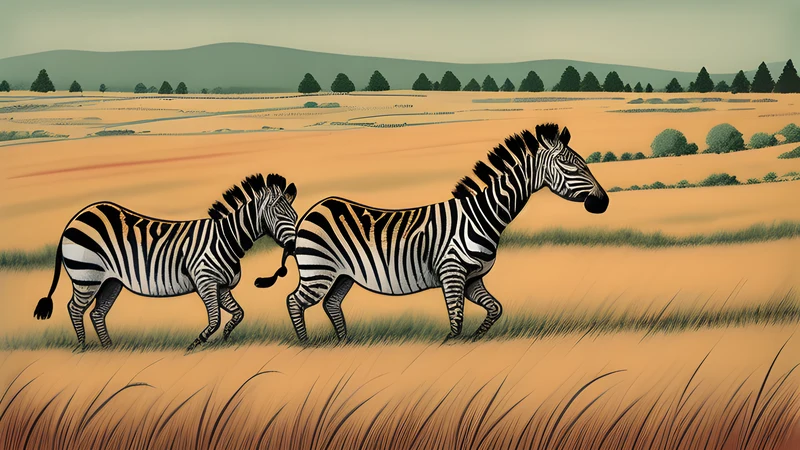
Each 31 January, conservation groups mark World Zebra Day, also called International Zebra Day, a date set aside to draw attention to Africa’s most recognisable equids and to a question that has occupied naturalists since Charles Darwin argued about it: why on earth is a zebra striped? The day pairs that genuine scientific mystery with a more urgent message, because behind the familiar black-and-white icon sit species in real trouble, one of them among the most endangered large mammals in Africa.
Three zebras, not one
There is no single zebra. There are three living species, and they differ more than their shared pattern suggests. The plains zebra (Equus quagga) is the common one, spread across the grasslands of eastern and southern Africa in large numbers, with broad stripes that often carry faint brown “shadow” stripes between the black. The mountain zebra (Equus zebra) is a hardier, cliff-dwelling species of south-western Africa, distinguished by a dewlap at the throat and a grid-like pattern on its rump. The Grévy’s zebra (Equus grevyi) is the largest and rarest, a narrow-striped animal with big rounded ears, confined now to the arid lands of northern Kenya and small parts of Ethiopia, with a wild population reduced to around two thousand animals.
That last species carries a curious piece of history in its name. In 1882 the Emperor of Abyssinia sent a zebra as a diplomatic gift to Jules Grévy, the President of France. The animal was recognised as a distinct species and named in his honour, which is why one of Africa’s zebras answers, oddly, to a nineteenth-century French statesman.
History, extinction and a lost stripe
The zebra’s history includes a warning about how quickly a common animal can vanish. The quagga was a subspecies of plains zebra, striped only on its head, neck and forequarters and fading to plain brown behind, that once roamed South Africa’s Cape in enormous herds. Hunted relentlessly by European settlers for meat and hides and to clear grazing for livestock, the last known wild quaggas were shot in the 1870s, and the final captive individual died at Amsterdam’s Artis zoo in 1883. Nobody realised it was the last of its kind until it was gone. Its story is a close cousin of the tale told each year on other days for vanished animals, and it directly inspires modern work: the Quagga Project in South Africa has spent decades selectively breeding plains zebras to recover the quagga’s distinctive reduced-stripe appearance.
The deeper history is the argument over the stripes themselves, a debate that ran through Victorian science. Darwin doubted that the pattern served as camouflage on the open plains, and for more than a century biologists proposed competing theories with little way to test them. That changed only recently.
Why the stripes, and why the day
The most robustly supported explanation for zebra stripes is defence against biting flies. Field experiments, notably by the biologist Tim Caro, dressed horses in striped coats and found that tsetse flies and horseflies struggle to land on striped surfaces, apparently confused by the high-contrast pattern as they approach. In a continent where such flies carry deadly diseases like nagana and sleeping sickness, and where zebras have thin coats that offer little protection, the stripes may function as a kind of insect repellent written onto the skin. Other proposed benefits, cooling airflow across alternating black and white bands, confusing predators through a dazzle effect when the herd moves, and helping individuals recognise one another, may all play supporting roles.
World Zebra Day uses that memorable mystery as a doorway into conservation. Grévy’s zebra has declined catastrophically over recent decades through habitat loss, competition with livestock for water and grazing, and hunting, making it a flagship for the fragile ecosystems of the Horn of Africa. Even the abundant plains zebra faces mounting pressure from fences and farmland that cut across its migration routes. The day channels attention and funding toward the research and community programmes trying to reverse those declines.
How it is marked
Zoos, wildlife charities and safari organisations lead the observance with keeper talks, fundraising appeals and social-media campaigns built around the animal’s photogenic pattern. Conservation bodies such as the Grevy’s Zebra Trust and research institutes release population updates and stories from the field. In Kenya, community-based conservation is central to the day, since much Grévy’s zebra habitat lies on land shared with pastoralist peoples, and protecting the species depends on local scouts, water management and the goodwill of herders. Schools and educators use the striking visual of the zebra to teach about camouflage, evolution and biodiversity, and the date’s simple hook, an animal everyone can draw, makes it an easy entry point for younger audiences.
Behaviour and the great migration
Zebras are intensely social. Plains zebras live in tight family groups of a stallion, several mares and their foals, and these families gather into larger herds, sometimes called a “dazzle”, that mingle with wildebeest and antelope on the move. Foals are born a reddish-brown colour, their stripes darkening as they grow, and a mother keeps her newborn away from the rest of the herd for its first days so it can imprint on her unique stripe pattern, voice and smell before joining the crowd. In 2014 researchers documented that plains zebras in Namibia and Botswana undertake the longest known land migration in Africa, a round trip of some five hundred kilometres between the Chobe River and the Nxai Pan salt flats, a journey that had gone unrecorded until GPS tracking revealed it.
Symbols, stripes and human borrowing
Few animal patterns have been borrowed by humans as freely as the zebra’s. The word “zebra crossing” entered British English in the late 1940s for the black-and-white striped pedestrian crossings introduced to make them visible to drivers, a design that turned the animal’s coat into everyday street furniture across much of the world. In sport, the black-and-white striped shirts of referees earned them the nickname “zebras”, and the bold contrast has been a staple of fashion and design precisely because it reads so strongly to the human eye. In medical training, students are taught the phrase “when you hear hoofbeats, think horses, not zebras”, a reminder to suspect common diagnoses before rare ones, so the animal has even become shorthand for the unusual and unexpected.
Across the African cultures that live alongside zebras, the animal appears in folklore and rock art stretching back thousands of years, its stripes explained in stories as scorch marks from fire or the result of a quarrel long ago. That imaginative pull is part of why the zebra makes such an effective conservation ambassador: people feel they already know it.
The relatives it keeps
Zebras belong to the horse family, the equids, alongside domestic horses, donkeys and the wild asses of Asia and Africa. That kinship is close enough that zebras can be crossbred with horses and donkeys to produce “zebroids”, sterile hybrids sometimes bred as curiosities. Yet the zebra’s evolutionary path diverged sharply from its tameable cousins, leaving it wild in temperament and equipped for a life of constant vigilance on predator-rich plains. Understanding the zebra as one branch of a wider equid family helps explain both its familiarity, it looks like a striped pony, and its stubborn refusal to be treated like one. It also underlines what is at stake with Grévy’s zebra: losing it would mean losing an entire distinct lineage of wild horse, not merely a variety of a common animal.
Fun facts worth spotting
A zebra is black with white stripes, not the other way round. The animals have black skin beneath their coat, and the white stripes are areas where pigment is switched off during development, so black is the base and white is the pattern laid over it.
They are famously untameable. Despite looking like striped ponies, zebras have never been successfully domesticated for riding or work, being skittish, aggressive when cornered and lacking the temperament of horses. The Victorian eccentric Walter Rothschild once drove a carriage pulled by zebras through London to prove a point, but the species resisted any wider use.
Each pattern is unique. No two zebras carry exactly the same arrangement of stripes, and researchers now use photographic stripe recognition, effectively a barcode reader for zebras, to identify and count individuals in the wild.
Grévy’s zebra brays like a mule. The rarest zebra sounds quite unlike its cousins, producing a loud, distinctive call, and its large rounded ears and narrow stripes make it look almost like a cross between a zebra and a donkey.
Their stripes may even keep them cool. One idea holds that the black bands absorb heat while the white ones reflect it, setting up tiny swirling air currents across the skin, and zebras in the hottest, sunniest parts of Africa do tend to carry the boldest, most complete striping.
A closing reflection
The zebra is one of those animals whose very familiarity can obscure how strange and unresolved it really is. We put it on nursery walls and crossing signs while scientists were still arguing about the purpose of its most obvious feature, and while one of its species was slipping toward the edge. World Zebra Day holds both truths at once, the delight of the pattern and the fragility of the animal wearing it. The wider fate of Africa’s grasslands ties the zebra to its tall neighbour on World Giraffe Day, to the swift predator honoured on International Cheetah Day, and to the river-bound giants of World Hippo Day. Every 31 January is a chance to look past the pattern and see the animal, and the vanished quagga, still standing behind it.
Related Content