World Wombat Day
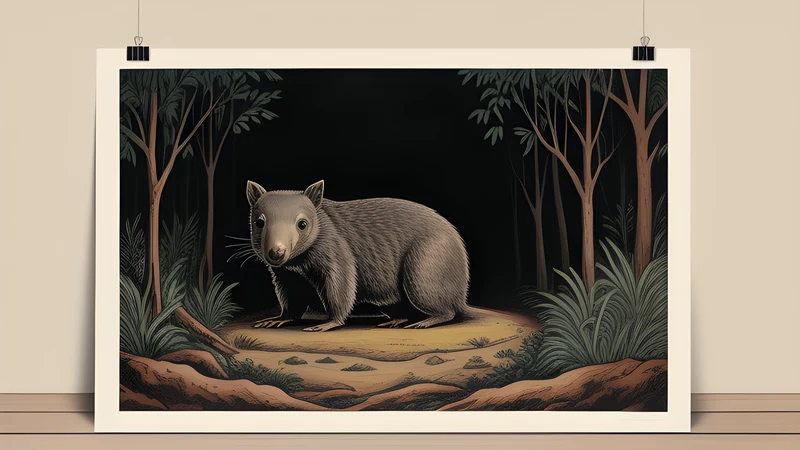
On 22 October each year, World Wombat Day celebrates one of the strangest and most endearing animals Australia has produced: a barrel-shaped, burrowing marsupial that can weigh as much as a large dog, run surprisingly fast, and produce, uniquely among all animals, droppings shaped like cubes. The day emerged from the community of Australian wildlife carers and conservation groups who work with wombats, and it gathers the sanctuaries, zoos and rescuers who look after them. Behind the affection lies a serious purpose, because one of the three wombat species is among the rarest mammals on Earth, and the others face a creeping list of threats that the day is meant to keep in public view.
Three species of digger
Wombats are marsupials, members of the family Vombatidae, and their closest living relative is the koala, with which they share a common ancestor and, oddly, a pouch that opens toward the rear. There are three species. The common wombat, Vombatus ursinus, is the largest and most widespread, found across south-eastern Australia and Tasmania, a stocky animal with a bare, leathery nose. The southern hairy-nosed wombat, Lasiorhinus latifrons, lives in the arid country of South Australia and has, as the name promises, a furred snout and softer ears. The third, the northern hairy-nosed wombat, Lasiorhinus krefftii, is one of the most endangered mammals in the world.
The northern hairy-nosed wombat once ranged widely, but by the 1980s it had crashed to a few dozen animals confined to a single site, Epping Forest National Park in central Queensland. Decades of intensive protection, including a predator-proof fence and the establishment of a second insurance colony at the Richard Underwood Nature Refuge, have slowly lifted the population back into the hundreds, but it remains perilously small. The recovery of this one species is among the quiet triumphs of Australian conservation, and it gives World Wombat Day a concrete story of near-loss and painstaking rescue.
The engineering marvel of the burrow
A wombat is built to dig, and it does so on an industrial scale. With powerful limbs and long claws it excavates extensive burrow systems, some stretching many metres and branching into networks that can be shared and reused across generations. It is the largest burrowing herbivore on Earth, and its warrens reshape the ground so thoroughly that they qualify the animal as an ecosystem engineer, creating shelter that other species exploit. During the catastrophic Australian bushfires of 2019 and 2020, a story spread that wombats were heroically herding other animals into their burrows; the truth was less deliberate but no less useful, as the deep, humid tunnels did shelter reptiles, small mammals and insects from the flames.
The pouch of a wombat faces backwards, opening toward the tail, an arrangement that would be absurd for most animals but is perfect for one that spends its life digging, since it stops the joey being buried in loose earth as the mother works. The wombat’s other famous piece of engineering is its rear end. The rump is reinforced with tough, cartilage-heavy tissue, and a wombat threatened in its burrow will present its backside to the entrance and, if a predator forces its way in, use its powerful legs to crush the intruder’s skull against the tunnel roof. It is a defence of startling brutality from so genial-looking a creature.
The cube-shaped mystery
Of all the wombat’s peculiarities, the one that has done most for its fame is its droppings. A wombat produces dozens of neat, roughly cubic pellets each night, up to eighty or a hundred, and it deposits them on rocks, logs and other raised surfaces to mark its territory, where the flat sides usefully stop them rolling away. For years no one could explain how a soft-walled gut could manufacture a cube, and the question was treated as a curiosity until a team of researchers took it seriously. Patricia Yang and David Hu, working at the Georgia Institute of Technology, dissected wombat intestines and found that the walls vary in stiffness around their circumference, stretching more in some places than others, so that as the drying faeces pass through the final stretch of gut they are moulded into flat-sided blocks.
The work earned Yang, Hu and their colleagues an Ig Nobel Prize in 2019, the award that celebrates research that first makes people laugh and then makes them think, and it turned an internet joke into a genuine piece of biomechanics with possible applications in manufacturing. The cube-shaped dropping is now the fact almost everyone knows about wombats, and World Wombat Day leans into it happily, because a good curiosity opens the door to the more serious conservation message behind it.
History of the day
World Wombat Day grew, like many single-species observances, out of the network of carers, sanctuaries and conservation groups devoted to the animal, among them the Wombat Protection Society of Australia. The 22 October date gives Australian wildlife organisations an annual focus for fundraising and education, and it has spread through the country’s zoos and wildlife parks, where hand-raised wombats are often ambassadors for the cause. The day belongs to the same family of grassroots wildlife celebrations as observances like World Wildlife Conservation Day, and it shares their basic logic: give an animal a date, attach some memorable facts, and use the resulting attention to fund the unglamorous work of keeping it alive.
Why the day matters
Even the common wombat, secure though it seems, faces mounting pressure. Sarcoptic mange, a disease caused by a mite, has swept through wombat populations in parts of the south-east, causing terrible suffering and local die-offs, and carers spend much of the year treating affected animals in the wild. Road deaths take a heavy toll, habitat is lost to agriculture and development, and wombats are sometimes killed as agricultural pests because their burrows undermine fences and fields. For the northern hairy-nosed wombat the margin is far thinner still, its entire species resting on a couple of protected sites. Placing the wombat in the public eye, alongside the concerns raised on days such as World Frog Day, is the surest way to keep support flowing to the people doing the work.
How it is celebrated
Zoos and wildlife parks host wombat-themed talks and feeds, and sanctuaries share the stories of individual rescued animals, especially the orphaned joeys that carers raise by hand. Fundraising drives support mange-treatment programmes and the maintenance of protected habitat, and schools use the day to introduce children to the marsupial and its cube-shaped signature. Online, the day fills with footage of wombats trotting through the bush with the rolling gait of a small tank, and of joeys peering out of backward-facing pouches.
Wombats in culture and language
The wombat has left a deep mark on Australian culture. Its name comes from the Dharug language of the Eora people around what is now Sydney, one of many Aboriginal words absorbed into Australian English, and for the peoples who lived alongside it the animal was both food and a familiar presence in Dreaming stories. In the colonial era the wombat became a national mascot of sorts, and the nineteenth-century painter and poet circle around Dante Gabriel Rossetti in London developed a famous obsession with the animals, Rossetti keeping pet wombats at his home and mourning one, named Top, in a sketch that has since become a small legend of art history. In the twentieth century the wombat entered children’s literature through books such as Ruth Park’s The Muddle-Headed Wombat and Jackie French’s Diary of a Wombat, the latter selling in the millions and fixing the animal’s image as a stubborn, grass-loving, thoroughly likeable creature.
The science of saving a species
The recovery of the northern hairy-nosed wombat has become a case study in intensive conservation. Because the entire species was for years confined to one park, a single fire, disease outbreak or drought could have ended it, so managers established a second colony hundreds of kilometres away, moving animals carefully to spread the risk. Supplementary feeding through droughts, predator-proof fencing to keep out dingoes, and remote cameras and burrow monitoring to track a shy nocturnal animal have all played their part, and geneticists watch the tiny gene pool for the inbreeding that threatens any small population. The lessons learned, from how to relocate a wombat to how to read the health of a warren, feed back into the care of the commoner species, and World Wombat Day helps fund the research and the fences alike.
Fun facts
Despite their heavy build, wombats can sprint at up to forty kilometres an hour over short distances, easily outrunning a human across open ground. Their digestion is among the slowest of any mammal, taking around two weeks to process a meal, an adaptation to the poor, dry grasses they eat and the scarce water of their range. The wombat’s ancient relatives include Diprotodon, a rhinoceros-sized marsupial that was the largest to ever live and roamed Australia until relatively recent geological times. And a baby wombat, like all marsupial young, is called a joey, and stays in the pouch for six to seven months before riding on its mother’s back and finally striking out to dig a burrow of its own.
A closing reflection
The wombat is easy to love for the wrong reasons, a comic animal with comic droppings, and World Wombat Day is quite content to draw people in with the joke. But behind the cube-shaped punchline is a creature of real ecological weight, an engineer of the underground whose burrows shelter a whole community, and a genus that came within a few dozen animals of losing one of its members forever. The 22nd of October asks its audience to laugh first and then to look closer, and to notice that keeping the wombat’s strange, sturdy presence in the Australian bush has taken decades of stubborn, unheralded care.
Related Content