World Typewriter Day
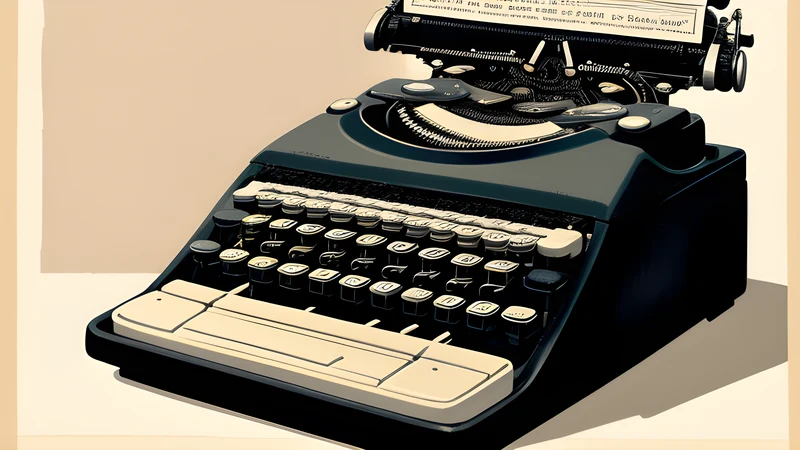
On 23 June 1868, three men in Milwaukee — the printer Christopher Latham Sholes, the lawyer Carlos Glidden and the mechanic Samuel Soule — were granted United States patent number 79,265 for a machine they called a “type-writer”. World Typewriter Day marks that grant, and the anniversary is exact rather than approximate: the same date on which the office worker of the next century was, in effect, invented.
The morning of the patent
Sholes was tinkering in Charles Kleinsteuber’s machine shop in Milwaukee when the idea took hold. He had first built a device for numbering the pages of books and tickets, and Glidden suggested it might be adapted to print letters as well as figures. The early prototypes were crude — a single key striking through a carbon sheet, one character at a time — but by 1867 the men had a working machine and the confidence to seek protection for it. The patent granted on 23 June 1868 was not the first ever issued for a writing machine; Henry Mill had patented an unbuilt “artificial machine” in London in 1714, and the Italian Pellegrino Turri had made one for a blind countess around 1808 so that she could write letters unaided. What Sholes and his partners produced was the first that could be manufactured and sold at scale, and that distinction is why the day belongs to them rather than to their many forgotten predecessors.
History
The path from patent to product ran through the gun-maker E. Remington and Sons of Ilion, New York, which had spare capacity after the American Civil War and the precision engineering to make small metal parts reliably. The first commercial model, the Sholes and Glidden Type-Writer, went on sale in 1874. It printed only capital letters, hid the paper behind the carriage so a typist could not see the words being formed, and was decorated with painted flowers and mother-of-pearl inlay because Remington built it on the same production line as its sewing machines. Sales were slow at first — the machine cost around 125 dollars, several months’ wages for a clerk — but a young author named Mark Twain bought one and later claimed his was among the first literary manuscripts submitted to a publisher in typescript, a boast historians have gently disputed ever since.
The keyboard layout mattered most of all. Sholes arranged the letters into the pattern that reads QWERTY across the top row, and a persistent story holds that he did so to slow typists down and stop the metal typebars jamming. The truth is more interesting: the layout separated letters that commonly appeared together in English so that their typebars, swinging up from opposite sides of the basket, were less likely to clash and stick. It was an engineering fix that solved a mechanical problem, and it survived long after the mechanism that required it disappeared. August Dvorak patented a rival layout in 1936 that he argued was faster and less tiring, placing the most common letters on the home row, yet QWERTY had already become the standard taught in every typing school, and standards, once set, are stubborn things that outlive their reasons.
By the 1890s the machine had matured. Franz Xaver Wagner designed the Underwood in 1895, which finally let the typist see the line as it was written, and “visible writing” swept the older blind models aside within a decade. Offices filled with typewriters, and with them came a quiet social revolution: typing was one of the first skilled clerical jobs opened widely to women, and the word “typewriter” for a time meant both the machine and the woman operating it. Whole schools of shorthand and touch-typing sprang up to feed the demand, and speed contests drew crowds to watch champions exceed a hundred words a minute. The unhurried craft of the pen and the industrial rhythm of the keyboard were, for several decades, direct competitors for the same page, a rivalry the reader can trace through World Calligraphy Day.
The decline, when it came, was swift. The electric typewriter of the mid-twentieth century, perfected by IBM’s Selectric with its spinning golf-ball type element in 1961, kept the form alive for a generation of secretaries and reporters. But the personal computer and the word processor of the 1980s offered something the typewriter never could: the chance to correct a mistake before it reached the page. Once a document could be edited on a screen and printed only when finished, the machine that fixed every error in ink the instant it was made began its retreat into the attic, the antique shop and, eventually, the museum case.
Why the machine mattered
The typewriter standardised written communication in a way the pen never could. A typed page looked the same whether it came from Boston or Bombay, and that uniformity made carbon copies, form letters, legal contracts and newspaper copy faster to produce and far easier to read. It accelerated bureaucracy, journalism and commerce all at once, and it changed how writers worked: many spoke of the machine’s rhythm shaping their prose, the clatter setting a pace that a nib could not match. The demand it created for skilled operators built an entire industry of typing schools, instruction manuals and speed competitions, and the profession it opened gave millions of people, women especially, an independent wage and a route out of the home into the paid workforce.
How the day is observed
World Typewriter Day is celebrated most enthusiastically by the community that calls itself the “typosphere” — collectors, restorers and writers who still compose on manual machines by deliberate choice. On 23 June, type-in events gather enthusiasts in cafés, bars and libraries, where strangers swap machines, hammer out short pieces on borrowed keys and admire each other’s Olivettis and Hermes Baby portables. Museums bring their oldest models out of storage, repair shops run open days, and social media fills with photographs of ribbon spools and platen knobs. The mood is affectionate and slightly defiant, a celebration of a technology that has refused to die quietly and that a new generation has adopted precisely because it does one thing, offers no notifications, and cannot be distracted.
Around the world
The machine adapted itself to every script it met. Typewriters were built for the Cyrillic, Greek, Arabic, Hebrew and Devanagari alphabets, each requiring its own solution to the problem of fitting a living language onto a fixed basket of keys — the Arabic machine, for instance, had to accommodate letters that change shape depending on their position in a word. Chinese and Japanese posed the hardest challenge of all, since their thousands of characters could never sit on a conventional keyboard; the Chinese typewriter that emerged used a flat tray of several thousand loose type slugs and a mechanical arm that hunted, gripped and struck each character in turn, a device so intricate that skilled operators became specialists in their own right. The story of getting the world’s writing systems onto a machine designed for twenty-six Latin letters is one of the great overlooked feats of twentieth-century engineering.
Traditions and symbols
The typewriter has become shorthand in film and photography for the serious writer at work, the private detective’s report and the newsroom at deadline, its keys a visual promise of words being made rather than merely spoken. The bell that rang at the end of each line, warning the typist to return the carriage, is one of the most recognisable sounds of the analogue century, and the return lever’s swing entered the language as a gesture of finality. Ribbon tins, key-top jewellery and the distinctive typebar fan have all become collectible objects in their own right, prized for a mechanical beauty that modern devices, sealed and silent, no longer offer to the eye.
Fun facts
The novelist Cormac McCarthy wrote nearly all of his published work on a single Olivetti Lettera 32 that he bought secondhand for about fifty dollars; when it finally wore out he sold it at a charity auction in 2009 for 254,500 dollars and replaced it with an identical model for eleven. The actor Tom Hanks is among the best-known modern collectors, owning more than a hundred machines and lending his name to a typewriter-simulator app that puts the old clatter on a tablet screen. The Godrej and Boyce factory in Mumbai, often described as the last manufacturer of manual typewriters, wound down its production line around 2011, closing a chapter that had run for more than a century. The word “QWERTYUIOP” — the entire top letter row — was reputedly typed by salesmen as a party trick to show the machine off, and later became the title of a short story. And the very word “type-writer” gave English both the machine and the verb “to type”, a rare case of an activity named after the tool that made it possible.
A Closing Reflection
The typewriter’s genius was that it made writing feel like a manufacturing process, each letter struck and fixed with a small violence that a screen has smoothed away entirely. Celebrating its patent day is a way of remembering that the tools we write with are never neutral — they set a rhythm, impose a discipline and leave a mark, quite literally, on the page in front of us. The clatter has faded from the world’s offices, but on 23 June it comes back for a day, and the people who still love the sound insist it was always part of the meaning. Those drawn to the other quiet crafts hidden behind a finished page might also enjoy International Translation Day, which honours a labour that leaves no visible mark at all.
Related Content