World Theatre Day
In 1961, at the ninth World Congress of the International Theatre Institute in Vienna, delegates agreed to set aside a single day each year for the art form they served, and they chose 27 March. The first World Theatre Day followed in 1962, timed to coincide with the opening of the Theatre of Nations season in Paris, and it came with a tradition that has survived unbroken ever since: each year a figure of international standing writes a message on the state and meaning of theatre, which is then translated into dozens of languages and read aloud from stages across the world. The first of those messages was written by Jean Cocteau. More than sixty have followed.
Introduction
World Theatre Day is organised by the International Theatre Institute, a body founded in 1948 under the wing of UNESCO to promote the exchange of theatrical knowledge and practice across borders. The day has three broad aims: to celebrate theatre in all its forms, to make the case for its cultural and economic value to those who fund and govern it, and to let the enormous, scattered community of theatre-makers feel, for one day, like a single profession. It is marked in well over a hundred countries. The Institute itself now has cooperating centres in around ninety countries, which is how a message written by one person can reach a stage on every inhabited continent within the same twenty-four hours.
The International Message
The centrepiece of the day is the International Message. Every year the Institute invites one distinguished figure, usually but not always a person of the theatre, to reflect on the art form’s place in the world. Cocteau’s message in 1962 set the tone, and the roll of authors since reads like a history of the modern stage: Arthur Miller, Laurence Olivier, Peter Brook, Ariane Mnouchkine, Dario Fo, Augusto Boal, Judi Dench, Helen Mirren and Julie Taymor among them. The chosen text is translated into more than twenty languages and distributed to theatres everywhere, where it is often read to the audience before the curtain rises. The messages tend to be short, personal and defiant, returning again and again to the idea that live performance offers something no screen can replicate: the shared presence of performers and audience breathing the same air in the same room.
History of the art
Theatre is one of humanity’s oldest formal arts, and the day sits on top of a lineage stretching back more than two and a half thousand years. Its Western strand is usually traced to the City Dionysia in Athens in the sixth and fifth centuries BC, a festival honouring the god Dionysus at which tragedies and comedies were staged in open-air amphitheatres. Tradition credits a performer named Thespis with being the first to step out of the chorus and speak as an individual character around 534 BC, which is why actors are still called thespians. The great Athenian dramatists, Aeschylus, Sophocles, Euripides and the comic writer Aristophanes, wrote works still performed today, and Aristotle’s Poetics remains one of the founding documents of dramatic theory.
Yet the Greek line is only one of several. In India the Natya Shastra, a vast Sanskrit treatise on performance sometimes dated to the early centuries of the common era, codified a theatrical tradition of extraordinary sophistication. Japan developed Noh in the fourteenth century and Kabuki in the seventeenth, each with its own rigorous conventions. China’s operatic forms, the shadow-puppet theatres of Southeast Asia, and the masked performances of West Africa all grew independently. When the Institute’s founders spoke of theatre as a universal human art, they had this plurality in mind: nearly every culture on earth arrived at the idea of gathering to watch people pretend, and to find truth in the pretence.
The European tradition ran from medieval mystery plays through the commedia dell’arte of Renaissance Italy, with its stock masked characters, to the extraordinary flowering of the Elizabethan stage. Shakespeare’s Globe on the south bank of the Thames, a wooden O holding perhaps three thousand people, produced work that has never left the world’s repertoire. The centuries since have brought the proscenium theatre, naturalism, Brecht’s deliberately jolting political drama, and the experimental companies of the twentieth century who tore the whole apparatus down and rebuilt it.
Why the day matters
Theatre is chronically undervalued by the people who hold its purse strings, and the Institute has always understood World Theatre Day as an act of advocacy as much as celebration. Live performance is labour-intensive, difficult to scale and easy to cut when budgets tighten, and it competes with cheaper, more portable forms of entertainment. The day exists partly to remind governments and funders that a theatre is a piece of civic infrastructure, a place where a community argues with itself, mourns, laughs and imagines other ways of living. In many countries the closures forced by the pandemic in 2020 and 2021 made that argument painfully concrete, as darkened theatres left towns measurably poorer in more than money.
How it is celebrated
The day is marked with open rehearsals, free performances, all-night play readings, workshops and processions. Drama schools throw their doors open; amateur companies stage showcases; professional houses often offer discounted or free tickets. The reading of the International Message is the one near-universal ritual, but around it each country improvises. In some places the day carries a festive, carnival quality, with performers spilling into the streets, which draws it close in spirit to World Circus Day and its own tradition of taking spectacle out of doors.
The living connection between the arts
Theatre rarely stands alone. It borrows the trained body from dance, the trained breath from song, and the trained voice from oratory, and its practitioners tend to move freely between those disciplines. An actor’s instrument is the same larynx celebrated on World Voice Day, and the choreographed movement that fills so much modern staging belongs equally to International Dance Day. World Theatre Day sits at the centre of that family of live arts, the one that most openly combines them all into a single evening’s work.
World variations
The character of the day shifts with local theatrical cultures. In the United Kingdom, with its dense network of subsidised and commercial houses, the day often becomes a moment to defend arts funding, and organisations use it to publish figures on theatre’s contribution to the economy and to tourism. In France, where the observance was effectively born with that first Paris season in 1962, it retains a strong institutional presence through the national theatres. In India the day frequently celebrates the classical Sanskrit and regional folk forms alongside contemporary work, and in Japan it may honour the transmission of Noh and Kabuki from master to apprentice, traditions passed down within families for centuries.
Eastern European countries, several of which have exceptionally strong theatrical traditions that survived and sometimes defied their twentieth-century regimes, tend to treat the day with particular seriousness, as a reminder of theatre’s power to say in public what could not otherwise be said. Across all these settings the International Message provides the common thread, a single text read aloud in a Warsaw studio, a Mumbai auditorium and a village hall in Wales on the same evening.
Traditions and symbols
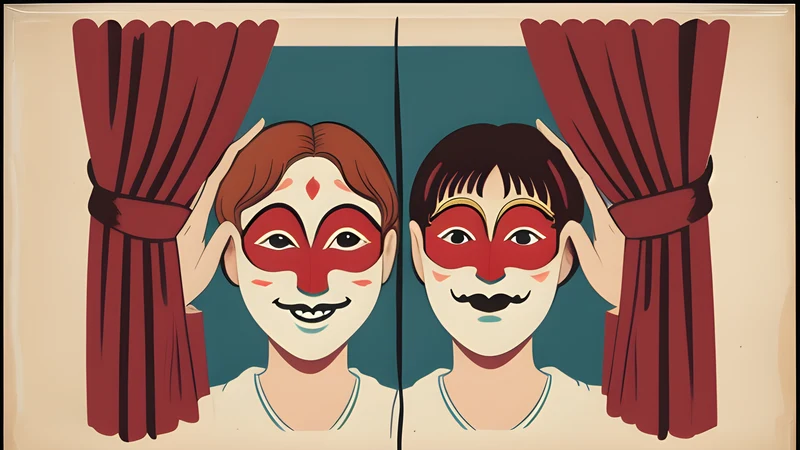
The comedy and tragedy masks are the most recognisable emblem, but the day has accumulated its own smaller rituals. The pre-performance reading of the Message has become a ceremony in itself, sometimes delivered by a distinguished actor, sometimes by a nervous student. Many companies mark the occasion by inviting the public backstage, demystifying the machinery of illusion, the flown scenery, the lighting rigs, the quick-change rooms, that audiences normally never see. Theatre schools hold marathon readings, staging a dozen short plays across a single day and night, and processions of costumed performers through town centres have become common in southern Europe and Latin America.
Fun facts
The theatrical superstition against saying “Macbeth” inside a theatre, actors instead call it “the Scottish play”, is old enough that its origin is genuinely lost, and elaborate cleansing rituals exist for anyone who slips up. The word “tragedy” derives from the Greek for “goat song”, possibly because a goat was the prize at the Dionysia or was sacrificed during the performances. The largest surviving ancient theatre, at Ephesus in modern Turkey, could seat around twenty-five thousand spectators, a capacity most modern venues cannot match. And the twin masks of comedy and tragedy that have become theatre’s universal emblem descend directly from the actual masks worn by performers in the ancient Greek theatre, where a single actor might play several roles by switching them. The ancient Greeks also invented the theatrical crane, the mechane, from which a god could be lowered onto the stage to resolve an impossible plot, giving us the phrase deus ex machina that critics still use, usually as an insult, more than two thousand years later.
A closing reflection
What the International Message returns to, year after year, is presence. A film can be watched alone at three in the morning a century after it was made; a play exists only in the moment of its performance, dependent on this particular audience on this particular night, and gone the instant the lights come up. That fragility is the point. World Theatre Day celebrates an art that refuses to be stored, one that insists on the same old bargain struck in an Athenian amphitheatre two and a half thousand years ago: that a group of people will gather in the dark, agree to believe in something they know is not real, and come away having understood something true.
Related Content