World Tapir Day
In 2008 a small group of tapir enthusiasts, several of them based in Australia, launched World Tapir Day and fixed it to 27 April, an odd date for an animal that most people cannot reliably picture. That is rather the point. The tapir is one of the largest land mammals in South America and South-East Asia, yet it remains almost invisible in the public imagination, overshadowed by the elephants and rhinos it distantly resembles. The founders wanted a fixed day to change that, a hook on which zoos, conservation groups and schoolteachers could hang a story about an animal that has walked the earth, more or less unchanged, for tens of millions of years.
An animal older than the Andes
The tapir’s strangeness begins with its family tree. Despite a bulk and snout that suggest a small elephant, the tapir is an odd-toed ungulate, a member of the order Perissodactyla, which makes its closest living relatives the horses and the rhinoceroses. The lineage is genuinely ancient: recognisable tapir-like animals appear in the fossil record going back around fifty million years, and the modern genus has changed so little that biologists sometimes call it a living fossil. When the founders of the day describe the tapir as a survivor from a vanished world, they are being literal, because these animals were browsing forest floors long before the Andes finished rising.
The most distinctive feature is the proboscis, a short, flexible trunk formed from the upper lip and nose. A tapir uses it like a fifth limb, stripping leaves, plucking fruit and probing for shoots, and when swimming it can raise the tip above the water and breathe through it like a snorkel. Tapirs are strong, unhurried swimmers that often flee into rivers when threatened, and they will happily sink to the bottom to let small fish nibble parasites from their skin. On land they follow well-worn paths through dense vegetation, and because they eat so much fruit and travel so far they are among the forest’s most important seed dispersers, effectively gardening the jungle as they go.
The living species
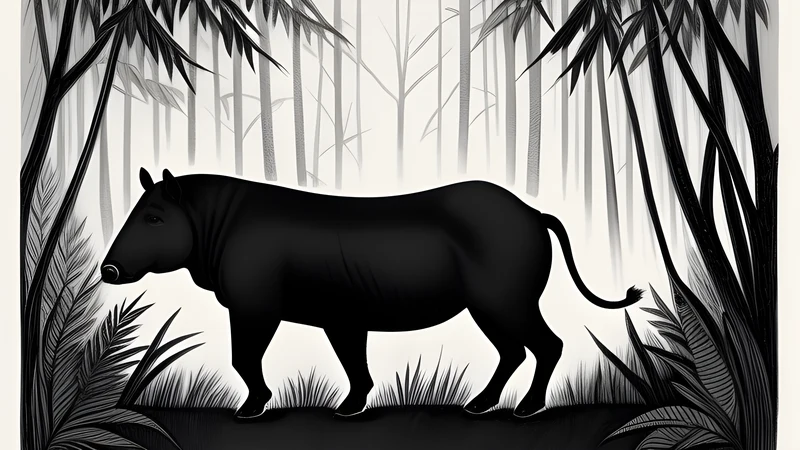
There are four widely recognised species, and a possible fifth that keeps taxonomists arguing. The Malayan tapir, Tapirus indicus, is the only one native to Asia and the easiest to recognise, thanks to the bold white saddle across its otherwise black body, a pattern that dazzles a predator’s eye in the broken light of the forest at night. The Baird’s tapir, Tapirus bairdii, is the largest land mammal in Central America, ranging from Mexico to Colombia and named after the American naturalist Spencer Fullerton Baird. The lowland or Brazilian tapir, Tapirus terrestris, is the most numerous and widespread, found across much of northern and central South America. The mountain tapir, Tapirus pinchaque, is the smallest and the woolliest, adapted to the cold cloud forests and páramo of the northern Andes, where its thick coat keeps out the chill.
In 2013 a team led by the biologist Mario Cozzuol described a fifth species, the Kabomani tapir, Tapirus kabomani, from the Amazon, drawing on Indigenous knowledge that had long distinguished it from its lowland cousin. Its status as a full species remains contested, with some geneticists arguing it falls within the range of Tapirus terrestris, and the debate is a reminder that even large mammals can still hold surprises. Whatever the final verdict, the discovery underlined how little close attention these animals had received.
History of the day
World Tapir Day grew out of the online tapir community of the mid-2000s, a scattering of keepers, researchers and hobbyists who corresponded across continents. The organisers chose 27 April and built a website to coordinate zoo events, share fundraising ideas and publish plain-language facts, and the idea spread through the network of institutions that keep tapirs, from regional zoos to the specialist breeding programmes that maintain a genetic safety net for the rarer species. The day was never a large, centrally funded campaign; it worked instead by giving already-interested institutions a shared date, and by 27 April each year a modest but genuine wave of tapir content reaches audiences who might otherwise never have heard the word.
The timing coincides with the long, patient work of the Tapir Specialist Group of the International Union for Conservation of Nature, the body that assesses each species and coordinates research across the tapir’s range. Their assessments are sobering: the mountain tapir and the Malayan tapir are both listed as endangered, and Baird’s tapir is endangered too, with the widespread lowland tapir classed as vulnerable and declining. The day exists to put a friendly face on those red-list categories.
Why the day matters
The threats to tapirs are the familiar ones, and they compound. Deforestation for cattle, oil palm and timber fragments the continuous forest that tapirs need, cutting populations into isolated pockets too small to stay healthy. Roads bring vehicle collisions, a leading cause of death for Baird’s tapirs in parts of Central America. Hunting for meat removes animals from forests that look intact on a satellite image, and because a female tapir usually bears a single calf after a gestation of around thirteen months, populations recover slowly from any loss. A slow breeder in a shrinking forest has little margin for error, which is why conservationists treat every tapir death as significant.
Because tapirs disperse the seeds of so many forest trees, their decline ripples outward into the whole ecosystem, thinning the next generation of the forest itself. That role as a keystone gardener places the tapir in the same conservation conversation as other quiet, unglamorous species whose loss unbalances a habitat, a theme shared with observances such as World Wildlife Conservation Day and International Cheetah Day. The organisers argue that saving a charismatic animal like the tapir helps protect everything sharing its patch of jungle.
How it is celebrated
Zoos are the natural home of the day. Keepers stage tapir-themed talks and feeds, hand out fact sheets, and often introduce visitors to individual animals by name, because a familiar face does more for a cause than a statistic. Enrichment sessions, where keepers hide food or scatter scents for the tapirs to investigate, double as public demonstrations of how clever and inquisitive the animals are. Conservation groups use the date to launch fundraising drives for fieldwork in Latin America and South-East Asia, and schools fold tapirs into lessons on rainforest ecology. Online, the day fills with photographs of the animals swimming, and above all with pictures of the calves.
Tapirs in myth and culture
For peoples who share the forest with tapirs, the animal has never been obscure. In parts of the Amazon, Indigenous stories cast the tapir as a slow-witted but powerful figure, and its trails through the undergrowth were followed by hunters as ready-made paths. In Malay and Chinese folklore the animal became entangled with the mythical baku or mo, a dream-eating creature said to devour nightmares, and the Malayan tapir’s piebald pattern was sometimes read as a patchwork of leftover parts from the making of other animals. The Portuguese word for the lowland tapir, anta, and the widespread Tupi-derived name tapir itself both entered European languages through early colonial encounters, when naturalists struggled to classify a beast that seemed to borrow features from the pig, the horse and the elephant at once. That confusion persisted for centuries; Linnaeus and his successors shuffled the tapir between groups before its true kinship with horses and rhinos was settled.
World variations
Because the four species are scattered across two continents, the day looks different depending on where it lands. In Malaysia and Indonesia the focus falls on the Malayan tapir and the pressures of oil-palm expansion, and rescue centres use the date to publicise animals recovered from roadsides and plantations. In Costa Rica and Panama, Baird’s tapir is a point of national pride, its image appearing on stamps and in the branding of protected areas, and rangers mark the day with guided walks in the reserves where the animal survives. In the Andean nations of Colombia, Ecuador and Peru, attention turns to the woolly mountain tapir of the high cloud forest, the rarest of the four and a symbol of the fragile páramo ecosystems that store much of the region’s water.
Fun facts
Baby tapirs of every species are born with the same striking coat, a rich brown dappled with cream stripes and spots that has earned them the nickname watermelon on legs; the camouflage breaks up their outline on the dappled forest floor and fades to adult colouring within about six months. The tapir’s snout, though it looks like a miniature elephant trunk, evolved entirely separately, a textbook example of convergent evolution. Tapirs have poor eyesight but an exceptional sense of smell and hearing, and they communicate with high, birdlike whistles that sound absurd coming from so large an animal. And the Malayan tapir’s bold two-tone pattern, which seems conspicuous in a zoo enclosure, is genuine camouflage in the wild, breaking the body into light and dark blocks that dissolve in moonlit undergrowth.
Traditions and the work behind the day
Much of the day’s substance comes from the unglamorous machinery of conservation that runs the rest of the year. Coordinated breeding programmes in zoos on several continents keep studbooks for the Malayan and mountain tapirs, matching animals across institutions to preserve genetic diversity against the day it might be needed for reintroduction. Field researchers fit wild tapirs with GPS collars and set camera traps along forest trails, slowly assembling the population data that the IUCN assessments depend on. World Tapir Day gives all of that patient effort a public window, a single date on which the keepers, scientists and fundraisers can point the general public toward an animal they have spent the year quietly working to save.
A closing reflection
There is something quietly instructive about giving a day to an animal most people cannot name. The tapir has no reputation to trade on, no myth or menace attached to it, only the fact of having endured, gardening the world’s forests through fifty million years of upheaval. World Tapir Day asks its audience to notice a creature that has never asked to be noticed, and in doing so to take an interest in the forests that both it and the wider World Frog Day constituency of overlooked species depend on. The tapir’s best hope is simply to be seen, and 27 April is the day set aside for the seeing.
Related Content