World Tapas Day
In 2016, Turespaña, the Spanish government’s tourism agency, drew a line in the calendar and declared the third Thursday of June to be World Tapas Day. The choice of a floating date rather than a fixed one was deliberate: tapas belong to the warm evening, to the hour when Spaniards spill out of offices and into bars, and mid-June in the northern hemisphere is when those evenings start to stretch. The point was to export a habit that Spain had never really thought of as remarkable, only as ordinary life.
What a tapa actually is
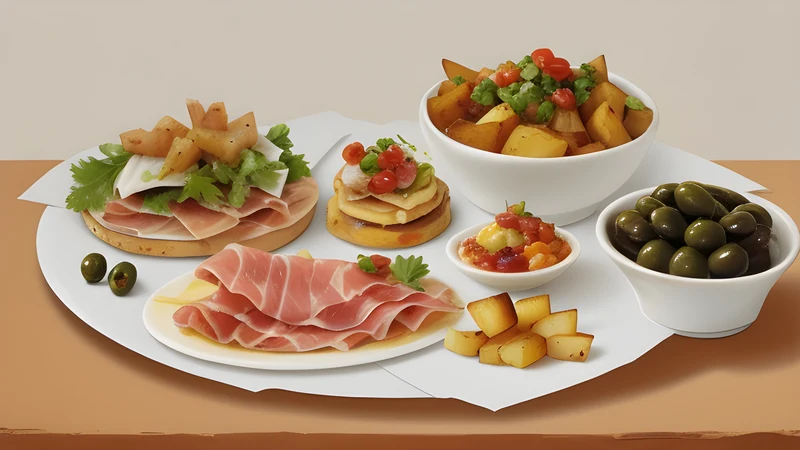
A tapa is a small plate of food served alongside a drink. That definition sounds thin until you see how much it contains: a saucer of olives, a wedge of tortilla española, a few slices of jamón, a ramekin of patatas bravas under a slick of spiced tomato, garlicky prawns still sizzling in oil, a fistful of blistered padrón peppers, a spoon of ajoblanco in high summer. The size is the whole idea. A tapa is meant to accompany conversation and a glass of something, not to fill you up, which is why an evening of tapas involves moving between several bars rather than settling in one.
The Spanish have a verb for the activity, tapear, and a noun, el tapeo, and the phrase ir de tapas describes an entire social outing built around grazing. In Granada and León, ordering a drink still earns you a free tapa chosen by the bar, so the food arrives unbidden and the surprise is part of the ritual. Elsewhere the tapa is charged for, and its larger cousins have their own names: a ración is a full plate meant for sharing, a media ración the half-size version, and a tapa proper sits below both, a single generous mouthful or two.
Where the word comes from
Tapa means “lid” or “cover” in Spanish, from the verb tapar, to cover. That etymology is the one point almost everyone agrees on; the story of how a lid became a snack is where the legends multiply.
The most repeated tale credits King Alfonso XIII, who is said to have stopped at a beachside inn, the Ventorrillo del Chato near Cádiz, on a windy day. A gust threatened to fill his glass of sherry with sand, so the waiter covered it with a slice of ham. The king ate the ham, enjoyed it, and ordered a second sherry “with the lid.” An older version reaches back to the thirteenth century and Alfonso X, called the Wise, who is supposed to have decreed that Castilian taverns serve a little food with every cup of wine, on the theory that a soldier or traveller with something in his stomach would stay soberer and less trouble. A more prosaic explanation holds that innkeepers simply laid a slice of bread or cured meat over a glass to keep out flies and dust. All three stories arrive at the same practical truth: food and drink in Spain travel together, and the food began as something that sat physically on top of the drink.
History that made it a national habit
Tapas grew out of Andalusia, the sun-baked south, and out of a drinking culture built around sherry and the long gap between the Spanish lunch and a very late dinner. Somewhere in that gap, a bite became necessary, and the bar culture obliged. Seville, Granada, Córdoba and Jerez each developed their own tapeo, shaped by what the land gave them: the fried fish of the coast, the cured pork of the mountain villages, the olives and almonds of the interior. By the twentieth century the practice had spread north and hardened into something close to a national identity, so that a Basque, a Galician and an Andalusian who agree on almost nothing about Spain will all defend the tapa.
Ernest Hemingway, who loved Spain to the point of distraction, wrote the country’s bars into his fiction and helped fix the image of the standing crowd, the marble counter, the small plates, in the foreign imagination. Spanish emigrants carried the habit to Latin America and beyond, and returning tourists carried it home in the other direction. By the time Turespaña launched its official day in 2016, the aim was less to invent a tradition than to give a name and a date to something Spain already exported quietly through every visitor who had ever stood at a Sevillian bar counting toothpicks. The small plate had become a diplomatic ambassador, cheaper and more persuasive than any advertising campaign.
Why the day matters
Turespaña’s motive was frankly commercial: Spain earns a colossal share of its national income from tourism, and food is one of the strongest reasons foreigners choose it over rival Mediterranean destinations. Fixing a date gave restaurateurs abroad a peg to hang a promotion on and gave the Spanish brand a recurring moment in the international calendar. Yet the day has grown past its marketing origins. It now functions as a quiet argument about how to eat, a reminder that a meal can be assembled from fragments, shared across a table, and stretched over hours without anyone ever ordering a main course.
How the day is marked
Across Spain, bars and restaurants build special tapas menus for the third Thursday of June, often with a fixed price for a drink and a signature bite. Culinary schools run competitions to crown the best new tapa, and cities that already stake their reputation on the tradition, Logroño’s Calle Laurel among them, turn the day into a street-wide event where a single narrow lane can offer dozens of specialities. Spanish embassies and cultural institutes abroad use it as an excuse to throw tastings, so a person in London, Tokyo or Buenos Aires can encounter the day without ever having set foot in Andalusia.
The internationalisation is the entire strategy. Spanish restaurants worldwide adopt the date, chefs post their interpretations, and the small plate spreads a little further each year. It has become a companion in the calendar to other Mediterranean food observances such as World Hummus Day, International Falafel Day and World Baklava Day, each of which does for a single dish what World Tapas Day does for an entire way of eating.
Variations across Spain and beyond
There is no single canonical tapa, which is the source of endless regional pride. Galicia offers pulpo a la gallega, octopus dusted with paprika and pressed onto a wooden board. The Basque Country reframes the whole thing as pintxos, small creations skewered with a toothpick and laid out along the bar, paid for by counting the sticks at the end. Andalusia leans on fried fish and jamón; Madrid claims the bocadillo de calamares and the humble patatas bravas; Catalonia adds pa amb tomàquet, bread rubbed with ripe tomato and oil. Move outside Spain and the format loosens further, so that “tapas bars” from Melbourne to New York serve small-plate menus that a purist from Seville might barely recognise, yet the social logic survives intact: order little, order often, and keep the table talking.
Symbols and rituals of the small plate
The enduring symbol of tapas is the shared table crowded with saucers, the visual proof that a group has been talking and grazing for hours. The toothpick, in the Basque tradition, becomes a currency and an accounting device. The counter, standing room rather than seated, keeps the crowd mobile and the conversation loose. Sherry, once the near-mandatory partner, has broadened to include vermouth, beer and wine, but the pairing instinct remains: something to eat must accompany something to drink, and neither is complete alone.
Fun facts
The date moves every year because it is pinned to the third Thursday of June rather than a fixed number, which means World Tapas Day can fall anywhere from the fifteenth to the twenty-first.
The word tapa literally means the lid you might put on a jar; the food is named after the act of covering a glass, so a tapa is grammatically a cover that you can eat.
In Granada and León, the free tapa with every drink is still standard, so a determined and thirsty visitor can, in theory, assemble a full dinner without ordering a single plate of food.
The Basque pintxo runs on an honour system: you pile your own plate from the bar and settle up by handing over your toothpicks to be counted, a method that survives largely because Spaniards, on the whole, do not cheat at it.
Spanish law has at times required bars in certain regions to serve food with alcohol, meaning the free tapa was, for stretches of history, less a courtesy than a public-order measure to keep drinkers fed.
A closing reflection
World Tapas Day celebrates a small plate, but the plate is only the vehicle. What Turespaña really put on the calendar was a defence of the slow evening, the standing crowd, the meal assembled from fragments and stretched across hours and several bars. In a world that increasingly eats alone and in a hurry, the tapa insists that food is a reason to stay, to share and to keep talking. That is a modest thing to fit onto a saucer, and a surprisingly durable one.
Related Content