World Snow Leopard Day
On 23 October 2013, in a conference hall in Bishkek, Kyrgyzstan, delegations from all twelve countries where wild snow leopards still roam sat down together for the first time and signed a document that gave the world’s most elusive big cat its own day on the calendar. The Bishkek Declaration on the Conservation of Snow Leopards emerged from the Global Snow Leopard and Ecosystem Protection Forum, a summit convened specifically because the animal it concerned is so rarely seen that even scientists who have spent careers studying it in the field sometimes go months without a direct sighting. World Snow Leopard Day, fixed to the date of that signing, has been observed every 23 October since.
Where the day began
The Bishkek Forum was the product of years of quiet diplomatic groundwork among the twelve snow leopard range states: Afghanistan, Bhutan, China, India, Kazakhstan, Kyrgyzstan, Mongolia, Nepal, Pakistan, Russia, Tajikistan and Uzbekistan, nations whose borders otherwise have little in common beyond the high mountain ranges, the Himalaya, the Tian Shan, the Altai, the Pamirs, that the cat inhabits. Kyrgyzstan, whose government hosted and championed the summit, pushed the twelve states towards a shared target rather than twelve separate national plans, and the declaration they signed committed to identifying and securing twenty distinct snow leopard landscapes across the cat’s range by the year 2020, a pledge that came to be known by the shorthand Secure 20 by 2020. The same forum established the Global Snow Leopard and Ecosystem Protection Program, GSLEP, as the coordinating body tasked with turning that commitment into funded, monitored projects on the ground, and it is GSLEP’s founding member states who continue to anchor the day each year.
The ghost of the mountains
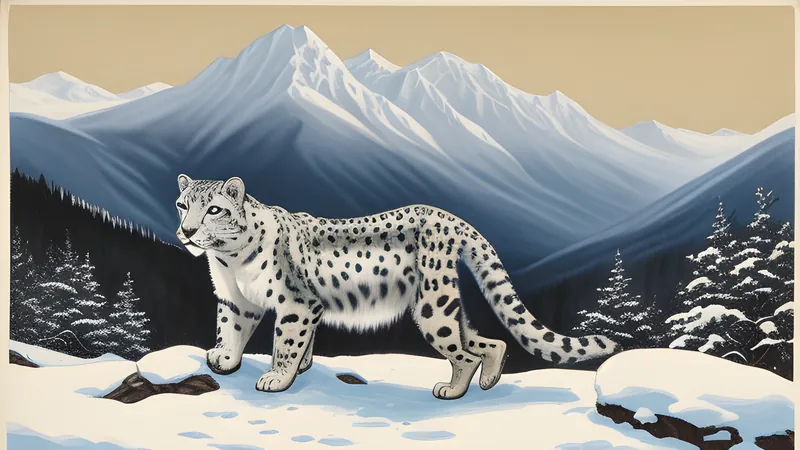
The snow leopard, Panthera uncia, earned its most common nickname honestly: it is built almost entirely around not being seen. Its coat, pale grey to cream with dark rosettes, breaks up its outline against rock and snow so effectively that even radio-collared animals under active study have vanished from view at ranges of a few dozen metres, and local herders across Central Asia have long described the cat as something closer to a spirit than an animal, a reputation that shaped its folklore across the region for centuries before biologists began collaring individuals in earnest. Genetically the snow leopard sits close enough to the tiger, lion, jaguar and leopard to share the genus Panthera, yet it is the only member of that genus that cannot roar; its laryngeal anatomy instead produces chuffing and low growls, a trait it shares with a handful of adaptations that set it apart from its lowland cousins in the same way that a tiger’s stripes and a rhino’s horn each answer to a completely different set of pressures, one visual camouflage in dense vegetation, the other a defence structure worn as a badge and a target at once.
Physically, the snow leopard is built for a landscape that punishes any wasted heat or effort. Its tail, which can measure close to a metre, nearly the length of its body, serves as a counterbalance on precipitous terrain and doubles as an insulating wrap the animal curls around its face and paws while resting in sub-zero temperatures. Enlarged nasal cavities warm and humidify frigid air before it reaches the lungs, thick fur grows even between the toes to protect against ice and rock, and unusually large paws, wide relative to body size, function almost like natural snowshoes, distributing weight across soft snow that would otherwise bog down a cat of similar mass. These adaptations let the species range across some of the most vertically punishing terrain on the planet, from around 3,000 metres up to beyond 5,000 metres in parts of the Himalaya and the Tibetan Plateau, territory where few large predators compete with it directly.
A century of near-invisibility
Serious scientific study of the snow leopard lagged decades behind work on Africa’s big cats, largely because the terrain it occupies, remote, high-altitude and often bordering politically sensitive frontiers, made sustained fieldwork difficult and expensive long after lions and tigers had been extensively studied and filmed. Early population estimates through the twentieth century were closer to guesswork than census, pieced together from scattered pelt records, occasional sightings and the testimony of herders who lost livestock to the cat. The naturalist George Schaller and the writer Peter Matthiessen, who journeyed together into Nepal’s Dolpo region in 1973 in a famous, largely unsuccessful search for the animal, did more than almost anyone to fix the snow leopard’s reputation in the Western imagination as a creature defined by its own absence, an experience Matthiessen turned into the book The Snow Leopard, published in 1978. It was only with the arrival of GPS collaring and, later, camera-trap networks from the 1990s onward that researchers began assembling reliable data on density, range and behaviour, work that underpins the population figures cited at every GSLEP meeting today.
Current estimates put the global wild population somewhere between roughly 4,000 and 6,500 individuals spread thinly across some two million square kilometres of mountain habitat, a density so low that a single healthy population may require thousands of square kilometres to sustain itself. The principal threats identified at Bishkek and reaffirmed at subsequent GSLEP meetings are retaliatory killing by herders after livestock losses, poaching for the illegal fur and bone trade, and the accelerating effects of climate change on the alpine tree line, which is creeping upward into the cat’s already narrow altitudinal band and squeezing its habitat from below even as human settlement expands from the valleys.
How the day is marked
GSLEP member governments use 23 October to publish updated national action plans and, in years that fall on the programme’s own review cycle, to report progress against the Secure 20 by 2020 landscapes, several of which, including sites in Nepal, India and Mongolia, have reached functional protection status with community-run anti-poaching patrols and livestock insurance schemes designed to reduce retaliatory killings. Conservation organisations such as the Snow Leopard Trust and Panthera run public fundraising and education campaigns timed to the date, often built around camera-trap footage that gives ordinary audiences a rare glimpse of an animal most will never see in the wild, the same strategy that keeps public attention on comparably elusive or endangered species around occasions such as World Pangolin Day. Schools and cultural institutions in the range countries, particularly Mongolia and Kyrgyzstan, mark the day with programmes that lean on the cat’s long-standing place in regional folklore as much as on its conservation status, treating the two as inseparable parts of the same story.
Symbol and superstition across the mountains
Long before the cat was formally studied, it held a fixed place in the belief systems of the herding communities who shared its range. In Kyrgyz and Kazakh folklore the snow leopard, known locally as ak ilbirs or by regional variants, appears as a totemic figure of the high pastures, sometimes as a guardian spirit and sometimes as an omen, and its image was adopted as a national emblem, appearing on Kazakhstan’s currency and on Kyrgyzstan’s coat of arms in stylised form. In Buddhist regions of the Himalaya and the Tibetan Plateau, the animal’s rarity fed into a broader spiritual reverence for high, difficult-to-reach places generally, and sightings were sometimes treated as auspicious rather than merely lucky. That inherited cultural weight has proved useful to modern conservationists, who have found that campaigns framed around restoring a locally revered animal, rather than around an abstract international target, tend to secure more durable buy-in from herding communities whose cooperation on livestock protection and anti-poaching patrols the whole GSLEP strategy depends on.
Fun facts
A snow leopard’s tail can reach nearly the length of its own body and functions as both a balance aid on cliffs and a personal blanket during rest. The species is the only big cat in the genus Panthera that cannot roar, producing chuffs and growls instead through a different laryngeal structure. Its oversized paws act as natural snowshoes, spreading the animal’s weight across snow that would otherwise slow it down. Snow leopards can reportedly leap horizontal distances of up to around 15 metres in a single bound when pursuing prey across broken mountain terrain, among the longest jumps recorded for any cat. And despite decades of study, no wild snow leopard has ever been reliably documented attacking a human being, a remarkable record for a large predator that shares its landscape with herding communities across twelve countries, and one that conservationists point to whenever they need to counter the retaliatory-killing narrative that still costs the species some of its number every year.
A Closing Reflection
The snow leopard’s entire identity rests on a contradiction: it is one of the world’s largest and most formidable mountain predators, and also one of the hardest animals on Earth to actually see. That combination, more than any single statistic about its dwindling numbers, is what makes the Bishkek Declaration and the day it produced feel urgent rather than ceremonial, because a species this good at disappearing from view could just as easily disappear from existence with almost nobody noticing until the count came back empty.
Related Content