World Shorebirds Day
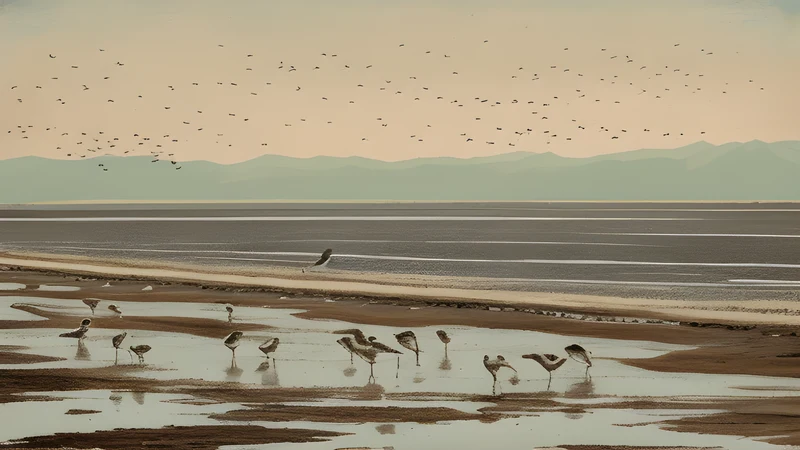
World Shorebirds Day was founded in 2014 by the Hungarian ornithologist György Szimuly and is observed each year on 6 September, timed to fall within the annual Global Shorebird Count that mobilises birdwatchers to survey and report the waders passing through their local wetlands. The day sets out to win attention and affection for a group of birds, known in British English as waders, that perform some of the most staggering feats of endurance in the animal kingdom while quietly declining across almost every flyway on the planet.
What counts as a shorebird
Shorebirds are a large assembly within the bird order Charadriiformes, taking in the sandpipers, plovers, godwits, curlews, oystercatchers, avocets, phalaropes and their relatives. They are the small-to-medium birds you see probing and scuttling across mudflats, estuaries, beaches and marshes, most of them equipped with long legs for wading and bills shaped precisely for their diet. A curlew’s long, downcurved bill reaches deep into soft mud for burrowing worms, a plover’s short bill snatches prey from the surface, and an avocet’s upturned bill sweeps sideways through shallow water. Many carry sensitive nerve endings in the bill tip that let them feel for hidden invertebrates in the mud without seeing them at all, effectively hunting by touch.
Their defining trait is movement. A great many shorebirds are long-distance migrants that breed in the high Arctic tundra during the brief northern summer and spend the rest of the year thousands of kilometres to the south, strung along coastlines that can stretch to the far tip of South America, Africa or Australasia. That twice-yearly journey is what makes them both wondrous and vulnerable.
History and the record-breakers
The scale of shorebird migration was properly understood only once tracking technology became small enough to fit on the birds. The results have astonished even the ornithologists who expected impressive numbers. The bar-tailed godwit holds the record for the longest non-stop flight of any land bird: in 2022 a young godwit fitted with a satellite tag was tracked flying from Alaska to Tasmania, a journey of around 13,560 kilometres, in a single unbroken flight of about eleven days. The bird did not eat, drink or rest for the entire crossing of the Pacific, burning through the fat it had laid down before departure and effectively shrinking its own digestive organs to save weight.
Such journeys depend utterly on a chain of stopover sites where the birds refuel, and the history of shorebird conservation is largely the history of protecting those links. Along the East Asian-Australasian Flyway, the tidal mudflats of the Yellow Sea are an irreplaceable service station for millions of migrating waders, and their large-scale reclamation for development in recent decades has driven steep declines. In the Americas, Delaware Bay is famous as the place where red knots time their arrival to gorge on the eggs of spawning horseshoe crabs, a synchrony so precise that overharvesting of the crabs helped push the rufa red knot toward the edge. These stories established the central lesson of shorebird science: a bird can be protected at both ends of its journey and still collapse if a single crucial waypoint in the middle is lost.
Why the day matters
Shorebirds are among the fastest-declining groups of birds in the world, and their troubles are easy to overlook precisely because they unfold across international borders and remote coastlines. A wetland drained in one country, a mudflat reclaimed in another, disturbance on a beach in a third, each chips away at populations that no single nation can save alone. World Shorebirds Day exists to make these dispersed, hard-to-see losses visible, and to grow the community of people willing to count, monitor and speak up for waders. The associated Global Shorebird Count turns ordinary birdwatchers into a distributed monitoring network, feeding observations into databases like eBird that help scientists track how populations are changing across whole flyways.
How it is celebrated
The heart of the day is counting. Around 6 September, and across the wider count window that typically runs over about a week, birdwatchers head to their nearest estuary, lagoon or shoreline to identify and tally the shorebirds present, submitting their records online. Nature reserves and bird observatories run guided walks, identification workshops and family events, using the arriving autumn migrants as a live spectacle. Conservation organisations publish updates on threatened species and flyway initiatives, and photographers and educators share the birds’ extraordinary migration stories to build public wonder. For newcomers, the day doubles as an accessible introduction to a notoriously tricky branch of birdwatching, since telling one small brown wader from another is a genuine skill that rewards patience.
The cast of characters
The shorebird world is full of remarkable specialists. The spoon-billed sandpiper, a tiny wader with an unmistakable spatula-shaped bill, is critically endangered, its global population reduced to a few hundred pairs breeding in the Russian Far East, making it a focus of intensive rescue efforts. The ruff performs one of the most elaborate mating displays of any bird, with males gathering at communal arenas called leks and sporting flamboyant feather ruffs in several distinct genetic types. Phalaropes overturn the usual pattern of the sexes, with brightly coloured females competing for duller males who then incubate the eggs. Sanderlings, the pale little birds that chase retreating waves along the tideline, may winter on beaches on the opposite side of the world from where they were hatched.
Flyways: the invisible highways
Conservationists organise the world’s migratory shorebirds around a handful of great flyways, the broad aerial corridors along which the birds travel between their breeding and wintering grounds. There are roughly nine of them worldwide, including the East Asian-Australasian Flyway, the Atlantic and Pacific Americas flyways, and the East Atlantic Flyway that funnels millions of waders down the coasts of western Europe and Africa. Each flyway is a shared responsibility, threading through dozens of countries whose decisions about coastal development, hunting and water management collectively determine whether the birds survive. International agreements such as the Ramsar Convention on Wetlands and dedicated flyway partnerships exist precisely because no country can protect a migratory wader on its own; a nation might safeguard every estuary within its borders and still watch its shorebirds vanish because a critical stopover elsewhere was paved over.
This flyway thinking is one of the most important ideas World Shorebirds Day promotes. It reframes a small bird on a local beach as a visitor passing through a global network, and it turns a birdwatcher’s count into a data point in an international effort. The Western Hemisphere Shorebird Reserve Network, for example, links protected sites up and down the Americas so that the chain of refuelling stops a bird needs is managed as a single connected system rather than a scatter of unrelated reserves.
Reading the mudflat
A tidal mudflat looks like empty brown sludge to most people, and that misreading is part of why shorebirds struggle for public sympathy. In truth those flats are among the most productive habitats on Earth, packed with worms, snails, tiny clams and shrimp in densities that can run to tens of thousands of animals per square metre. Each incoming and outgoing tide lays out and covers this feast, and the shorebirds have evolved a bill for every layer of it, some snatching from the surface, some probing shallowly, some plunging deep. Watching which species feed where, and how, turns an apparently featureless expanse into a legible, crowded ecosystem, and learning to read it is one of the quieter pleasures the day invites.
Fun facts worth wading into
Some shorebirds can sleep on the wing. During their marathon flights, species like godwits are thought to rest half of the brain at a time, snatching microsleeps in mid-air without falling from the sky.
They rebuild their own bodies for the journey. Before a long migration a shorebird can nearly double its weight in fat, then shrink its stomach, liver and intestines to reduce dead weight, regrowing them on arrival, a feat of physiological remodelling few animals can match.
The woodcock, a plump woodland wader, has eyes set so far back and high on its head that it can see a full 360 degrees, all the way around and behind itself, while probing the ground for worms.
Distances defy belief. Some individual waders clock up hundreds of thousands of kilometres in a lifetime of annual migrations, the equivalent of flying to the Moon and part of the way back, all on wings that span barely more than a hand.
Their timing can be uncanny. Migrating waders arrive at some stopovers within a few days of the same date each year, synchronised so tightly with events like the horseshoe-crab spawning that a shift of a week in either direction can mean the difference between refuelling and starving.
A closing reflection
There is a particular humility in watching a flock of small grey-brown birds lift off a mudflat and swirl in unison against the dawn, knowing that some of them hatched on Arctic tundra and are bound for the far side of the world, and that they will do it on fat, instinct and a handful of coastal wetlands that human choices are steadily erasing. Shorebirds ask us to think at the scale of whole flyways and shared coastlines, connecting the mudflats they depend on to the underwater meadows of World Seagrass Day, the reefs of World Reef Awareness Day and the free-flowing rivers of World Fish Migration Day. To count waders on 6 September is to take part in one of the simplest and most useful acts of conservation there is: paying attention, and writing down what you see.
Related Content