World Rhino Day
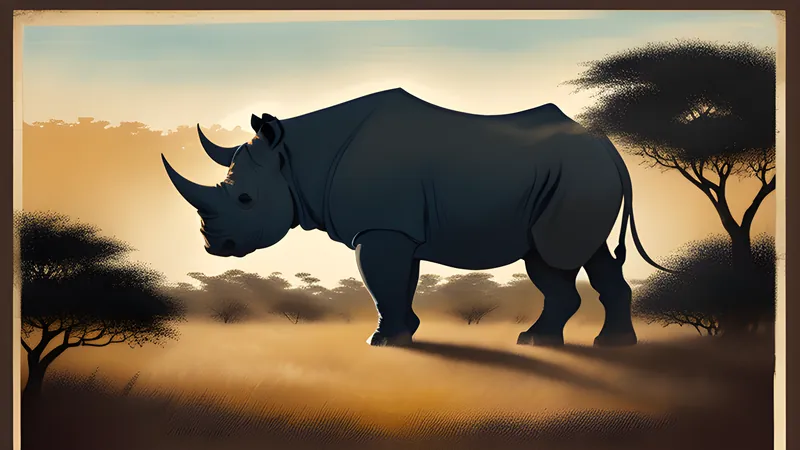
In 2010 the South African arm of the World Wide Fund for Nature announced a date, 22 September, on which the world might turn its attention to an animal that has walked the earth for some fifty million years and now teeters on the edge of vanishing from it. What began as a national gesture soon slipped its borders. Within a year the day had been adopted by campaigners on other continents, and it has since grown into the single largest annual occasion devoted to the rhinoceros, speaking for all five surviving species across Africa and Asia. It is a day shaped by an uncomfortable arithmetic: at the start of the twentieth century perhaps half a million rhinos roamed the wild, and by its close the figure had collapsed to a small fraction of that.
Origins
The credit for the first World Rhino Day belongs to WWF-South Africa, which floated the idea in 2010. The following year gave the observance its more familiar shape. In 2011 two women, Lisa Jane Campbell of Chishakwe Ranch in Zimbabwe and Rhishja Cota in the United States, began corresponding by email about how to mark the day. Campbell wanted an occasion that embraced every rhino species, and Cota, who ran a conservation blog, had the reach to help spread the word. Their collaboration turned a South African initiative into an international one, and 22 September 2011 was observed by supporters, zoos, NGOs and ordinary members of the public around the globe. The date has stayed fixed ever since, falling each year on 22 September regardless of the weekday.
The choice to cover all five species mattered. Africa is home to the white rhinoceros and the black rhinoceros; Asia to the greater one-horned rhino of India and Nepal, the Sumatran rhino and the Javan rhino. Their fortunes differ enormously, and a single day allowed campaigners to tell those very different stories under one banner rather than letting the better-known African animals crowd out their rarer Asian cousins.
History
The rhinoceros has been hunted and mythologised for as long as it has shared the land with people. Albrecht Dürer produced his famous woodcut of an Indian rhino in 1515, working only from a written description and a sketch of an animal that had been shipped to Lisbon as a gift to King Manuel I of Portugal; his rendering, armour-plated and riveted, shaped European imaginations for centuries despite its inaccuracies. For most of recorded history the greater threat to rhinos was the value placed on their horns, prized in parts of Asia for traditional medicine and, in Yemen, carved into the handles of ceremonial daggers called jambiyas.
The modern crisis is measurable and grim. The western black rhino, a subspecies once found across west and central Africa, was declared extinct by the International Union for Conservation of Nature in 2011, the last confirmed sightings dating to around 2006 in Cameroon. The northern white rhino has fared little better. On 19 March 2018 a bull named Sudan, the last male of his subspecies, was euthanised at the Ol Pejeta Conservancy in Kenya after age-related complications, leaving only two females, his daughter Najin and granddaughter Fatu, alive. Scientists have since turned to in vitro fertilisation and stored genetic material in an effort to pull the northern white rhino back from functional extinction.
Against these losses sits one of conservation’s genuine successes. The southern white rhino was thought nearly gone in the late nineteenth century, reduced to perhaps a few dozen animals in the Umfolozi region of South Africa. Careful protection over the following century brought the population back to something like twenty thousand, making it by far the most numerous rhino alive and proof that recovery is possible where the will and the funding exist. The greater one-horned rhino tells a similar story: down to around two hundred animals in the early twentieth century, it has climbed past four thousand thanks to strict protection in India’s Kaziranga National Park and Nepal’s Chitwan.
Why It Matters
Poaching remains the shadow over every gain. The pressure intensified sharply from around 2008, driven by a surge in demand for rhino horn in parts of Asia, particularly Vietnam, where it was marketed as a cure for ailments ranging from hangovers to cancer and as a symbol of wealth. Horn is made of keratin, the same protein as human hair and fingernails, and has no proven medicinal value, yet at the height of the trade it fetched prices by weight rivalling gold. South Africa, holding the great majority of the world’s rhinos, bore the brunt: recorded poaching there rose from a handful of animals a year in the mid-2000s to a peak of 1,215 killed in 2014. World Rhino Day gives that statistic a hearing it might otherwise not receive.
The animal’s ecological role adds weight to the case. Rhinos are megaherbivores, grazing and browsing on such a scale that they shape the landscapes they inhabit, keeping grasslands open and maintaining habitats that countless smaller species depend upon. Losing them would ripple outward through whole ecosystems, much as the loss of other keystone creatures does, a theme explored on International Beaver Day.
How It Is Celebrated
The day has no single owner, and that looseness is part of its strength. Zoos and safari parks stage keeper talks and fundraising events; schools run lessons; conservation charities launch appeals timed to the date. Social media carries a torrent of images under shared hashtags, and organisations release fresh population figures and campaign updates to coincide with the attention. Some supporters organise sponsored walks or runs, others hold auctions and dinners, and rhino-range countries use the occasion for official statements on anti-poaching efforts. The organisers deliberately encourage people to mark it however they wish, provided the rhino is the focus.
Money raised on and around 22 September flows towards ranger patrols, tracking technology, community programmes near reserves and veterinary care for orphaned or injured animals. Some of it funds the dehorning of live rhinos, a controversial but increasingly common tactic in which the horn is trimmed under anaesthetic to make an animal a less tempting target, the horn being keratin and able to regrow over time.
World Variations and Cultural Context
The rhinoceros occupies a curious place in human imagination, revered in some cultures and hunted for superstition in others. In Nepal, the greater one-horned rhino of Chitwan features in Hindu ritual and royal history; Nepalese kings once reserved the right to hunt it, and the animal’s recovery has become a point of national pride tied to the country’s community-forestry programmes. In parts of East Asia the same animal’s horn drove the poaching crisis, sought as a supposed remedy in traditional medicine despite consisting of nothing more than keratin. Conservation groups have responded with demand-reduction campaigns aimed squarely at consumer countries, enlisting celebrities and public figures to argue that a rhino is worth more alive. The day’s global spread means it is marked as readily in Vietnamese classrooms as in South African game reserves, and organisers have leaned into that reach, framing 22 September as an occasion to bridge the gap between the places where rhinos live and the places where the demand that threatens them originates.
Traditions and Symbols
The observance has gathered its own visual language. Grey ribbons and rhino silhouettes recur across campaign material, and the number five appears often, a nod to the five surviving species that the day was expressly created to represent. Sanctuaries frequently use the date to introduce the public to individual animals by name, giving a species-level crisis a face that people can hold in mind, a technique that echoes the personal framing of days such as World Lion Day.
Fun Facts
A rhino’s horn is not attached to its skull; it grows from the skin and is composed entirely of compacted keratin fibres, which is why a trimmed horn can regrow.
Rhinos and horses are surprisingly close relatives. Both belong to the order Perissodactyla, the odd-toed ungulates, which also includes tapirs.
The white rhino is not white and the black rhino is not black. Both are grey; the “white” is thought to derive from a mistranslation or adaptation of a word describing the animal’s wide, square lip, suited to grazing.
Oxpecker birds ride on rhinos, feeding on ticks and parasites, and their sudden flight and alarm calls can warn a short-sighted rhino of approaching danger, giving the birds their Swahili name askari wa kifaru, the rhino’s guard.
The Sumatran rhino is the smallest living species and the only Asian rhino with two horns and a covering of coarse hair, a living link to the woolly rhinoceros of the Ice Age.
A Closing Reflection
There is a particular strangeness to marking a day for an animal so ancient that it predates the primates entirely, an animal whose ancestors grazed alongside creatures we know only as fossils. The rhinoceros carries a deep geological patience in its very body, and the crisis it faces has unfolded in barely more than a human lifetime. The southern white rhino’s return from a few dozen individuals shows that the direction of the story is not fixed, and that the choices made in a single century can bend a fifty-million-year lineage towards survival or towards the fate of the western black rhino. World Rhino Day asks its observers to sit with both possibilities at once, which may be the most honest thing a conservation day can do.
Related Content


