World Plumbing Day
World Plumbing Day was launched in 2010 by the World Plumbing Council, a body founded two decades earlier, in 1990, to represent the plumbing industry across national borders. The date chosen was 11 March, and the aim was blunt and serious: to make the world notice that plumbing is a matter of public health, not merely of dripping taps and blocked drains. Behind the modest trade lies one of the great, unglamorous achievements of civilisation, the delivery of clean water and the removal of waste, which has saved more lives than almost any branch of medicine.
What the day is for
The World Plumbing Council promotes World Plumbing Day to highlight the vital role that plumbing plays in protecting public health and the environment. The argument is straightforward. Safe drinking water and the sanitary disposal of human waste are the foundations of a healthy society, and it is plumbers and plumbing systems that deliver both. Where those systems fail or do not exist, people die, chiefly of the waterborne diseases, cholera, typhoid, dysentery, that once ravaged even the wealthiest cities and that still kill hundreds of thousands of people, many of them children, in parts of the world that lack proper sanitation.
The day therefore has two audiences. To the developed world it says: value the invisible infrastructure you take for granted, and the skilled people who maintain it. To the wider world it says: clean water and sanitation are human rights that billions still lack, and closing that gap is a task for plumbers as much as for doctors or politicians.
The history hidden in a word
The word “plumber” carries its history openly for anyone who looks. It comes from the Latin plumbum, meaning lead, the soft metal the Romans used to make their water pipes, and the same root gives lead its chemical symbol, Pb. A Roman plumbarius was a worker in lead, and the pipes he laid supplied the fountains, baths and public latrines of the empire. Rome’s genius for water was formidable: a network of aqueducts carried millions of litres a day into the city by gravity across great stone arches, feeding a system of distribution that would not be matched in Europe for well over a thousand years after the empire’s fall.
That knowledge was largely lost in the medieval West, and cities returned to wells, rivers and cesspits, with predictable consequences for disease. The revival came slowly, and its decisive moment was as much scientific as engineering. In 1854, during a cholera outbreak in the Soho district of London, the physician John Snow traced the deaths to a single public water pump on Broad Street and, in a now-famous act, persuaded the authorities to remove its handle. His demonstration that cholera spread through contaminated water, rather than through bad air, established the link between sanitation and disease and helped launch the modern public-health movement.
The great sanitary engineers
London itself provided the next chapter. After the “Great Stink” of 1858, when the stench of the sewage-choked Thames drove Parliament to act, the engineer Sir Joseph Bazalgette designed and built a vast network of intercepting sewers beneath the city, carrying waste downstream and away from the drinking supply. His system, completed in the 1860s and 1870s and built so generously that it served London for well over a century, is credited with ending the city’s cholera epidemics and stands as one of the greatest public-health engineering projects ever undertaken. Similar works transformed cities across the industrialising world, and the death rates fell accordingly. The humble sewer and the clean-water main did what no physician could: they removed the cause of the disease rather than treating its victims.
World Plumbing Day belongs, in spirit, to a family of observances that honour the essential and often overlooked trades, standing beside International Firefighters’ Day and International Day of the Midwife, each celebrating a profession on which lives quietly depend.
From lead pipes to modern materials
The materials of plumbing tell their own history of trial, error and hard-won safety. The Romans’ beloved lead pipes, so central that they named the whole trade after the metal, carried a hidden cost that took centuries to understand: lead leaches into water and is a cumulative poison, and some historians have argued that lead plumbing contributed to ill health among the Roman elite. The twentieth and twenty-first centuries saw a long, unfinished campaign to remove lead from drinking-water systems, dramatised most painfully in modern water crises where old lead service lines contaminated whole cities’ supplies. Copper, galvanised steel, and later a range of durable plastics such as PVC and PEX replaced lead, each solving old problems and occasionally introducing new ones. The plumber’s job has always included keeping pace with this evolving science of what may safely touch the water we drink.
Sanitation on the disposal side evolved just as dramatically. The flushing water closet, popularised in Victorian Britain, is often wrongly attributed to a plumber named Thomas Crapper; in truth Crapper was a real and successful sanitary engineer who improved and marketed toilets and held several plumbing patents, but he did not invent the device, whose ancestry runs back to Sir John Harington in the sixteenth century. The genuinely crucial invention was the humble S-bend or U-bend trap, which holds a plug of water to seal foul sewer gases out of the home, a small piece of pipe geometry that made indoor plumbing tolerable and safe.
Why it matters
The case for taking plumbing seriously is written in mortality statistics. Access to safe water and sanitation is among the strongest predictors of life expectancy anywhere on earth, and the World Health Organization consistently ranks it among the most cost-effective health interventions available. Billions of people still live without safely managed sanitation, and preventable waterborne disease remains a leading killer of young children globally. A day devoted to plumbing is, at its heart, a day devoted to that unfinished work, and to the recognition that the skilled trade of plumbing is a frontline health profession in every country that has not yet solved the problem.
How the day is observed
World Plumbing Day is marked mainly by the industry itself and by the educational and charitable bodies attached to it. Plumbing organisations run campaigns to promote careers in the trade, hoping to draw young people into a profession facing skills shortages in many countries. Schools and colleges hold events explaining how water and sanitation systems work. Charities that build wells and sanitation systems in the developing world use the day to raise funds and awareness. The tone is practical and educational rather than festive, in keeping with a trade that prides itself on competence over show.
Symbols and tools of the trade
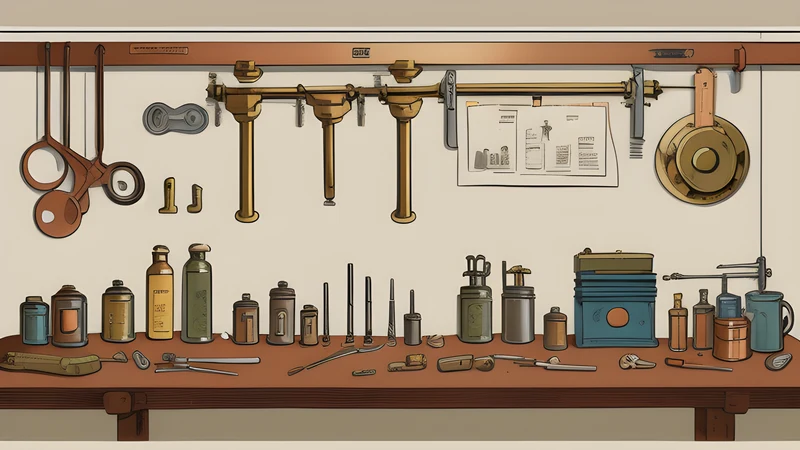
The plumber’s tools are among the most recognisable of any craft: the pipe wrench and the adjustable spanner, the blowtorch and solder for joining copper, the plunger, the run of gleaming copper pipe and the brass fittings that connect it. Water itself, clean and running, is the ultimate symbol of what the trade delivers. The image of a well-ordered array of pipes and valves stands for control over one of nature’s most necessary and most dangerous substances, the water that sustains life and, when contaminated, ends it.
Fun facts
The word plumber comes from the Latin plumbum, meaning lead, the metal the Romans used for their pipes, which is also why lead’s chemical symbol is Pb; a plumber is, etymologically, a lead-worker.
John Snow’s removal of the Broad Street pump handle in 1854 is often cited as the founding moment of epidemiology, and it was, in effect, a plumbing intervention: cut off the contaminated water and the disease stops.
Albert Einstein reportedly remarked that if he had his life to live again he would become a plumber, and in 1954 the Plumbers and Steamfitters Union in the United States responded by making him an honorary member.
Sir Joseph Bazalgette deliberately doubled the diameter of London’s Victorian sewers beyond what the population then required, and that foresight is the main reason his 1860s system kept serving a vastly larger city for more than a hundred years.
The S-bend trap under every sink and toilet works purely by holding a small reservoir of water in a curve of pipe, and that little water seal is the single feature that keeps sewer gases and the diseases they carry out of homes, a piece of eighteenth-century cleverness still doing its job in every bathroom today.
The World Plumbing Council estimates that inadequate water and sanitation cause a large share of the world’s disease burden, which is why it frames plumbers as guardians of public health working on the same front line as doctors and nurses.
A closing reflection
Plumbing is the infrastructure we notice only when it fails, which is the surest sign of how well it usually works. Every glass of safe water and every flushed toilet rests on centuries of accumulated knowledge, from Roman aqueducts to Bazalgette’s sewers, and on the daily labour of a trade that rarely asks for thanks. World Plumbing Day asks us to give some anyway, and to remember that for much of the world’s population the quiet miracle of clean water and safe waste remains a promise not yet kept. That is a serious thing to hang on a spanner, and a wholly deserved one.
Related Content