World Paella Day
In September 2018, the city of Valencia and a cluster of local rice producers declared the first World Paella Day, and they did so partly out of exasperation. For a generation, the wider world had been taking the name of their regional rice dish and attaching it to almost anything cooked in a wide pan: chorizo, frozen peas, a fistful of mixed seafood, a scattering of parsley. The 20 September observance was meant to celebrate paella, certainly, but also to plant a flag for what paella actually is — a specific dish, from a specific corner of Spain, with a history and a set of ingredients that would surprise most of the people who order it. That its inaugural year coincided with a genuinely global argument about the dish only sharpened the point.
What the Day Marks
World Paella Day, or Día Mundial de la Paella, was created in 2018 as a promotional and cultural initiative — a Spanish culinary flag-planting in the same spirit as World Tapas Day — led by Valencian institutions and the rice sector of the region. The date, 20 September, was chosen to sit in the early autumn, close to the rice harvest around the Albufera lagoon south of Valencia, where much of Spain’s short-grain rice is grown. From the start the day mixed civic pride with soft diplomacy: a public paella cook-off in Valencia, restaurants around the world invited to serve the dish, and a running conversation, largely on social media, about tradition and authenticity.
The organisers were careful not to make the day purely about the strict Valencian recipe. They acknowledged that paella has become a world dish, cooked in countless variations much as the humble dumpling has (International Dumpling Day), and celebrated that reach. But they used the platform to teach the original story too, and to remind cooks that “paella” first meant something quite precise.
A History Rooted in a Lagoon
The word paella began as the name of the pan, and only later attached itself to the dish cooked in it. It comes from the Valencian and Catalan word for a shallow, wide, two-handled frying pan, itself descended from the Latin patella, a small dish or plate. In much of Spain that pan is still called a paellera, but in Valencia the food took the name of the vessel it was cooked in, and a Valencian will gently correct anyone who calls the pan a paellera at all.
The dish emerged in its recognisable form in the eighteenth and nineteenth centuries in the rural districts around Valencia, and especially the marshy rice-growing country of the Albufera. Rice had been cultivated there since the period of Muslim rule in the Iberian Peninsula, which introduced both irrigation techniques and the crop itself. Paella was field food and farmhouse food: labourers cooked it outdoors at midday over a fire of orange and vine wood, using whatever the land around them provided. That is the key to the original recipe. The classic Valencian paella — paella valenciana — contains chicken, rabbit, sometimes snails, flat green beans called ferradura or bajoqueta, large white garrofó butter beans, tomato, sweet paprika, saffron and a sprig of rosemary. There is no seafood in it at all, because the fields of the Albufera are inland.
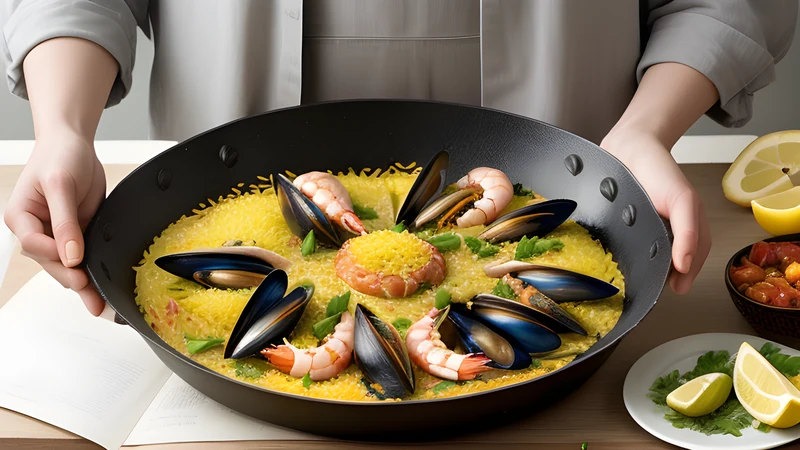
Seafood paella, paella de marisco, is a genuine coastal Valencian tradition too, made with prawns, mussels, squid and often no meat. What purists object to is paella mixta, the surf-and-turf combination of meat and shellfish that became the international default, and which most Valencians regard as a tourist compromise rather than a real recipe. Duck sometimes joins the chicken and rabbit; in the eel-rich Albufera, an all-eel-and-bean paella called all i pebre territory produces yet another local version. The lesson of the history is that “authentic” paella was always what the immediate landscape offered, which makes the modern policing of ingredients a slightly newer instinct than it first appears.
The Chorizo War
No account of the modern dish can skip the incident that, two years before World Paella Day existed, turned paella into an international flashpoint. In 2016 the British cook Jamie Oliver published a recipe for “my kind of paella” that included chorizo, the paprika-spiced Spanish sausage. Spain, and Valencia in particular, erupted. Chorizo appears in nothing a Valencian would call paella; adding it was treated as a small act of cultural vandalism, and the row ran for days across international media. The episode is faintly comic, but it captured something real: paella had become so globally beloved, and so freely reinterpreted, that its home region felt its identity was being eroded one sausage at a time. World Paella Day arrived, in part, as the constructive answer to that frustration.
The Craft of Cooking It
Done properly, paella is a lesson in restraint. The rice is short-grain — bomba is prized because it absorbs liquid without turning to mush — and it is spread thin across the pan so that every grain cooks in the flavoured stock rather than steaming in a heap. Crucially, the rice is not stirred once the liquid goes in, which is the opposite of making a risotto. That stillness is what produces the socarrat, the thin layer of toasted, caramelised rice stuck to the bottom of the pan, scraped up at the table and considered by many the best part of the whole dish. Saffron gives the true colour and aroma, though cheaper cooks use food colouring or paprika. The wide pan and the wood fire matter because they let heat reach the rice evenly across a large surface, which is why a paella made for forty at a village fiesta and a paella made for four at home are essentially the same technique scaled up.
Paella Around the World
Spanish emigration and tourism carried paella everywhere, and it put down roots in some surprising places. In the Philippines, where Spain ruled for more than three centuries, a rich festive rice dish called arroz a la valenciana — often made with glutinous rice and coconut milk — descends directly from it. In parts of Latin America, local arroces owe an obvious debt to the same idea. Across the United States and northern Europe, seafood paella has become a fixture of summer parties and restaurant menus, usually in the mixta style the purists lament. Each of these is a legitimate branch of the family, and World Paella Day tries to hold two thoughts at once: that these descendants are welcome, and that the ancestor deserves to be remembered as itself rather than replaced by its offspring.
Why the Ingredients Matter
Paella is really a stage for two luxury ingredients that punch far above the humble farmhouse origins of the dish. The first is saffron, the dried stigmas of the Crocus sativus flower, each bloom yielding only three threads that must be picked by hand at dawn before the sun wilts them. Spain, and La Mancha in particular, has long been one of the great saffron regions, and it takes something like 150 flowers to produce a single gram of the spice, which is why it remains, weight for weight, one of the most expensive foodstuffs on earth. A pinch is enough to colour and perfume a whole pan, and its presence is one of the clearest tells separating a real paella from one tinted with cheap food dye.
The second is the rice itself. Valencian bomba and the arroz de Valencia protected-origin varieties are prized for a specific quality: they swell outward rather than lengthwise as they cook, absorbing up to three times their volume in stock without collapsing into starch. That structural stubbornness is what lets each grain stay separate and flavour-soaked, and it is why substituting a long-grain or risotto rice produces something that tastes wrong even when every other ingredient is correct. The dish, in other words, is an argument that where your rice and your saffron come from decides everything about the result.
Fun Facts
The largest paellas ever cooked have fed tens of thousands of people from pans several metres across, requiring cranes, cement-mixer-sized stirring apparatus and specially built burners; one 1992 attempt in Valencia claimed to feed around 100,000 people, and the pursuit of the record has continued for decades.
Snails are a traditional Valencian paella ingredient, prized because the small land snails called vaquetes browse on wild herbs like rosemary and lend the rice a subtle aromatic note. Where snails are out of season, cooks sometimes add a sprig of rosemary instead to mimic the flavour.
Valencians will tell you paella is properly a lunch dish, eaten in the middle of the day and never in the evening, and traditionally eaten straight from the communal pan with a spoon, each person working their own wedge-shaped territory rather than serving onto plates.
There is a certified body of guardianship: Wikipaella, an association of Valencian cooks and enthusiasts, has catalogued restaurants and recipes in an effort to document what a genuine paella contains, a kind of grassroots quality mark for a dish with no legal protected-origin status of its own.
A Closing Reflection
There is a temptation to see World Paella Day as a scolding — a wagging finger from Valencia about sausages and prawns. It is better understood as an act of hospitality with a memory attached. The Valencians are happy for the world to enjoy its own versions; what they ask is that the original not be forgotten in the process, that somewhere behind the global buffet-line paella there remains a farmhouse pan over orange wood, filled with rabbit and beans and saffron rice, cooked exactly as it was when the dish had no fame at all.
Related Content