World Metrology Day
On 20 May 1875, seventeen diplomats gathered in Paris to sign a treaty most of the world has never heard of, yet everyone depends on: the Metre Convention. It fixed, for the first time, a shared and legally binding basis for measurement across national borders, and it created the small international body, headquartered a few miles outside the city, that still guards the definitions of the kilogram, the second and the metre today. World Metrology Day marks that signature every 20 May, and it exists to make a case that sounds modest until you think it through: nothing in trade, medicine, engineering or science works without agreement on what a unit actually means.
Origin
The day was established in 1999 by the Conférence Générale des Poids et Mesures, the treaty organisation’s governing assembly, to mark the anniversary of the 1875 signing, and it was first celebrated globally in the year 2000. It is jointly organised each year by the Bureau International des Poids et Mesures, the Paris-area body that acts as the world’s measurement referee, and the International Organization of Legal Metrology, which deals with the more everyday business of making sure a supermarket scale or a fuel pump reads honestly. Each year’s observance carries a theme, chosen by the two organisations together, ranging from “Measurements for Health” to sustainability and the environment, and national metrology institutes such as NIST in the United States, NPL in Britain, and PTB in Germany mark it with public events, open laboratories and school outreach.
History
The push for standard measures traces back a century earlier, to the French Revolution’s suspicion of anything inherited and arbitrary, including the tangle of regional measures then in use across France, where a pound or a foot could mean a different quantity from one town to the next. In the 1790s the French Academy of Sciences set out to define a new unit, the metre, as one ten-millionth of the distance from the North Pole to the Equator along the meridian running through Paris, a task that sent surveyors Jean-Baptiste Delambre and Pierre Méchain out to measure the actual arc of the Earth over several gruelling years, through the Terror, arrest and war. Their platinum bar embodying the result, cast in 1799, became known as the Mètre des Archives, and it sat in the National Archives as the physical, if imperfect, definition of the new unit.
That French standard spread slowly beyond France’s borders through the nineteenth century, adopted piecemeal by scientists and engineers who found a decimal, rationally derived system easier to work with than the older customary units. By the 1870s the pressure for a genuinely international agreement, rather than a French export, had become strong enough that an international commission met in Paris to draft a treaty. Twenty nations took part in the negotiations; seventeen, including the United States, signed the finished Metre Convention on 20 May 1875. It created the Bureau International des Poids et Mesures, based in the Pavillon de Breteuil at Sèvres on the western edge of Paris, and commissioned new prototype bars and weights, made from an alloy of ninety per cent platinum and ten per cent iridium by the London firm Johnson Matthey, to serve as the physical anchors of the metre and the kilogram.
Those prototypes did not last as definitions forever, because physical objects have an inconvenient habit of changing. The metre was redefined in 1960 in terms of a specific wavelength of light emitted by krypton-86, then again in 1983 as the distance light travels in a vacuum in exactly one two hundred ninety-nine million, seven hundred ninety-two thousand, four hundred and fifty-eighth of a second, tying it to a constant of nature rather than an object in a vault. The kilogram held out longest, remaining defined by an actual lump of metal, nicknamed Le Grand K, until 2019, when metrologists finally replaced it with a definition based on the Planck constant, measured using an exquisitely sensitive device called a Kibble balance. The 2019 change was significant enough that the World Metrology Day theme that year was “International System of Units: Fundamentally Better”, marking the point at which every base unit of measurement finally rested on an unchanging fact about the universe rather than a piece of metal that could, and did, change.
Importance
It is easy to take measurement for granted until something depends on it going wrong. A pharmacist’s dose, an aircraft’s fuel load, the tolerance on a surgical implant, the reading on an electricity meter, the calibration of a supermarket scale, and the timing signals that keep satellite navigation accurate to a few metres all rest on the same underlying agreement: that a kilogram measured in Tokyo and a kilogram measured in São Paulo mean exactly the same thing. International trade in particular depends on this invisibly. A shipment of steel, a batch of vaccine, or a cargo of grain is bought and sold against measurements that both parties trust, and that trust is manufactured, quite literally, in metrology laboratories that trace every instrument back through a chain of calibrations to the same seven base units: the metre, kilogram, second, ampere, kelvin, mole and candela.
How it’s celebrated
National metrology institutes tend to treat the day as a rare chance to explain what they do to people outside the profession, since precision measurement is not naturally a subject that draws crowds. Laboratories that are normally closed to the public open their doors for tours, showing off equipment like Kibble balances and atomic clocks that most visitors will never otherwise see. Universities run lectures and competitions for students, sometimes framed around that year’s theme, and industry bodies use the date to publish reports on measurement’s economic value, since studies in several countries have put metrology’s contribution to GDP at several percentage points once its role in quality control, trade and regulation is properly accounted for.
World variations and cultural context
Because the Metre Convention was always an international treaty rather than a national holiday, the day is marked with unusual consistency across very different countries, from India’s National Physical Laboratory to Australia’s National Measurement Institute, each running events tuned to that year’s theme. Some countries lean into public science communication, with hands-on demonstrations of things like a balance so sensitive it can register the mass of a fingerprint; others use the day for professional conferences aimed at engineers and quality-assurance specialists who rely on calibrated instruments daily. The one country that never fully embraced the metric system it helped create, the United States, still keeps a seat at the table: it was among the original seventeen signatories in 1875, and its National Institute of Standards and Technology remains one of the most active national participants in the modern celebration.
Traditions and symbols
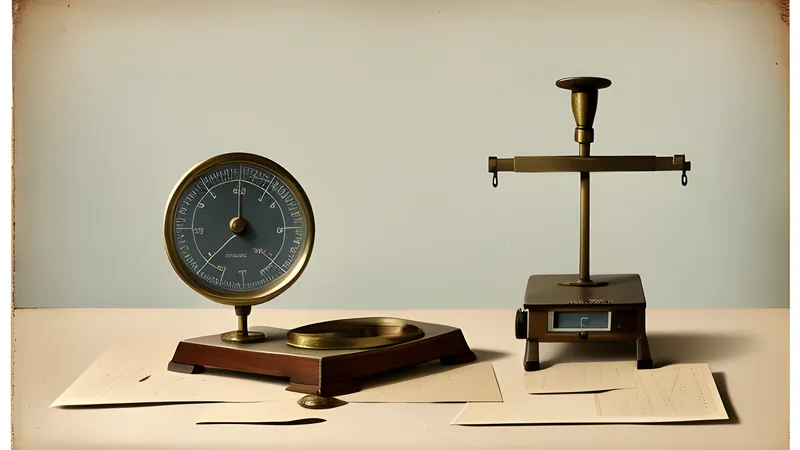
There is no cake or costume attached to World Metrology Day, and its emblem is functional rather than festive: the letters BIPM and the outline of a balance or calibration instrument feature in most official material, alongside that year’s chosen theme rendered as a simple graphic. The closest thing to a relic is Le Grand K itself, the cylinder of platinum-iridium that defined the kilogram for over a century, kept in a vault at Sèvres behind three keys held by three different custodians, alongside six official copies called témoins that were used to check it was not silently drifting. It was retired from active duty in 2019 but preserved as a historical object, a physical monument to the century when a unit of mass was, quite literally, a specific object in France.
Fun facts
Le Grand K lost around fifty micrograms relative to its official copies over roughly a century, an amount lighter than a grain of sand, and that tiny drift was one of the reasons metrologists finally abandoned physical artefacts as the basis for the kilogram. The original metre bar, the Mètre des Archives, was cut about 0.2 millimetres short of the true meridian-based definition because Delambre and Méchain’s eighteenth-century survey of the Earth’s shape had a small error in it, meaning the “true” metre has been slightly wrong since 1799 and nobody has ever bothered to correct it, since the definition is now fixed by light rather than by the old bar. Sèvres, home to the BIPM, sits on land granted a kind of extraterritorial status by the Metre Convention, comparable in spirit to an embassy, so that the world’s reference standards would not be subject to the whims of any single national government. And the modern definition of the second, one of the seven base units, is counted out by measuring over nine billion oscillations of a caesium-133 atom, a number chosen in 1967 specifically so that the new atomic second would match, as closely as physics allowed, the old astronomical second that had defined time for centuries beforehand.
Readers curious about how a single number can reshape a discipline might also enjoy Tau Day, which makes a similarly technical argument about a constant everyone assumes is already settled, or World Logic Day, which traces the history of the reasoning tools scientists use to build systems like this one in the first place.
A Closing Reflection
What makes World Metrology Day worth marking is what the treaty made possible: a world in which a measurement taken in one country can be trusted absolutely in another, without argument, translation or renegotiation. It is one of the quietest forms of international cooperation there is, has held for a century and a half through wars and revolutions in physics alike, and it succeeds precisely by being invisible, since nobody thinks about the kilogram until the day it stops meaning the same thing everywhere.
Related Content