World Maritime Day
On 17 March 1958, after a decade of diplomatic stalling, a United Nations convention finally entered into force and brought into being the body first called the Inter-Governmental Maritime Consultative Organization, later renamed the International Maritime Organization. Twenty years on, in 1978, that same body inaugurated World Maritime Day to mark the anniversary of its own founding convention. The observance now falls on a day in the last week of September, the IMO leaving the exact date to member states so they can fit it around their own calendars, and it turns attention to an industry that moves the overwhelming bulk of the planet’s traded goods while remaining almost entirely out of public view. It is a day about ships, about the rules that keep them from sinking or poisoning the sea, and above all about the people who crew them.
Where the day comes from
The organisation behind the day was slow to arrive. A convention to create an international maritime agency was agreed in Geneva in 1948, but the necessary ratifications crept in so reluctantly that it took until 1958 for the threshold to be met, and the first proper assembly did not gather in London until 1959. The reluctance was political: shipping nations were wary of ceding authority over a fiercely competitive industry to an international regulator. Once established, the IMO set about writing the rules that govern life at sea, from the construction standards that keep hulls intact to the conventions on pollution that followed a string of catastrophic oil spills. World Maritime Day, launched in 1978, was conceived as the annual occasion to focus this regulatory machinery on a single chosen theme, whether the year’s concern is decarbonisation, the safety of fishing vessels or the treatment of crews.
A history written in cargo
Humanity’s traffic on the water is old, but the shape of the modern industry is startlingly recent and owes much to one man and one idea. In April 1956 an American trucking magnate named Malcolm McLean loaded fifty-eight aluminium boxes onto a converted tanker, the Ideal X, and sailed them from Newark to Houston. The standardised shipping container he was experimenting with would, within two decades, gut the old world of the dockside. Before the box, loading a ship meant gangs of stevedores manhandling barrels, sacks and crates one item at a time, a process so slow that a vessel might spend longer in port than at sea. Containerisation collapsed those costs, mechanised the waterfront and made it economic to manufacture a thing on one continent and sell it on another. The economist Marc Levinson has argued that the container did as much to create the modern global economy as any tariff treaty, and the figures bear him out: the great majority of world trade by volume now travels by sea, stacked in identical steel boxes that machines lift in seconds.
Why it matters
Shipping is the cheapest way yet devised to move heavy goods across long distances, and the modern economy is wholly dependent on it. That dependence is precisely why regulation is not optional. A laden tanker that breaks up off a coastline can foul hundreds of miles of shoreline for years; the Torrey Canyon in 1967 and the Exxon Valdez in 1989 each forced the rules to be rewritten. Safety standards protect not only cargo but the lives of those aboard, and the IMO’s pollution conventions exist because the sea does not respect the borders of the nation that owns a given ship. The day also presses a quieter case for the people of the industry. Seafarers spend months at a stretch far from home, working in isolation and at real physical risk, and their wellbeing tends to drop out of public consciousness exactly as the goods they carry arrive on schedule. The maritime sector has had to confront a genuine crisis of crew mental health, a concern it shares with broader campaigns such as World Suicide Prevention Day, and recent themes for the day have begun to name that problem directly rather than leave it unspoken.
How it is observed
The day is marked chiefly by governments, ports, maritime academies and the shipping industry rather than by the general public. The IMO holds events at its London headquarters and, each year, designates a different host country for a parallel celebration, a rotation designed to give the occasion genuine geographic reach. Conferences and seminars dissect the year’s theme; ports and training colleges run open days and talks; and industry bodies use the moment to lobby and to publicise. The texture of the day reflects its audience, which is overwhelmingly professional, so it looks less like a festival than a working summit of an industry talking to itself about its own future. The themes themselves chart the shifting anxieties of the sector: where earlier years dwelt on basic safety and the prevention of collisions, recent editions have turned to the daunting task of decarbonising a global fleet that runs largely on heavy fuel oil, and to the long-overlooked welfare of the crews who keep it moving. That migration of subject matter is itself a record of how the maritime world’s sense of its own responsibilities has widened, from keeping ships afloat to keeping oceans and seafarers alike from harm.
A genuinely international enterprise
Few industries are as tangled across borders as shipping. A single vessel may be designed in South Korea, built in China, registered under the flag of Panama or Liberia, owned by a company in Greece, managed from Singapore and crewed by Filipino and Ukrainian sailors. This dispersal is exactly why a body like the IMO has to exist: no single state can regulate a ship that touches a dozen jurisdictions on one voyage. The same problems of coordination that arise when many nations must agree on common standards arise in civic life within nations too, and the maritime day’s insistence on shared rules and collective responsibility rhymes with observances of participatory duty such as India National Voters’ Day, where a system functions only if its members hold up a common bargain. Piracy off the Horn of Africa, the fair treatment of stranded crews, the long task of cutting greenhouse emissions from the world fleet: none of these yields to a solution that one country can impose alone.
Symbols and traditions
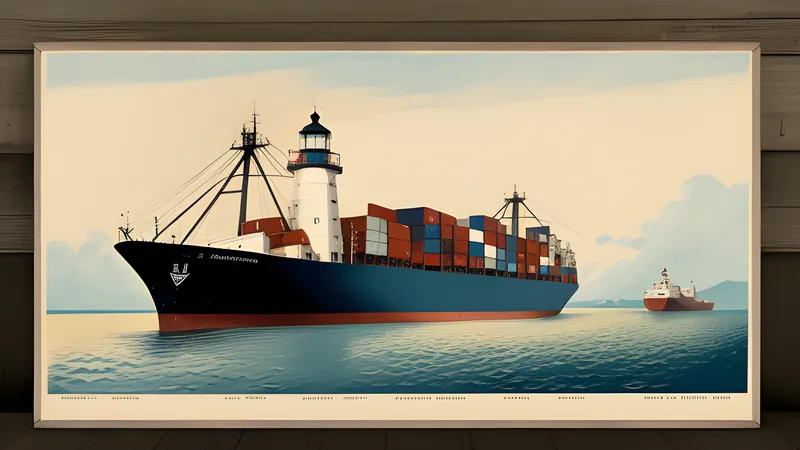
The imagery of the day is drawn straight from the sea: the container ship riding low under its stacked cargo, the lighthouse keeping watch over a treacherous coast, the anchor and the ship’s wheel. At the centre of it all stands the seafarer, more often unseen than honoured. The annual unveiling of each year’s theme gives the occasion a sense of ceremony, and flags, addresses and exhibitions lend it the trappings of a formal event, but the deeper symbolism is simpler. It points to the horizon, to the long voyages that bring the contents of an ordinary home from the far side of the planet, and to the human labour behind a system most of us never think about.
Fun facts
- The IMO began life under the cumbersome name Inter-Governmental Maritime Consultative Organization; it was not renamed the International Maritime Organization until 1982, more than two decades after it first met.
- The container ship has grown so large that the biggest now carry well over twenty thousand standard boxes, a single vessel holding more cargo than entire merchant fleets of the early twentieth century.
- The very first container voyage, in 1956, carried just fifty-eight boxes on a converted oil tanker; the idea was initially resisted by dockworkers and shipping lines alike before it remade the trade entirely.
- Many of the world’s largest merchant fleets sail under “flags of convenience” such as those of Panama and Liberia, small nations whose ship registries vastly outweigh their own seagoing populations.
- Roughly nine-tenths of internationally traded goods by volume travel by sea at some stage, which means almost everything in a typical room has spent time in a steel box on the water before reaching the shop where it was bought.
A closing reflection
The strangeness of the maritime world is how completely it has disappeared from view even as it has grown indispensable. A container leaves a factory, crosses an ocean and arrives as a parcel on a doorstep, and the only evidence of the voyage is a tracking notification. World Maritime Day asks for a moment’s attention to the part of the journey that happens out of sight, the weeks at sea, the crews who never make the news unless something goes catastrophically wrong, the careful and unglamorous rule-writing that keeps the whole apparatus from breaking down. The goods arrive so quietly that gratitude never gets a chance to form. Perhaps the most honest thing the day does is interrupt that silence just long enough to remember the people on the far end of the supply line, working where no one is watching, in conditions the rest of us will never see and rarely pause to imagine.
Related Content