World Manatee Day
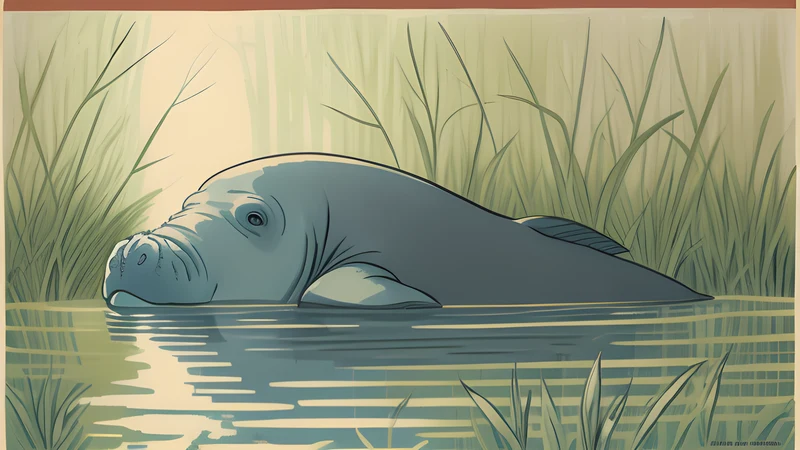
On 7 September, aquariums in Florida, river-tour operators in Belize and conservation charities across West Africa turn their attention to one of the least hurried animals on Earth. World Manatee Day, observed each year on this date and often listed as International Manatee Day, celebrates the slow, whiskered, seagrass-grazing sirenians that have been mistaken for mermaids, hunted for their meat, and battered by boat propellers, yet somehow persist in warm shallow waters on three continents.
An unlikely elephant relative
The manatee looks like a swimming sofa, but its family tree runs to some surprising places. Manatees belong to the order Sirenia, and their closest living relatives are not seals or whales. They sit within a group called Paenungulata alongside elephants and the rabbit-sized hyraxes of Africa. The shared ancestry shows in odd details: manatees have thick, wrinkled grey skin, sparse bristly hairs across the whole body rather than in patches, and toenails on their flippers that echo an elephant’s toes. Even their teeth follow an elephant-like plan. Manatees grow “marching molars” that erupt at the back of the jaw, wear down as the animal chews gritty aquatic plants, then fall out at the front and are replaced from behind throughout life.
There are three living manatee species. The West Indian manatee (Trichechus manatus) ranges from the south-eastern United States through the Caribbean to Brazil, and includes the well-studied Florida subspecies. The Amazonian manatee (Trichechus inunguis) is the only one that lives entirely in fresh water, hidden in the river systems of the Amazon basin. The West African manatee (Trichechus senegalensis) moves between coastal lagoons and inland rivers from Senegal to Angola and remains the least studied of the three. Their cousin the dugong, found across the Indian and western Pacific oceans, completes the order Sirenia. The two groups differ in an easy way to spot: a manatee has a rounded, paddle-shaped tail, while a dugong has a fluked tail shaped like a whale’s.
History written in mermaid sightings
The written record of manatees is tangled up with sailors’ imaginations. In January 1493, off the coast of what is now the Dominican Republic, Christopher Columbus logged the sight of three “mermaids” rising from the sea and complained in his journal that they were “not half as beautiful as they are painted.” He was almost certainly looking at manatees. The order’s very name, Sirenia, comes from the sirens of Greek myth, a nod to centuries of mariners squinting at these creatures and seeing women of the sea.
The most sobering chapter in sirenian history belongs to a relative that no longer exists. In 1741 the German naturalist Georg Wilhelm Steller, shipwrecked on Bering Island in the North Pacific, described an enormous cold-water sirenian up to eight metres long, later named Steller’s sea cow. Slow, trusting and enormous, it was hunted relentlessly by fur traders passing through the region. Within 27 years of its scientific discovery, by 1768, the species was gone. It is one of the fastest documented extinctions of a large mammal by human hands, and it hangs over every modern conservation effort for the animals that survived.
The word “manatee” itself carries older history. It comes from manatí, a term from the Taíno people of the Caribbean, and was recorded by Spanish colonists in the sixteenth century. For coastal and river communities across the tropics, the manatee was long a source of meat, oil and hide, and traditional hunting shaped populations for centuries before industrial threats arrived. In parts of West Africa the animal also occupies folklore, sometimes regarded as a former human or a spirit of the water, a status that has offered some populations informal protection.
Why the day matters
A manatee has almost no natural predators. An adult can weigh half a tonne and has no need to fear a shark or a caiman. The danger it faces is almost entirely human. In Florida, collisions with boat hulls and propellers are a leading cause of death, and many surviving manatees carry a lifetime of scars that researchers actually use to tell individuals apart. Manatees are also acutely sensitive to cold. Below roughly 20°C they begin to suffer cold-stress syndrome, which is why in winter they crowd into warm natural springs and, awkwardly, into the warm-water outfalls of power stations, an artificial habit that complicates plans to retire ageing plants.
Their diet ties them tightly to the health of shallow water. A manatee eats around a tenth of its body weight in vegetation every day, cropping seagrass meadows and freshwater plants for hours on end. When seagrass beds collapse under pollution or algal blooms, manatees starve. A severe die-off along Florida’s Atlantic coast in the early 2020s, driven largely by seagrass loss in the Indian River Lagoon, killed record numbers and forced wildlife officials into an emergency programme of hand-feeding animals with lettuce. World Manatee Day exists to keep that fragile link, between clean water, healthy seagrass and surviving manatees, in public view.
How it is marked
The day is low-key by design, matching its subject. Marine parks and aquariums that care for rescued manatees run behind-the-scenes talks and feeding demonstrations. In Florida, spring-fed parks such as those around Crystal River, one of the few places people can legally swim near wild manatees under strict rules, use the date to remind visitors to keep their distance and cut their boat speed in marked zones. Conservation groups release the year’s mortality and rescue figures, and schools near manatee habitat build lessons around the animal. Online, the day leans on the manatee’s gentle celebrity, with charities encouraging symbolic “adoptions” of named wild individuals whose scar patterns are tracked year after year.
Communities in Mexico, Belize and across West Africa, where manatees are harder to see and far less studied, use the occasion to run awareness campaigns aimed at fishers, since accidental entanglement in nets is a serious local threat. The observance is generally traced to Mexico, where the manatee has held legal protection since 1921, and it has since spread through conservation networks into an international date.
Manatees around the world
The three species live very different lives. The Amazonian manatee spends the dry season in deep river pools where food grows scarce, and it can survive long stretches on little more than its own fat reserves until the floodwaters return and open up drowned meadows of aquatic plants. Because it lives in murky brown rivers rather than clear Caribbean shallows, it is rarely seen and poorly counted, and much of what science knows about it comes from a handful of research stations in Brazil.
The West African manatee is arguably the most mysterious large mammal on its continent. It turns up in mangrove creeks, coastal lagoons and hundreds of kilometres up rivers, occasionally straying into reservoirs behind dams where it becomes trapped. The West Indian manatee is the best documented simply because so much of its range overlaps with Florida’s boats, canals and research budgets. Comparing the three is a reminder that public affection tends to follow visibility, and that the least-seen animals often need the day’s attention most.
Fun facts worth surfacing
The manatee’s lungs run almost the full length of its body, lying horizontally along the spine rather than in a compact chest. This helps the animal control its buoyancy with great precision, trimming its position in the water almost like a diver adjusting a wing.
Manatees are among the very few mammals with an unusual number of neck vertebrae. Almost all mammals, from mice to giraffes, have exactly seven. Manatees typically have only six, which is why they cannot turn their heads sideways and must swivel the whole body to look around.
Their split, prehensile upper lip works a little like a short elephant’s trunk. The two halves can move independently to grasp and shovel plants into the mouth, giving the manatee a surprisingly dextrous way of feeding for such a bulky animal.
A manatee’s slow metabolism means it can hold its breath for up to twenty minutes while resting, though it usually surfaces every few minutes when active. That leisurely biology is exactly why cold water is so dangerous to them.
Perhaps the strangest fact is behavioural. Manatees appear to enjoy a kind of social play, greeting one another with “kissing” muzzle-to-muzzle contact and body-surfing in the current where springs push water fast. Researchers have also recorded them following predictable travel routes between feeding and resting sites, a set of watery highways passed between generations that makes them predictable, and therefore vulnerable, to boats that learn the same paths.
A closing reflection
There is something clarifying about an animal whose survival depends so directly on the ordinary quality of the water around it. The manatee cannot be saved by charisma alone, and it has plenty of that. It is saved or lost by seagrass, by boat speed, by the temperature of a spring in January. Marking a day for the manatee is really a way of asking whether the shallow, sunlit edges of the tropics, the places people find most convenient to develop, can be kept alive enough to hold something so large and so slow. The same question hangs over the International Day of the Seal and World Whale Day, and it links the manatee to freshwater neighbours honoured on World Otter Day. Watch a manatee graze, unbothered and unhurried, and it becomes hard to argue that the water it lives in is anything less than worth defending.
Related Content