World Lemur Day
On the last Friday of October each year, zoos, research centres and Malagasy conservation groups mark World Lemur Day, a celebration that began in 2014 and grew out of an alarming statistic: the lemurs of Madagascar had become the most endangered group of mammals on Earth. The day was set up by a coalition that included the Lemur Conservation Network and the Malagasy primate research group GERP, and its purpose was blunt from the start. These animals exist nowhere else on the planet, they are disappearing fast, and most of the world knew them only as a cartoon king. A day of its own was an attempt to turn affection into action before the window closed.
Creatures of one island
Every wild lemur on Earth lives on Madagascar, the great island off the south-east coast of Africa, with only a couple of species reaching the neighbouring Comoros, where they were probably carried by people. This is one of the most remarkable examples of isolation in the natural world. The ancestors of the lemurs are thought to have reached Madagascar around fifty to sixty million years ago, most likely rafting across the Mozambique Channel on floating mats of vegetation, at a time when the crossing may have been shorter and the currents more favourable. Arriving on an island empty of monkeys and apes, they radiated into an astonishing variety of forms, filling ecological roles that on other continents belong to quite different animals.
The result is a group of primates found in no other place, ranging from the giant to the tiny. The indri, the largest living lemur, is a tailless, black-and-white animal that sings eerie, carrying duets through the eastern rainforest, calls that Malagasy tradition treats with reverence. At the other extreme, Madame Berthe’s mouse lemur, weighing around thirty grams, is the smallest primate in the world, small enough to sit in the palm of a hand. Between them lie more than a hundred recognised species, and taxonomists continue to describe new ones, a number that has climbed steeply as genetic tools have revealed distinctions the eye alone missed.
The name of the dead
The name lemur carries a shiver of the uncanny, and deliberately so. When Carl Linnaeus classified the animals in the eighteenth century, he reached for the Latin word lemures, meaning the restless spirits or ghosts of the dead in Roman belief. The choice reflected the nocturnal habits of the species then known to European science, their reflective eyes shining out of the dark, their unearthly night-time calls, and the ghostly way they moved through the trees. The association with the supernatural runs deep in Madagascar too, where several species, the aye-aye above all, are surrounded by taboos and omens, sometimes protected by them and sometimes killed on sight because a sighting is thought to bring misfortune.
The aye-aye deserves its strange reputation. It is a nocturnal lemur with rodent-like ever-growing teeth, enormous ears and a spindly, elongated middle finger that it uses to tap along branches, listening for the hollow sound of grubs beneath the bark before hooking them out, a foraging method called percussive foraging that no other primate uses. For a long time naturalists could not decide whether it was a lemur, a rodent or something else entirely, and its bizarre appearance has made it one of the most persecuted animals on the island.
History of the day
World Lemur Day emerged from a moment of genuine crisis in lemur conservation. In 2013 and 2014 primatologists warned that political instability in Madagascar had accelerated illegal logging and hunting, and a widely reported assessment found that around ninety per cent of lemur species were threatened with extinction, a figure that would later be revised upward to some ninety-eight per cent, with dozens ranked as critically endangered. The Lemur Conservation Network, an alliance of the organisations working to save the animals, launched the day, and later expanded it into a whole Lemur Festival spanning the surrounding week, to rally attention and funding. The last Friday of October was chosen to give the celebration a reliable weekend anchor.
The day drew energy from the animals’ unexpected fame. The Madagascar animated films, released from 2005 onward, had made a ring-tailed lemur named King Julien one of the most recognisable cartoon characters of the era, and conservationists were quick to point out that the real animals behind the joke were vanishing. The Duke Lemur Center in North Carolina, home to the largest population of lemurs outside Madagascar, became a hub of the celebration, using it to showcase the research and captive breeding that underpin the effort to keep the rarest species alive.
Why the day matters
The threat to lemurs comes down largely to the loss of forest. Madagascar has lost the great majority of its original forest cover, cleared over centuries by the slash-and-burn agriculture known as tavy, in which land is burned to plant rice and then abandoned as the thin soil exhausts. Poverty drives the cycle, and it has left many lemur populations stranded in isolated fragments too small to sustain them. On top of habitat loss come hunting for bushmeat, which rose sharply during periods of political and economic breakdown, and the capture of infants for the illegal pet trade, both within Madagascar and abroad.
Because lemurs are so specialised and so confined, they have nowhere else to go, and their decline echoes the fate of countless other island and forest species pushed to the margins. The day therefore belongs to the same conversation as broader observances like World Wildlife Conservation Day, and its stress on habitat protection connects it to the concerns of days such as World Tapir Day. Save the forest, the argument runs, and you save every creature that depends on it, an entire endemic community rather than a single animal.
The strange lives of lemurs
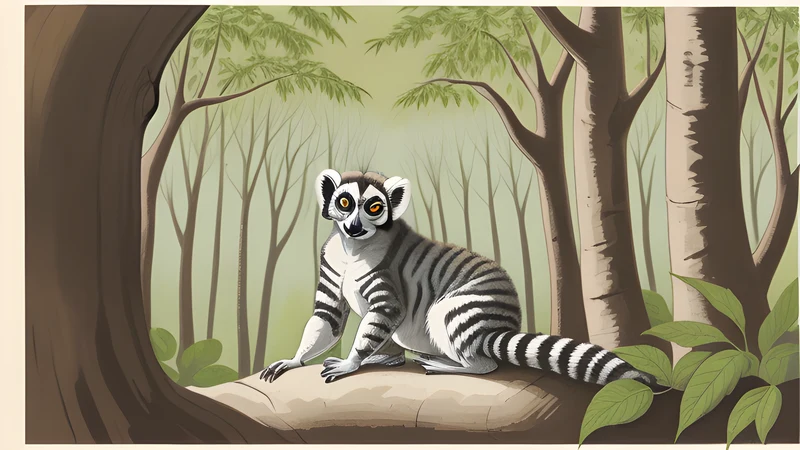
Lemurs behave in ways that surprise people used to monkeys. In most lemur species the females are dominant, feeding first and leading the group, an arrangement rare among primates. Ring-tailed lemurs, the black-masked, banner-tailed animals of the dry south, greet the morning by sitting upright with their arms outstretched and their pale bellies turned to the sun, a sunbathing posture that looks almost devotional. Males of the species wage what researchers call stink fights, wiping scent from glands on their wrists onto their tails and then wafting the smell at rivals, settling disputes by odour rather than force. Many lemurs are seed dispersers and pollinators, and some, like the ruffed lemurs, are among the largest pollinators of any flowering plant, spreading pollen on their fur as they feed.
How it is celebrated
Zoos and sanctuaries run keeper talks, feeds and fundraising drives, and many host school visits built around the day. In Madagascar itself, the Lemur Festival brings parades, music and educational events to towns near the forests, aiming the message squarely at the communities whose decisions shape the animals’ future. Research centres open their doors and publish new findings, and the online celebration fills with footage of indris singing, ring-tailed lemurs sunbathing and mouse lemurs peering wide-eyed from a researcher’s hand. Fundraising is central, because so much lemur conservation depends on small, chronically underfunded field projects.
Lemurs in Malagasy culture
Lemurs are woven through the beliefs of the peoples who live alongside them, and those beliefs have often been the animals’ best protection. In many regions a system of taboos known as fady forbids the killing or eating of particular species, and some communities regard the indri as a sacred ancestor, telling stories in which it was once human or in which its mournful cry is the voice of a lost child calling through the trees. Where such taboos hold firm, lemur populations tend to fare better, and conservationists increasingly work with local elders rather than against tradition. Elsewhere the opposite belief prevails, and the aye-aye in particular is treated as an omen of death, sometimes killed and hung at the edge of a village to turn misfortune away. This patchwork of reverence and dread means the animals’ fate can differ sharply from one valley to the next, and it makes cultural understanding as important to their survival as any fence or patrol.
Fun facts
The aye-aye’s tapping finger is so specialised that the animal has a ball-and-socket joint in the digit, letting it swivel freely as it probes for grubs. The indri cannot survive in captivity and has never been successfully kept for long, which means every indri alive is a wild one, and its haunting song can carry for more than a kilometre through the forest. Some dwarf and mouse lemurs are the only primates known to hibernate, sleeping through the dry season in tree holes with their body temperature dropping to match the surrounding air. And Madame Berthe’s mouse lemur, the smallest primate on Earth, was only described in the year 2000 and named after the Malagasy conservationist Berthe Rakotosamimanana, a reminder of how recently science is still meeting the island’s inhabitants.
An island still being discovered
One of the quieter facts about lemurs is how much remains unknown. The count of recognised species has more than doubled since the 1990s, driven less by the discovery of wholly new animals than by genetic analysis splitting what were once thought to be single species into several. New mouse lemurs in particular are described almost every few years, each confined to its own small patch of forest, which means that habitat destroyed before it is surveyed may take undocumented species with it. That race between the taxonomist and the chainsaw gives World Lemur Day an added urgency: the animals being lost include the famous ring-tails and indris of the zoo posters and, alongside them, an unknown number of small, nocturnal creatures science has not yet had time to name.
A closing reflection
Madagascar has been called a separate world, and its lemurs are the proof, a whole order of primates that took one evolutionary path while the rest of us took another. To lose them would be to lose an experiment fifty million years in the running, with no way to start it again. World Lemur Day asks the people charmed by a cartoon king to reckon with that stake, and to notice that the ghost-named animals of one island are running out of the forest they need. The last Friday of October is a small annual insistence that they are worth the trouble, and that there is still time to prove it.
Related Content