World Hummus Day
In 2012, an American technology entrepreneur named Ben Lang, then still a student, decided that the beige purée he loved deserved a global holiday, and he fixed World Hummus Day on 13 May. There was no committee, no government agency, no ancient precedent; there was a website, a hashtag, and an appetite. More than a decade later the day is observed by restaurants and home cooks on several continents, which says something about both the reach of the internet and the near-universal appeal of mashed chickpeas.
What hummus is
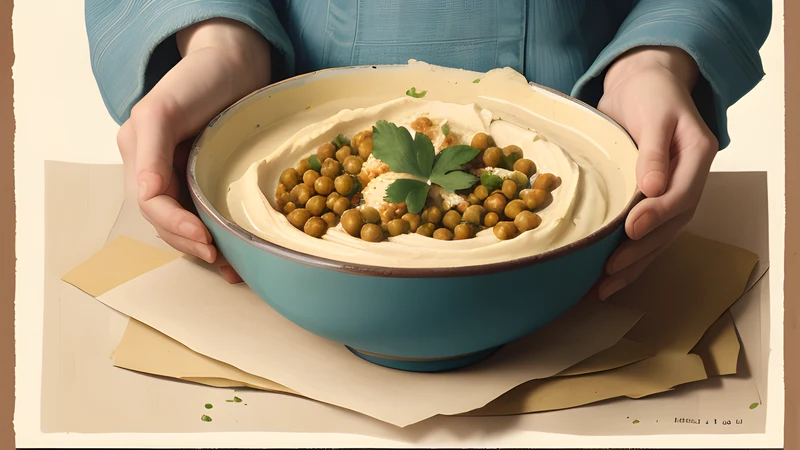
Hummus, in its proper form, is a smooth paste of cooked chickpeas blended with tahini (sesame seed paste), lemon juice, garlic and salt, loosened with a little of the chickpea cooking water and finished with a generous pour of olive oil. The full Arabic name is ḥummuṣ bi ṭaḥīna, “chickpeas with tahini,” and the word ḥummuṣ on its own simply means chickpeas. In other words, the dish is named after its main ingredient, and to a purist, tahini is non-negotiable, so a bowl made without it is something lesser wearing the name.
The texture is the battleground. A great hummus is silky to the point of being almost airy, achieved by cooking the chickpeas until they are falling apart, sometimes peeling them, and blending patiently. The supermarket tubs that made hummus a global staple are, to a Levantine cook, a pale industrial shadow of the warm, freshly made bowl scooped up with torn bread. That gap between the mass-produced dip and the handmade original runs through the whole story of the day.
Ancient roots and a modern claim
Chickpeas are among the oldest cultivated crops on earth, domesticated in the Middle East thousands of years ago, so the raw material of hummus has fed the region since antiquity. Pinning down the dish itself is harder. The earliest written recipes that resemble hummus appear in Arabic cookbooks from the thirteenth century, several of them compiled in Cairo, describing cold chickpea purées seasoned with vinegar, herbs and spices. Tellingly, those medieval versions often lack the two things a modern cook considers essential, tahini and garlic, which suggests the dish we now call hummus took its final shape later than its ingredients might imply.
That historical fog has not cooled the modern arguments over ownership. Hummus sits at the centre of a long-running culinary dispute between Lebanon and Israel, the loudest front in the so-called “hummus wars.” Lebanese business groups have argued that hummus is a Lebanese dish being marketed abroad as Israeli, and at one point sought protected status for it, comparable to the way champagne is tied to its French region. The quarrel spilled into a genuine contest of national pride expressed in kilograms, with cooks on both sides building record-breaking platters to stake their claim. The day itself steers clear of the flag-waving, and it belongs to the same family of borderless food celebrations as International Falafel Day and World Tapas Day, each honouring a dish older than the disputes surrounding it.
History of the day
Ben Lang’s motive was affection rather than politics. He built a simple site inviting people to eat hummus and share it on 13 May, and the idea caught because hummus had, by 2012, already conquered Western supermarkets and become the default dip of the health-conscious middle class. The day gave that quiet ubiquity a focal point. It has since been adopted by hummus brands as a marketing peg, by Middle Eastern restaurants as a chance to show what the handmade version can do, and by charities highlighting plant-based, affordable protein. Its grassroots, ownerless character is precisely why it has survived: nobody controls it, so everybody can join in.
Why it matters
Hummus earns its place in the diet on merit. Chickpeas and sesame together supply protein, fibre, healthy fats, iron and folate, and the whole thing is naturally vegan and gluten-free, which is why it became a cornerstone food of vegetarian and flexitarian eating long before those labels were fashionable. In a world trying, unevenly, to eat less meat, hummus is a template that needs no reinvention. A day devoted to it is a small nudge towards a larder built on pulses, and it happens to taste good enough that the nudge rarely feels like a lecture.
How the day is celebrated
Restaurants offer free bowls or special mezze spreads, brands run competitions and giveaways, and food writers publish the definitive method for the hundredth time, each convinced theirs is the one that finally cracks the silkiness. Home cooks treat it as a challenge to make hummus from scratch, soaking dried chickpeas overnight rather than reaching for a tin, and the results are shared online in a flood of swirled bowls and glugs of olive oil. Because the day is decentralised, it looks like whatever its participants make of it, from a supermarket promotion in Manchester to a family lunch in Beirut.
Variations across the region
Regional hummus is a study in small, defended differences. In much of the Levant, hummus is eaten warm for breakfast, topped with whole chickpeas, cumin and a pool of oil. Msabbaha, the chunkier cousin, leaves the chickpeas mostly whole in a looser tahini sauce. Hummus bi lahm crowns the purée with spiced minced meat and pine nuts, turning a dip into a full meal. Cooks argue over whether to peel the chickpeas, whether garlic should be raw or mellowed, how much lemon is too much, and whether cumin belongs at all. Outside the region the dish mutates freely into beetroot hummus, roasted red pepper hummus and countless other tinted variations that a Damascus purist would regard with polite horror.
The long road west
Hummus reached the wider world along two very different paths, and the contrast explains a lot about how it is eaten today. The first path was migration: Levantine and other Middle Eastern communities settling in Europe, the Americas and Australia carried the dish with them, kept it warm and handmade, and served it as a breakfast and a mezze rather than a party snack. The second path was commercial. From the 1980s onward, food manufacturers spotted a chilled, shelf-stable, vegetarian product with broad appeal and pushed it into supermarkets across the West. Sabra, Tribe and a host of own-label brands turned hummus into one of the fastest-growing chilled foods of the era, and by the 2010s it was a fixture in millions of fridges that had never seen a chickpea soaked overnight.
That industrial success is what made a global holiday plausible in the first place, and it is also what the handmade tradition quietly resents. The tub in the supermarket is smoother by machine, stabilised for a long life, and often lighter on tahini than a Beirut cook would tolerate. World Hummus Day, in its small way, is a chance for the original version to remind the mass-market one what it is descended from, and for a home cook to discover that the difference between the two is a single afternoon of patient blending.
Symbols and rituals
The defining ritual of hummus is communal and wordless: a shared bowl, warm bread torn rather than cut, and the sweeping motion, the tazbila, of scooping from the edge inward so the surface stays neat. It is food for the middle of the table, not the individual plate, and eating it that way is part of what it means. The generous slick of olive oil, the dusting of paprika or sumac, the scatter of whole chickpeas, all serve as the finishing signature that turns a purée into a presented dish.
Fun facts
In 2010, Lebanese chefs prepared a plate of hummus weighing roughly 10,452 kilograms, and the number was chosen on purpose: 10,452 is the area of Lebanon in square kilometres, making the record a patriotic statement as much as a culinary one.
The word ḥummuṣ means “chickpeas” in Arabic, so ordering “hummus” is, strictly, ordering “chickpeas,” and the full name specifies that they come with tahini.
Some of the oldest recipes resembling hummus, found in thirteenth-century Arabic manuscripts, contain neither tahini nor garlic, which means the dish’s most beloved features were later additions to an older idea.
Across much of the Middle East hummus is a breakfast food served warm, a fact that surprises Western eaters accustomed to meeting it cold, from a plastic tub, as a party dip.
The Israeli town of Abu Ghosh and the Lebanese food industry have traded record attempts back and forth, each briefly claiming the title of world’s largest hummus plate, turning a kitchen staple into a stage for national one-upmanship measured by the tonne.
Tahini, the sesame paste that defines true hummus, is itself an ancient product, and the quality of a hummus is bound tightly to the quality of its tahini; a bitter, cheap paste will sink an otherwise perfect bowl.
A closing reflection
World Hummus Day began as one student’s enthusiasm and grew into a genuinely global moment, which is a fair mirror of the food itself: humble in its ingredients, vast in its reach. The disputes over who owns it will not be settled by a hashtag, and perhaps they should not be, because the arguing is a form of love. What the day offers instead is a simpler invitation, to make a bowl properly, to put it in the middle of the table, and to let a food thousands of years old do the quiet work of bringing people around it.
Related Content