World Giraffe Day
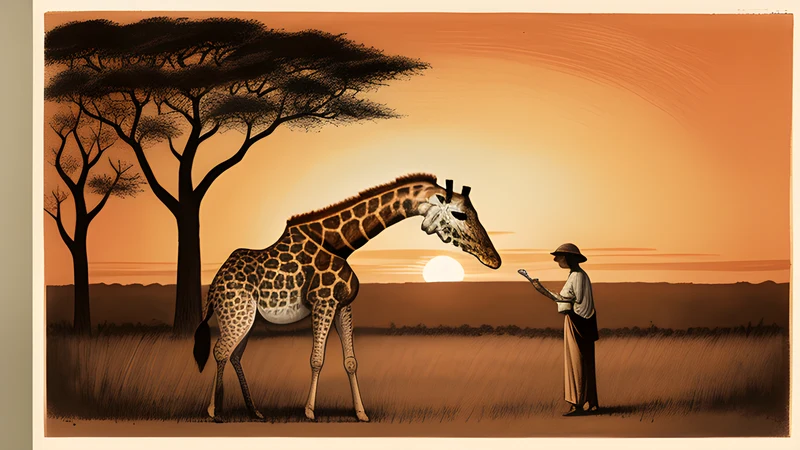
In 2014 the Giraffe Conservation Foundation, founded by the biologists Julian and Stephanie Fennessy, launched World Giraffe Day and fixed it to 21 June, the longest day of the year in the northern hemisphere. The pun was deliberate and the point was serious: the tallest animal on Earth was quietly disappearing, and almost nobody had noticed. A decade on, the day each 21 June is the single largest global focus on an animal that conservationists had taken to calling the victim of a “silent extinction”.
The animal at full height
A giraffe can stand five and a half metres tall, high enough to look into a first-floor window, and it reaches that height with a neck that contains exactly seven vertebrae, the same number as a mouse or a human. Each bone is simply enormously elongated. That neck is powered by one of the most extraordinary cardiovascular systems in the animal kingdom. A giraffe’s heart weighs around eleven kilograms and generates blood pressure roughly twice that of a human, enough to push blood two metres straight up to the brain. When the animal bends down to drink, a network of blood vessels and one-way valves stops that pressure from causing a catastrophic rush of blood to the head, and reverses the effect when it lifts up again.
Feeding is done with a prehensile tongue up to fifty centimetres long, coloured dark blue-black, a pigmentation thought to protect it from sunburn during the hours a giraffe spends stripping leaves from thorny acacia trees. Its coat pattern is unique to each individual, like a fingerprint, and research suggests the patches sit over a network of blood vessels that help the animal shed heat, making the coat a cooling system as well as camouflage.
History and the science of counting
The giraffe has fascinated humans for millennia. Ancient Egyptians kept them and gave them a hieroglyph, and in 1414 a giraffe sent from East Africa arrived in China, where it was received at the Ming court as a mythical qilin, an auspicious beast. For centuries Europeans called the animal a “camelopard”, believing it a cross between a camel and a leopard, a name preserved in the giraffe’s scientific genus, Giraffa camelopardalis.
The most consequential recent history is genetic. For a long time science recognised a single giraffe species with several subspecies. Then in 2016 a major study led by the Giraffe Conservation Foundation, analysing DNA from across the animal’s range, argued that there are in fact four distinct giraffe species, the northern, southern, reticulated and Masai giraffe, that do not interbreed in the wild despite living on the same continent. Later work has refined the picture further. The finding matters enormously for conservation, because a population that looks healthy as “one species” can conceal individual species and subspecies that are critically endangered. The Kordofan and Nubian giraffes of central and north-east Africa, caught up in regions of conflict, number only a few thousand animals each.
Overall giraffe numbers are estimated at around 117,000 in the wild, a figure that represents a steep decline over recent decades driven by habitat loss, the fragmentation of savannah into farmland, poaching for meat and hides, and the instability of some of the regions where giraffes live. That combination is why the “silent extinction” phrase stuck: the giraffe is so familiar, so beloved on postcards and in children’s books, that its real-world decline went strangely unremarked.
Why the day matters
World Giraffe Day was built to close that gap between the giraffe’s cultural fame and its ecological neglect. The animal receives a tiny fraction of the research funding and public attention lavished on elephants, rhinos and big cats, despite being classed as vulnerable overall and worse in several regions. The day funds and publicises concrete conservation work, from GPS-tracking collars fitted to monitor movements, to translocations that move small groups of giraffes into safer or restored habitat to rebuild populations. It also uses the giraffe as a flagship for the wider African savannah, since protecting the space a giraffe needs protects countless other species that share it.
How it is celebrated
Zoos and wildlife parks around the world anchor the day, running keeper talks, feeding sessions where visitors can offer browse to giraffes at head height, and fundraising drives for field projects. The Giraffe Conservation Foundation coordinates the global campaign, encouraging supporters to “stick their necks out” for the animal, and conservation groups release the latest population figures and research findings to coincide with the date. Schools build lessons around giraffe biology, and the longest-day timing gives southern-hemisphere and northern participants a shared hook, since it is midsummer for some and midwinter for others.
Fun facts worth stretching for
Giraffes barely sleep. In the wild they may rest for only around thirty minutes to two hours in a full day, often in brief bursts of a few minutes, sometimes standing up, because lying down leaves them dangerously slow to rise if a lion appears.
They hum in the dark. In 2015 researchers recording zoo giraffes at night discovered a low humming sound at about 92 hertz, near the bottom edge of human hearing, suggesting the animals communicate more than the near-silent reputation they had long carried.
Birth is a dramatic drop. A giraffe calf, after a gestation of around fifteen months, is born while its mother is standing, falling roughly two metres to the ground, a jolt that helps break the birth sac and prompt its first breath. Within an hour it can usually stand and run.
Their closest living relative looks nothing like them. The okapi, a shy, striped forest animal from the Democratic Republic of the Congo, is the only other member of the giraffe family, sharing the long dark tongue and ossicone-like features despite its much smaller size and horse-like appearance.
Their legs alone can be taller than a person, around two metres, and end in dinner-plate-sized hooves that deliver a kick powerful enough to kill a lion, the giraffe’s main line of defence.
They drink rarely and awkwardly. A giraffe gets much of its water from the leaves it eats and can go days without drinking, and when it does drink it must splay its front legs wide and lower that long neck, a briefly defenceless posture that predators sometimes exploit.
Traditions and symbols
The giraffe has become a global shorthand for the exotic and the gentle, its image everywhere from nursery walls to corporate logos. Its calm, deliberate movement and improbable proportions give it a place in the human imagination out of all proportion to how much most people know about it. That very ubiquity is part of what World Giraffe Day tries to convert into genuine engagement, turning the cartoon giraffe of childhood into an animal whose real numbers people actually track.
Combat in slow motion
Male giraffes settle disputes with a behaviour called “necking”, and it is far more violent than the graceful swaying it resembles from a distance. Two bulls stand side by side and swing their heavy heads on those long necks like clubs, driving the bony ossicones and the reinforced skull into the opponent’s body and legs. A full blow carries enormous force, and contests can leave animals stunned or knocked off their feet. The stakes are dominance and the right to mate, and older bulls develop thicker, heavier skulls over their lives specifically as weapons, growing so top-heavy that their fighting style shifts with age. It is a rare case of an animal whose anatomy is shaped as much by combat as by feeding.
Beneath the drama, giraffe society is loosely organised and surprisingly fluid. They live in open, shifting groups sometimes called “towers”, with individuals coming and going rather than forming tight, permanent herds. Females often form nursery groups and take turns watching over calves at a communal “creche” while others browse, a cooperative arrangement that helps guard the vulnerable young from lions and hyenas.
Where giraffes still roam
The giraffe’s range has shrunk and splintered over the past century. Once spread almost continuously across the savannahs and open woodlands of sub-Saharan Africa, giraffes now survive in scattered pockets from the Sahel to South Africa, their populations divided by farmland, fences, roads and settlements. Some of the healthiest numbers are in southern Africa, where southern giraffes have actually increased in well-managed reserves, a genuine conservation success. The most fragile populations cling on in central and eastern Africa, where drought, poaching and armed conflict make protection far harder. This uneven picture is exactly why the split into distinct species matters so much: lumping every giraffe together hides the fact that some kinds are thriving while others are down to their last few thousand individuals, and a day of global attention helps direct effort where it is genuinely urgent.
A closing reflection
There is a peculiar lesson in the giraffe’s plight. An animal can be one of the most instantly recognisable on the planet and still slide toward danger unnoticed, precisely because familiarity breeds the assumption that it must be fine. World Giraffe Day is an argument against that complacency, a yearly insistence that we look properly at something we think we already know. The same story of savannah under pressure links the giraffe to neighbours honoured on World Zebra Day and International Cheetah Day, and to the riverine giants of World Hippo Day. To mark 21 June is to stick your neck out, gently, for an animal that has been hiding in plain sight all along.
Related Content