World Car-Free Day
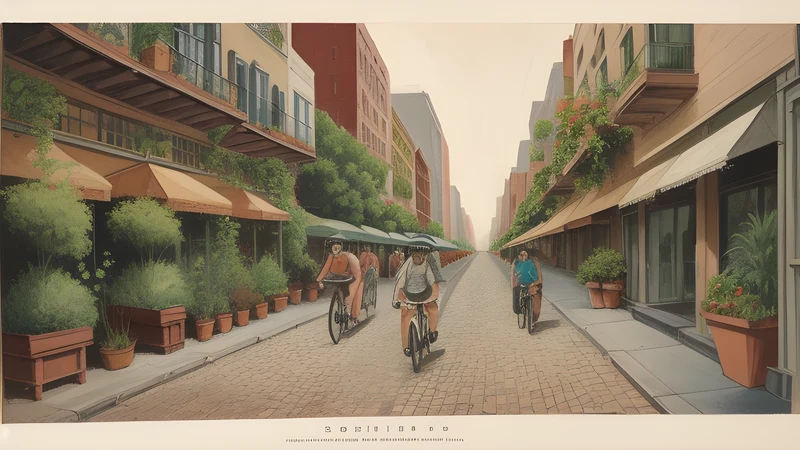
On 22 September, in cities from Bogotá to Brussels, streets that are usually rivers of metal fall silent. World Car-Free Day invites towns to close their centres to private cars for a day and hand the tarmac back to people on foot, on bicycles and simply standing about in a space that is normally forbidden to them. The point is less a protest than an experiment: to let a city feel, for a few hours, what it might be like if the car were a guest rather than the owner of the street.
An idea that predates its date
The modern movement crystallised in France. In 1997 the coastal city of La Rochelle ran an event it called “En ville, sans ma voiture!”, or “In town, without my car!”, closing its heart to traffic for a day. The idea spread quickly across France and then Europe, and in 2000 the European Commission folded it into a wider framework, launching European Mobility Week, which runs from 16 to 22 September and culminates in the car-free day itself. By then the date of 22 September had become the informal global anchor.
The deeper roots run back further. During the Suez oil crisis of 1956 and again in the OPEC embargo of 1973, several European governments imposed car-free Sundays to save fuel, and photographs of families cycling and roller-skating along empty motorways in the Netherlands became unexpectedly joyful images of scarcity. Reykjavik and the English city of Bath ran early car-free experiments in the mid-1990s. The 1997 La Rochelle event simply gave the impulse a name and a repeating date.
History on four wheels
To understand why a day is needed to remove cars, it helps to remember how completely they arrived. The motorcar was a novelty at the turn of the twentieth century and the dominant fact of urban life by its middle. In between, city streets were remade around it. Before the 1920s the street was a shared, chaotic commons of pedestrians, pushcarts, children and the occasional tram. The word “jaywalker”, now so ordinary, was in fact a slur, pushed in the 1920s by American motoring interests to shame walkers off the roadway and recast the street as a place for cars, with people confined to the kerb.
That redefinition succeeded so thoroughly that it became invisible. Post-war planning, especially in North America, bulldozed neighbourhoods for urban motorways and zoned homes far from shops so that a car became a precondition of ordinary life. The backlash produced its own heroes, among them the writer and activist Jane Jacobs, whose 1961 book The Death and Life of Great American Cities defended the messy, walkable street against the planners, and who helped stop a motorway that would have driven through Lower Manhattan. World Car-Free Day is a direct descendant of that argument, staged annually on the asphalt itself.
Why it matters
Cars shape far more than traffic. Roughly a fifth of global carbon emissions comes from transport, most of it road transport, which ties the day closely to the International Day of Clean Air for Blue Skies, since exhaust and the fine dust from tyres and brakes are major sources of the pollution that shortens urban lives. Traffic kills directly too: well over a million people die on the world’s roads each year, and road danger is the single largest reason parents give for no longer letting children walk or cycle, a worry that shadows the International Walk to School Day.
There is a quieter cost in space. A parked car sits idle for around ninety-five per cent of its life, yet claims valuable land at both ends of every journey. Add the width of the lanes it moves in, and a startling share of any city, often a third or more of its land, is given over to the storage and movement of vehicles. Car-free day makes that arithmetic briefly visible by showing residents the plazas, markets and playgrounds their streets could hold. The economic case has grown alongside the environmental one, because pedestrians and cyclists, freed from the need to park, tend to visit local shops more often and spend more over a month than the drivers retailers imagine they depend on, a finding that has surprised many a high-street trader who first opposed losing the parking outside the door.
How it is marked
The day looks different in every city, but the ingredients recur. Councils cordon off a central district and fill it with things a road cannot normally hold: pop-up cafés, cycle-repair stands, street music, chalk drawings, tai chi classes and rows of potted trees. Public transport is often free or discounted to prove that the city still works without private cars. Campaigners use the occasion to lobby for permanent change, and many of the pedestrian zones and cycle lanes now taken for granted began as a single car-free day that a city decided to keep.
Variations around the world
The most famous version is not on 22 September at all. Since the 1970s Bogotá has closed more than a hundred kilometres of its streets every Sunday morning for the Ciclovía, when a million or more residents walk, cycle and skate along arteries usually thick with cars, and the city added an annual weekday Día sin carro in 2000. Jakarta holds car-free mornings on its main avenues. Paris has run ambitious car-free days across its whole centre and used them as a testing ground for the wider pedestrianisation its mayor has pursued. In many smaller European towns the day is woven into Mobility Week, complete with awards for the city that does most to shift people out of their cars.
From one day to permanent design
The most interesting legacy of car-free day is the permanent experiments it has inspired. Barcelona’s “superblocks”, or superilles, group nine city blocks into a single cell and push through traffic to the perimeter, freeing the interior streets for play, planting and cafés; the first opened in the Poblenou district in 2016 after years of temporary trials. Ghent in Belgium redrew its entire circulation plan in 2017, dividing the centre into sectors between which cars cannot drive directly, and saw cycling rise sharply within a year. Pontevedra in Spain has pedestrianised almost its whole historic core since the turn of the century and now reports that no one has died in traffic within it for well over a decade. Each of these began, in spirit, as the question a car-free day poses out loud: what if it were always like this? The answer, where cities have dared to test it, has usually been a rise in footfall for local shops, quieter air and streets that fill with children again.
The health dividend
Pulling cars from a street does more than cut collisions. Physical inactivity is one of the largest risk factors for ill health in wealthy societies, and the simplest remedy, walking or cycling as part of an ordinary day, is exactly what car-dependent design engineers out. Cities that shift journeys onto foot and bicycle record lower rates of heart disease, obesity and the mental strain that a long, congested commute reliably produces. There is a noise dividend too, easily forgotten until it is gone: on a car-free day residents of busy streets often remark, with genuine surprise, that they can hear birdsong, conversation and their own footsteps in a place that is normally a wall of engine and horn.
Fun facts
The oil-crisis car-free Sundays of 1973 were so complete that people held picnics on Dutch motorways, and the images remain some of the most-shared symbols of the environmental movement. The colombian Ciclovía has been copied so widely that “open streets” events now run in hundreds of cities worldwide, many under the imported Spanish name. A single city bus at capacity can replace dozens of cars and the road space they need, which is why transport planners speak of “person throughput” rather than vehicle counts. And the geometry is unforgiving: no matter how the lanes are arranged, a road can move far more people per hour on bicycles or in buses than in private cars, a fact car-free day turns from a slide in a planning report into something a resident can watch happen. The car itself is a poor space traveller: the typical private vehicle carries barely more than one person for most journeys, hauling well over a tonne of metal to move a single commuter to work. Even the language of the movement has spread, and “Park(ing) Day”, begun in San Francisco in 2005, encourages people to feed a parking meter and turn the metered bay into a tiny temporary park, a pointed reminder of what that patch of tarmac costs and what else it could be.
A closing reflection
World Car-Free Day is easy to dismiss as a gesture, a single day that changes nothing before the traffic floods back at midnight. Its defenders make a subtler claim. Cities are shaped less by grand plans than by habit, by the thousand small assumptions about what a street is for that harden into concrete over decades. A car-free day interrupts the habit just long enough for a different assumption to be glimpsed: that the space between the buildings belongs, first, to the people who live among them. Most participants go back to their cars the next morning. A few do not, and a few streets, once tasted empty, are never quite handed back.
Related Content