World Bonobo Day
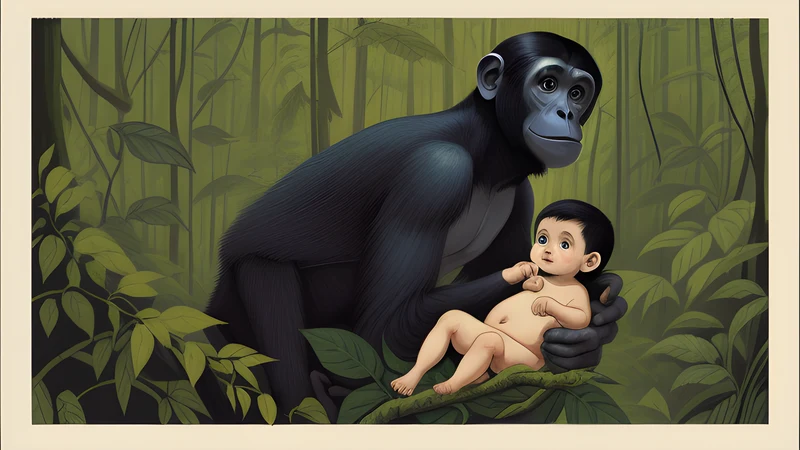
World Bonobo Day falls on 14 February, and the date is a deliberate joke with a serious point. Bonobos, one of humanity’s two closest living relatives, are famous among primatologists for defusing conflict through affection and sex rather than aggression, so placing their day on Valentine’s Day makes the argument in a single stroke: this is the “make love, not war” ape. Promoted since around 2017 by conservation groups led by the Bonobo Conservation Initiative, the day exists to raise the profile of a great ape that most people have never heard of, even though it shares almost ninety-nine per cent of our DNA.
The last great ape to be recognised
The bonobo (Pan paniscus) was the last of the great apes to be described by science, and it happened almost by accident. In 1929 the German anatomist Ernst Schwarz examined a small ape skull held in the museum at Tervuren in Belgium, a skull that had been catalogued as a juvenile chimpanzee, and realised it belonged to an adult of a wholly separate species. Until then, the animals living in the forests south of the Congo River had been lumped in with common chimpanzees. The animal was for a time misleadingly called the “pygmy chimpanzee”, a name that stuck for decades despite being inaccurate: bonobos are a distinct species with their own biology and behaviour, and calling them small chimps obscures that.
Their entire wild range lies within a single country. Bonobos are found only in the Democratic Republic of the Congo, in the lowland rainforest enclosed by the great curve of the Congo River. That river is the reason they exist as a species at all. Around one and a half to two million years ago, the ancestors of bonobos and chimpanzees were separated by the forming of the Congo, which bonobos cannot cross because, unlike many primates, they do not swim. Isolated on the southern bank in a lush, resource-rich forest, they evolved along a very different path from the chimpanzees to the north.
A society run by females
The most striking thing about bonobos is how they organise themselves. Chimpanzee communities are dominated by males and can be brutally violent, with recorded cases of lethal raids and warfare between groups. Bonobo society works almost the opposite way. Females form strong alliances with one another and collectively hold the highest social status, keeping individual males in check despite the males being physically larger. A male’s rank tends to depend on his mother’s standing rather than his own strength, and mothers actively help their sons navigate the social world.
Tension in a bonobo group is typically resolved through physical affection and sexual contact of many kinds, used as a social lubricant to ease conflict over food, to reconcile after squabbles and to build bonds. Female bonobos in particular engage in a behaviour researchers call genito-genital rubbing, which appears to cement the coalitions that underpin the whole peaceful structure. The result is a species in which no case of one bonobo killing another has ever been confirmed in the wild, a claim that cannot be made for chimpanzees or, for that matter, for humans. The primatologist Frans de Waal did much to bring this behaviour to wider attention, framing bonobos as a living counterweight to the assumption that our lineage is inherently warlike.
Why the day matters
Bonobos are endangered, and their situation is precarious in ways the public rarely sees. Estimates of the wild population range from perhaps ten thousand to fifty thousand animals, and the trend is downward. They are threatened by hunting for bushmeat, by the loss and fragmentation of their forest to logging and agriculture, and by the long instability and conflict that has affected parts of the Democratic Republic of the Congo. Because their range is so concentrated in one country, and much of it remote and hard to survey, they receive far less conservation funding and attention than gorillas, orangutans or chimpanzees. World Bonobo Day is an attempt to correct that neglect, using the animal’s remarkable social life as a hook to win it supporters and to fund the community-led protection efforts that offer the best hope for its survival.
How it is marked
The day is largely a digital and educational campaign. Conservation organisations, zoos that keep bonobos and primate research centres use 14 February to share footage, facts and fundraising appeals, leaning happily on the overlap with Valentine’s Day and the “make love, not war” framing. Sanctuaries such as Lola ya Bonobo near Kinshasa, which rehabilitates orphaned bonobos rescued from the bushmeat trade, feature prominently in coverage. Educators use the day to introduce students to the idea that our closest relatives include a peaceful, female-led species, a fact that reliably surprises people and opens up discussion about human nature and evolution.
Kanzi and the question of language
Much of what the wider world knows about bonobo intelligence comes from a single famous individual. Kanzi, a bonobo studied for decades in the United States by the psychologist Sue Savage-Rumbaugh, learned to communicate using a keyboard of abstract symbols called lexigrams, appeared to understand a considerable amount of spoken English, and was even taught to make simple stone cutting tools by striking flakes from a core. Kanzi’s abilities became central to long-running debates about whether apes can grasp elements of language and about the cognitive gap between humans and our nearest kin. Whatever the final verdict on those questions, the research demonstrated a depth of bonobo intelligence that reframes the species as something far more than a forest curiosity.
Life in the forest
Bonobos spend their days moving through the trees and across the forest floor in search of food, and their diet is dominated by fruit, supplemented with leaves, stems, seeds, the occasional insect and, rarely, small animals. That abundance shapes their character. The forests south of the Congo are rich enough that bonobos rarely need to compete fiercely over food, and many researchers link this ecological comfort to their relaxed, cooperative temperament. Chimpanzees, living in patchier and more contested habitats, evolved sharper competition; bonobos, cushioned by plenty, could afford to be tolerant.
They build a fresh nest of bent branches and leaves in the trees each night to sleep in, a habit shared with all great apes, and infants stay close to their mothers for years, nursing and learning in a prolonged childhood that mirrors our own long dependency. Bonobo mothers are famously devoted, and the bond between mother and offspring is the single most important relationship in their society, lasting well into adulthood and directly determining a male’s place in the hierarchy.
The Congo, and a fragile stronghold
Everything about the bonobo’s future is bound to one landscape. The Congo Basin holds the second-largest rainforest on Earth after the Amazon, and the bonobo’s survival depends on keeping large blocks of that forest intact and connected. Conservationists increasingly work through local communities, recognising that protection imposed from outside rarely holds in a region where forest is also a source of food, income and land. Some of the most promising initiatives create community-managed reserves in which local people become the guardians and beneficiaries of bonobo protection, combining anti-poaching patrols with healthcare, education and sustainable livelihoods. The approach is slow and difficult, but for an animal that lives in only one country, in forest that is remote, poorly mapped and politically fragile, there is little alternative to winning the trust of the people who share the trees.
Fun facts worth sharing
Bonobos keep youthful traits into adulthood. Compared with chimpanzees they retain a more juvenile appearance and playful temperament throughout life, an example of what biologists call neoteny, and they are born with dark faces and pink lips where chimp infants have paler faces that darken with age.
Their voices are unexpectedly high. Bonobos communicate with distinctive high-pitched barks and peeps that sound almost bird-like, quite unlike the lower hoots of chimpanzees.
They share food readily. In experiments, bonobos have chosen to share food with strangers even at a cost to themselves, a level of tolerance toward outsiders that chimpanzees rarely show, and one that fascinates researchers studying the roots of human generosity.
They are strong swimmers’ opposite. Bonobos avoid deep water entirely and cannot swim, which is precisely why the Congo River became the wall that split their ancestors from chimpanzees and made them a separate species.
Their name is a probable mistake that stuck. “Bonobo” is thought to derive from a misspelling of Bolobo, a town on the Congo River, that appeared on a shipping crate used to transport the animals in the 1920s, so the ape may carry the garbled name of a river port by pure accident.
A closing reflection
The bonobo offers an uncomfortable and useful mirror. We are equally related to two great apes, one prone to lethal violence and rigid male hierarchy, the other to reconciliation, sharing and female-led peace, and both carry nearly identical fractions of our genome. That symmetry unsettles any tidy story about human nature being fixed in one direction. World Bonobo Day asks us to remember the gentler cousin, the one hidden in a single stretch of Congolese rainforest and slipping toward danger while the world looks elsewhere. Its plight connects to the wider work marked on World Wildlife Conservation Day and to fellow primates celebrated on World Lemur Day, just as its shrinking forest home echoes the pressures facing the savannah animals of World Giraffe Day. To mark the fourteenth of February for the bonobo is to entertain a hopeful thought: that peaceability, too, runs in our family.
Related Content