World Baklava Day
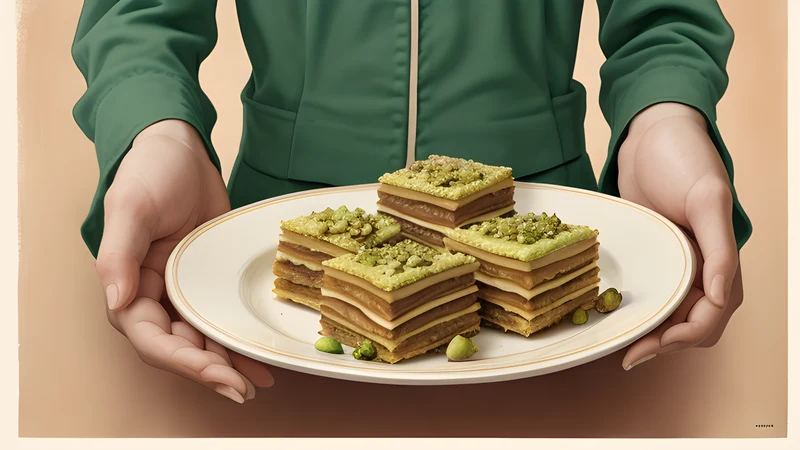
On 17 November each year, pastry shops from Istanbul to Athens to New York mark World Baklava Day, and few sweets carry so much history in so small a diamond. Baklava is tissue-thin pastry, dozens of buttered sheets stacked and filled with ground nuts, baked until brittle and gold, then drenched in syrup or honey while still warm. It is at once a humble street sweet and a dish of imperial pedigree, and the argument over which nation truly owns it is nearly as rich as the pastry itself.
What baklava is
The essential baklava is built from yufka or filo, sheets of unleavened dough rolled and stretched until you can read newsprint through them. A skilled maker will layer forty or more of these sheets in a tray, brushing each with clarified butter, laying in a bed of ground pistachios, walnuts or almonds, then topping with more buttered sheets. Baked slowly, the layers separate into hundreds of crisp leaves. The final act is the syrup, a hot or cold pour of sugar-and-water scented with lemon, rosewater or honey, which soaks into the pastry and sets it into a sweet, dense, shattering block. The cook cuts it into diamonds or squares before baking so the syrup can penetrate every piece.
The balance between crispness and syrup is where baklava is won or lost. Too little syrup and it is dry sawdust; too much and it turns to sodden paste. The best examples, particularly the pistachio baklava of Gaziantep in southern Turkey, achieve a texture that crackles and then dissolves, with the butter and nut flavour surviving the sugar rather than drowning in it.
Where it comes from
The origins of baklava are genuinely disputed, and the dispute is old. Layered dough sweets appear in several ancient traditions, and scholars have variously traced baklava’s ancestry to the Assyrians, who are said to have layered bread dough with nuts and honey; to the Byzantine Greeks, who had their own filo-like pastries; and to the nomadic Turkic peoples of Central Asia, who brought a tradition of thin layered dough west with them. What is clear is that the dish as we now know it was perfected in the kitchens of the Ottoman Empire, and specifically in the vast palace kitchens of Topkapı in Istanbul.
The competing national claims, Turkish, Greek, Armenian, Arab, Persian and more, are less a puzzle to be solved than a map of the Ottoman world, whose borders once contained all of these peoples and whose shared court cuisine they all inherited. Baklava is one of many foods that outlived the empire that spread it, and each successor nation now defends its version as the authentic one. The same pattern of shared heritage and rival ownership runs through neighbouring sweets and dishes, which is why baklava sits so naturally beside food observances like World Hummus Day and International Falafel Day on the calendar.
History in the Ottoman court
Baklava’s grandest moment in history was an annual ceremony rather than a single invention. In the palace kitchens of the Ottoman sultans, baklava was a luxury reserved for the wealthy and for special occasions, its ingredients, butter, sugar, imported nuts, filo made by hand, being far too costly for everyday tables. Each year during Ramadan, on the fifteenth day of the fasting month, the sultan would present trays of baklava to the Janissaries, the elite infantry corps, in a procession known as the Baklava Alayı, the Baklava Regiment or Baklava Procession. Two soldiers from each unit would carry the trays back to their barracks slung on poles, and the ceremony functioned as both a reward and a gauge of the troops’ loyalty; a refusal to accept the baklava was understood as a sign of discontent, even of impending mutiny.
That a single pastry could serve as a political barometer for the most feared soldiers of the age says a great deal about how precious it was. Baklava was court food, festival food, wedding food, and its association with celebration and wealth persists across the whole region to this day.
Why it matters
Baklava matters as a living link to a vanished empire and to the shared table it left behind. It is one of the clearest examples of a food that binds peoples who are otherwise divided by borders, language and history, a common inheritance claimed separately by many. A day devoted to it is partly an excuse to eat something magnificent, and partly a quiet acknowledgement that some of the best things in the world’s kitchens were made by cultures mixing rather than staying apart.
How the day is celebrated
World Baklava Day is marked chiefly by eating, and by the pastry shops that make baklava their life’s work. Turkish, Greek, Armenian, Lebanese and Persian bakeries run promotions, offer tastings, and post cross-sections of their finest trays. Home bakers, the brave ones, attempt filo from scratch or, more sensibly, buy ready-made sheets and try to master the buttering and the syrup. Cultural institutions and restaurants use the day to tell the pastry’s history, and social media fills with the unmistakable amber sheen of freshly syruped diamonds.
Variations across the region
Every baklava-making culture guards its own signature. Turkish baklava, above all the pistachio version from Gaziantep, favours a light syrup and a high ratio of nuts, and it is the benchmark by which many judge the rest. Greek baklava leans heavily on walnuts, cinnamon and honey, giving a darker, spicier, stickier result. Levantine versions come in many shapes beyond the diamond, including the rolled burma and the shredded-pastry cousins. Iranian baklava is often lighter and more perfumed, cut small and scented with rosewater and cardamom. The choice of nut, the sweetener, the spice and the shape together announce a baklava’s homeland before the first bite.
How baklava is made, step by patient step
To understand why baklava commands respect, it helps to know what making it demands. The dough is a simple mix of flour, water and a little oil, but turning it into filo is an art that traditional makers spend years learning. A ball of dough is rolled, dusted with cornflour, stacked, and rolled again, the sheets stretched over a long thin pin until they are almost transparent and wide enough to drape over a table. In Gaziantep, the pistachios are ground from the region’s own small, intensely green nuts, prized above all others, and the butter is clarified so that no water is left to make the pastry soggy. The assembly is meticulous: half the sheets buttered and laid down, the nut layer spread even, the remaining sheets buttered on top, then the whole tray cut into its final diamonds before it ever sees the oven so that the hot syrup, poured over cold pastry or cold syrup over hot pastry, can flood into every cut. The rule that the syrup and the baklava must be at opposite temperatures is one of the craft’s iron laws, and breaking it produces a limp, greasy failure.
Because each step rewards experience and punishes shortcuts, baklava became the province of dedicated pastry houses, some of them family businesses running for generations. The great names of the trade, particularly in Gaziantep and Istanbul, treat their recipes and their sourcing of pistachios as closely guarded assets, and a reputation for baklava can outlast a shop’s founders by a century.
The pastry beyond its homeland
Ottoman migration and the wider Middle Eastern and Mediterranean diasporas carried baklava across the world, so that Greek, Armenian, Turkish and Arab communities now sell it on high streets from Sydney to Toronto. In many Western countries baklava first arrived through immigrant-run delicatessens and Greek restaurants, where it became the default sweet ending to a meze meal. Its long shelf life, a happy consequence of all that sugar, made it a natural export, sold boxed as a gift and shipped across borders. Yet the industrially produced trays sold in supermarkets rarely match the hand-stretched original, and part of the point of a day like this one is to send people towards a proper bakery to taste the difference.
Fun facts
Gaziantep baklava was the first Turkish product to receive European Union protected geographical indication status, in 2013, meaning that only pistachio baklava made in that region to the traditional method may legally be sold as genuine Gaziantep baklava within the EU.
A master baklava maker traditionally aims for around forty sheets of filo in a single tray, each rolled by hand thin enough to see through, which is why serious baklava has long been the work of specialists rather than home cooks.
In the Ottoman court, the annual Baklava Procession doubled as a loyalty test: soldiers who declined their trays were signalling rebellion, so the sweet was, in effect, an instrument of statecraft.
The etymology of the word baklava is itself unsettled, with proposed roots in Mongolian and various Turkic languages, a fitting uncertainty for a pastry whose origins no single nation can prove.
A closing reflection
Baklava is a small, sticky argument about history. Every diamond is claimed by several nations, each certain of its case, and yet the pastry keeps being made the same patient way across all of them: the sheets stretched thin, the butter brushed, the nuts scattered, the syrup poured while it is still warm. World Baklava Day does not settle the quarrel and has no wish to. It simply sets a date to enjoy a thing that so many cultures loved enough to fight over, which may be the highest compliment a food can earn.
Related Content