Vesak (Buddha Day)
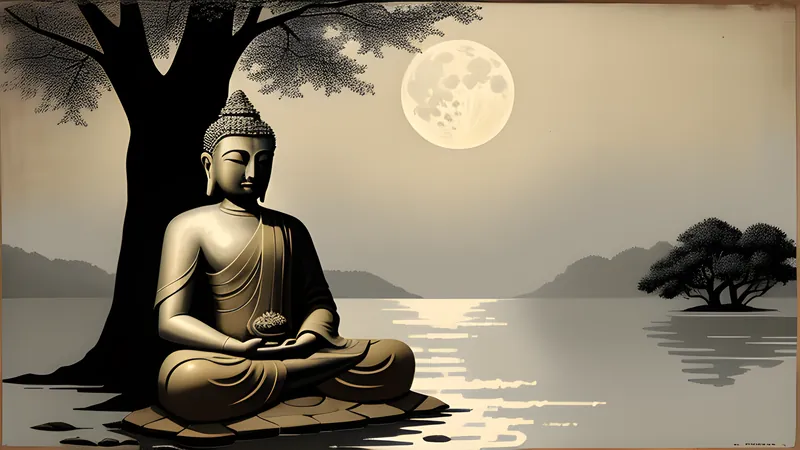
In May 1950, at the first conference of the newly founded World Fellowship of Buddhists in Colombo, delegates from twenty-seven countries agreed to give a single shared name and standing to a festival their traditions had kept separately for over two thousand years. That festival was Vesak — the day on which Theravada Buddhists commemorate three events they hold to have fallen on the same full-moon night: the birth of Siddhartha Gautama, his enlightenment as the Buddha, and his passing into final nirvana. It is the most sacred day of the Buddhist year across South and Southeast Asia, a night of lamps, offerings and quiet resolve, and it moves through the Western calendar because it is fixed to the moon rather than to a numbered date.
Why the Date Moves
Vesak has no fixed place in the Gregorian calendar because it follows a lunar reckoning. The festival falls on the day of the full moon in the lunar month called Vesakha in Pali — Vaisakha in Sanskrit — which corresponds to April or May. In most years this places Vesak in early or mid-May, though it can arrive in late April, and in years with an intercalary “leap month” in the lunisolar calendar it may slip to June. Because different Buddhist countries use slightly different calendrical systems, the exact date is not uniform: Sri Lanka, Thailand, Myanmar and Malaysia may observe it on different days in the same year, and China, Korea and Japan calculate it differently again. The representative date given here stands in for a day that must be recalculated each year against the phases of the moon — the same reason Diwali and Easter Sunday wander across the calendar.
The word “Vesak” is the Sinhala form; the festival travels under many names — Visakha Bucha in Thailand, Waisak in Indonesia, Saga Dawa among Tibetans, and simply Buddha Purnima, “Buddha’s full moon”, across much of India and Nepal.
History and the Three Events
The historical Buddha, Siddhartha Gautama, is generally placed by scholars in the fifth or sixth century BCE, born into the Shakya clan at Lumbini, in what is now southern Nepal. Tradition holds that his mother, Queen Maya, gave birth to him in a grove there while travelling; the site was confirmed as a place of ancient pilgrimage in 1896, when the archaeologist Alois Anton Führer and the Nepalese governor Khadga Shumsher Rana identified a stone pillar erected by the emperor Ashoka in the third century BCE, its inscription recording that Ashoka himself had visited the Buddha’s birthplace. Lumbini remains one of the four great pilgrimage sites of Buddhism and a focus of Vesak devotion.
The second event, the enlightenment, tradition places at Bodh Gaya in the Indian state of Bihar, where Gautama, having abandoned years of extreme asceticism, sat beneath a pipal tree — ever after called the Bodhi tree, the tree of awakening — and resolved not to rise until he had understood the cause of suffering and the way beyond it. He was, by the traditional account, thirty-five. The third event, the parinirvana, is his death at around eighty in the town of Kushinagar, his final release from the cycle of rebirth. That all three should share one full-moon night is a devotional tradition rather than a datable historical fact, and Mahayana traditions in East Asia often commemorate the three events on separate days; the unified observance is chiefly a Theravada inheritance, and it is that version the 1950 conference raised to a shared international feast.
Why It Matters
Vesak concentrates the whole arc of the Buddha’s life — its beginning, its turning point and its end — into a single act of remembrance, and in doing so it reminds practitioners of what the tradition is for. The enlightenment is the pivot: the claim that a human being, unaided by any god, worked his way to a complete understanding of suffering and its ending, and then taught it. To celebrate Vesak is to affirm that the same path remains open, and much of the day’s observance is therefore practical rather than merely festive — an occasion for taking the precepts, meditating, and renewing moral commitments.
In 1999 the United Nations General Assembly formally recognised Vesak, acknowledging the contribution of Buddhism to the world’s spiritual heritage and noting that the day is observed at UN headquarters and offices. That recognition gave a two-and-a-half-thousand-year-old lunar festival a place on the modern international calendar alongside the civil year.
How It Is Celebrated
The dominant practice on Vesak is the making of merit through generosity and restraint. Devout Buddhists rise before dawn to visit the temple, bringing offerings of flowers, candles and incense laid before images of the Buddha — the flowers chosen deliberately, for they wilt within the day and so teach the lesson of impermanence at the heart of the Buddha’s message. Many observe the eight precepts for the day, taking only vegetarian food and abstaining from luxuries. Alms are given to monks, and charitable acts are directed outward: in Sri Lanka the dansala, free food and drink stalls, line the streets, offering meals to any passer-by without charge.
Light is the festival’s signature. Homes and temples are hung with paper lanterns, oil lamps are floated and lit in their thousands, and in Sri Lanka great illuminated pandals — vast painted structures depicting scenes from the Buddha’s past lives — are raised in public squares and strung with coloured bulbs. In Korea, the Lotus Lantern Festival fills Seoul with processions of glowing lanterns shaped like the flower. Another widespread custom is the ceremonial release of caged birds and fish, a gesture of compassion for all living things, though conservationists have raised concerns about the trade in animals it can encourage.
Variations Across the World
The festival’s texture changes with each Buddhist culture. In Thailand, Visakha Bucha is a national holiday marked by the wian tian, a candlelit procession in which worshippers walk three times, clockwise, around the temple’s main hall, once for each of the Three Jewels — the Buddha, his teaching and the monastic community. In Indonesia, Waisak centres on the ninth-century monument of Borobudur in Java, the largest Buddhist temple in the world, where thousands of monks and pilgrims gather and, at the climax, release sky lanterns into the night. Tibetan Buddhists keep the whole lunar month of Saga Dawa as sacred, believing merit made during it is enormously multiplied, and circumambulate holy sites in vast numbers.
In China, Korea and Japan the “Bathing of the Buddha” is central: a small standing statue of the infant Siddhartha, one hand pointing up and one down, is placed in a basin, and devotees ladle scented water over it, re-enacting the legend that the heavens sent down streams of water to wash the newborn. Japan keeps this rite as Hana Matsuri, the Flower Festival, on 8 April by the solar calendar rather than the lunar full moon — one of the clearest signs of how far the observance has diversified.
Symbols and Their Meaning
The lotus is Buddhism’s foremost emblem and never more visible than at Vesak: rooted in mud yet flowering clean above the water, it stands for the mind that rises unstained from a world of suffering. The Bodhi tree, under which the enlightenment came, is honoured directly — the sacred fig at Anuradhapura in Sri Lanka is held to have grown from a cutting of the original tree, brought from Bodh Gaya in the third century BCE, which would make it one of the oldest documented planted trees on earth. The lamp and the candle carry the plainest meaning of all: the light of wisdom dispelling the darkness of ignorance, which is why the festival glows.
Fun Facts
- Vesak commemorates three separate events on one day — birth, enlightenment and death — a compression unique among the major religious festivals, and one that the Mahayana traditions of East Asia frequently spread across the year instead.
- The sacred Bodhi tree at Anuradhapura, grown from a cutting of the Buddha’s own tree of enlightenment and planted around 288 BCE, is among the oldest human-planted trees in the world with a continuous recorded history.
- The whole festival gained a single shared name only in 1950, at the founding conference of the World Fellowship of Buddhists in Colombo — before that, each country kept the day under its own name and reckoning.
- The emperor Ashoka, who ruled most of the Indian subcontinent in the third century BCE, did more than almost anyone to spread the Buddha’s cult, erecting pillars at the holy sites — including the one that fixed Lumbini as the birthplace over two millennia later.
- In Sri Lanka the government traditionally suspends the sale of alcohol and meat for the Vesak holiday, and slaughterhouses close, extending the day’s principle of non-harm to the whole country for its duration.
A Closing Reflection
Most festivals of a founder’s life pick a moment — a birth, a martyrdom, a resurrection — and build the celebration around it. Vesak instead insists on holding the whole life in view at once, and there is a discipline in that. To remember the enlightenment without the death would be to forget that even a Buddha grew old and died; to keep the birth without the awakening would be to celebrate a man rather than what he found. The flowers laid at the shrine wilt by evening, on purpose, and the lamps that blaze so brightly are lit precisely because they will burn down. The festival’s beauty is inseparable from its subject: everything that arises passes, and the only lasting thing on offer is understanding.
Related Content


