US National Vanilla Ice Cream Day
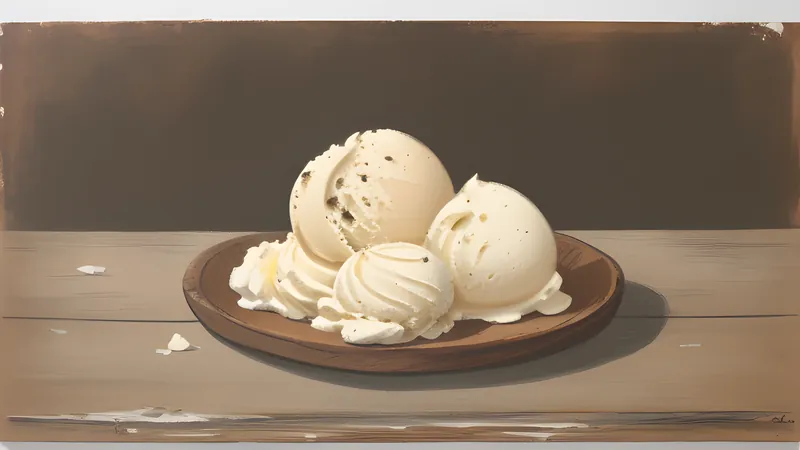
One of only ten recipes surviving in Thomas Jefferson’s own handwriting, now held by the Library of Congress, is for ice cream. It calls for two bottles of good cream, six egg yolks, half a pound of sugar and a stick of vanilla, and it is the first ice cream recipe known to have been written down by an American. Jefferson almost certainly picked it up during his years as minister to France in the 1780s, probably from his butler Adrien Petit. Every 23rd July, US National Vanilla Ice Cream Day honours the flavour at the heart of that document, the one so common that “plain vanilla” became an insult.
Where the day comes from
The modern observance has no recorded founder and no documented reason for its late-July placement, though falling at the height of the American summer is plainly no accident. Rather than fabricate an origin story, it is worth dwelling on what is genuinely known, which is the long and well-attested history of vanilla and of ice cream itself.
History
Chilled and frozen sweets long predate ice cream proper. Persian rulers enjoyed flavoured ices, and snow brought down from the mountains and sweetened was a luxury in several ancient courts. The frozen, churned, milk-based dessert recognisable today emerged in Italy and France in the seventeenth and eighteenth centuries and arrived in colonial America as an aristocratic treat. Jefferson’s recipe sits at exactly that transitional moment, when ice cream was still the preserve of the wealthy who could afford ice, sugar and the labour to make it. Monticello, Jefferson’s estate, had its own ice house, filled with sixty-two wagon-loads of ice cut from the frozen Rivanna River in winter, which let him serve ice cream year-round.
Vanilla’s own story is the longer one. The flavour comes from the cured pods of a Mexican climbing orchid, first cultivated by the Totonac people around Papantla in present-day Veracruz and later prized by the Aztecs, who blended it into a chocolate drink. The Spanish carried it to Europe in the sixteenth century, but the orchid stubbornly refused to fruit outside Mexico, because its natural pollinator did not live elsewhere. For nearly three centuries vanilla stayed rare and ruinously expensive, until 1841, when an enslaved boy named Edmond Albius on the French island of Réunion devised a quick hand-pollination technique that is still used on plantations today. Only then did vanilla become cheap enough to flavour something as everyday as a scoop of ice cream.
The democratisation of ice cream followed the technology. Nancy Johnson patented a hand-cranked freezer in the United States in 1843, and through the later nineteenth century mechanical refrigeration and commercial production turned an aristocratic dessert into a five-cent pleasure. Vanilla, simple to make and agreeable to almost every palate, became the default flavour and the benchmark against which every other was measured.
How ice cream became everyone’s
The leap from Jefferson’s aristocratic dessert to the five-cent cone took roughly a century, and it was driven entirely by the falling cost of cold. In Jefferson’s day, making ice cream meant owning an ice house, packing the mixture in a pewter mould, burying it in a salt-and-ice bath and turning and scraping it by hand for an hour. Ice itself was a luxury good, cut from frozen lakes and rivers in winter and stored under sawdust, and the trade in it was a serious nineteenth-century industry; the “Ice King” Frederic Tudor built a fortune shipping New England lake ice as far as India.
Nancy Johnson’s hand-cranked freezer of 1843 was the first democratising step, replacing the tedious hand-scraping with a paddle and a crank that any household could turn. The arrival of mechanical refrigeration later in the century removed the dependence on natural ice altogether, and commercial production scaled the dessert up. The ice-cream cone, popularised at the 1904 St Louis World’s Fair when a waffle vendor reportedly rolled his wares into cones to help an ice-cream seller who had run out of dishes, made it portable and street-ready. By the early twentieth century ice cream had completed its journey from the tables of presidents to the hand of any child with a nickel, and vanilla, cheap and universally liked, led the way at every stage.
Why it matters
The day rewards a second look because vanilla’s reputation for blandness is unearned. Real vanilla is among the most chemically complex flavourings there is, carrying hundreds of aromatic compounds beyond vanillin itself, which is why a good vanilla ice cream tastes faintly floral, woody and warm rather than merely sweet. The phrase “plain vanilla” entered English to mean standard or unadorned, a slightly unjust fate for a flavour with such depth.
There is a practical reason vanilla matters too: it is the foundation on which the rest of the frozen-dessert world is built. The sundae, the float and the à la mode pairing all depend on a neutral, creamy base that flatters whatever is poured over it, and vanilla plays that role better than anything else.
How it is celebrated
Falling in late July, the day needs little encouragement. Most people simply have a scoop, from a tub at home, a parlour counter or a passing van. The more ambitious churn their own, making a vanilla-infused custard base flecked with the seeds scraped from a split pod. Sundaes, banana splits, floats and milkshakes all feature, and many parlours mark the date with offers. The vanilla scoop is the obvious partner to the shake celebrated on Vanilla Milkshake Day and the broader summer festivities of National Ice Cream Day, and it shares its egg-and-cream base with the denser dessert marked on Vanilla Custard Day.
Variations across the world
The “vanilla” on the label varies more than most people realise. French vanilla is not a bean variety at all but a style, an egg-yolk-rich custard base that gives a deeper, eggier flavour and a yellower colour, exactly the style Jefferson’s recipe describes. American “vanilla” tends to be lighter and whiter, often without yolks. The plainest commercial vanilla may use synthetic vanillin rather than real pods, while a premium scoop will show the dark seeds of genuine Madagascar or Tahitian vanilla, the latter prized for its more floral, anise-like note. Madagascar now produces the majority of the world’s natural vanilla, all of it pollinated by hand.
The texture of the scoop varies as much as its flavour. American premium ice cream is dense, with relatively little air whipped in, while cheaper “economy” ice cream can be nearly half air by volume, the inflation that lets a manufacturer sell less product in a larger tub. Italian gelato, by contrast, is churned slowly with less fat and less air and served warmer, which is why it tastes more intensely of its flavour and feels softer on the tongue. The French glace, built on a cooked custard, is closer to Jefferson’s eggy original. Each of these is a different answer to the same question of how much air, fat and egg a frozen cream should carry, and a vanilla base is the fairest test of all of them, because it hides nothing.
Traditions and symbols
The cone and the scoop are the universal emblems of ice cream, and vanilla’s pale, creamy colour, sometimes speckled with dark seed, is instantly read as the classic. Its long-standing role as the default flavour has made it a symbol of comfort and childhood summers, while its neutrality made it the natural canvas of the sundae.
Fun facts
- Thomas Jefferson’s handwritten vanilla ice cream recipe is one of only ten recipes surviving in his hand and is the earliest known ice cream recipe written by an American.
- Monticello’s ice house held sixty-two wagon-loads of ice cut from the Rivanna River, which let Jefferson serve ice cream in any season.
- “French vanilla” describes a method, not a bean: it means an egg-yolk custard base, which is why it tastes richer and looks more yellow than plain vanilla.
- Real vanilla carries hundreds of aromatic compounds beyond vanillin, which is why it tastes floral and complex rather than simply sweet.
- The orchid that produces vanilla was so hard to fruit outside Mexico that for almost three hundred years no one could grow it commercially elsewhere, despite repeated attempts in European greenhouses.
- Cheap “economy” ice cream can be close to half air by volume, which is how a maker fits less product into a bigger-looking tub.
A closing reflection
There is a small irony in a nation’s first written ice cream recipe being the one flavour later generations would dismiss as boring. Vanilla earned its ubiquity honestly, by being genuinely good and endlessly accommodating, and the contempt baked into “plain vanilla” says more about how we treat the familiar than about the thing itself. A scoop on a hot July afternoon is, quietly, a taste of a Mexican orchid, an enslaved boy’s ingenuity on a distant island and a president’s French dinners, all folded into something a child can buy with loose change. Few everyday pleasures carry so long a history so lightly.
Related Content


