US National Spaghetti Day
Around 1154, an Arab geographer named Muhammad al-Idrisi, working at the court of King Roger II of Sicily, described a town near Palermo called Trabia where workers made a food of flour shaped into long strings, dried in the sun, and shipped out by the boatload to Calabria and beyond. He called it itriyya. It is the earliest clear documentary record of an industry built on dried, string-shaped pasta — the direct ancestor of the bowl of spaghetti that the United States stops to celebrate every 4 January. National Spaghetti Day has no founder and no institution behind it, but the food it honours has a paper trail that runs back the better part of nine hundred years.
Where the day came from
The day belongs to the sprawling, unofficial family of American “national food days,” most of which appeared in the late twentieth century with no charter, no committee and no traceable origin. National Spaghetti Day is no exception: no person or organisation can be reliably credited with founding it, and it survives entirely on the enthusiasm of restaurants, home cooks and recipe sites. Its placement is the one shrewd thing about it. Dropping the date into early January, when the festive excess has passed and a cheap, warming, carbohydrate-heavy supper is exactly what most households want, all but guarantees the day a willing audience.
A history that predates Italy as a nation
Spaghetti’s own history is far older and better evidenced than the day’s. The popular tale that Marco Polo carried noodles back from China in 1295 is a fiction; it appears to originate in a 1929 article in an American trade magazine, The Macaroni Journal, and has no support in Polo’s actual writings, which mention pasta only as something already familiar in Italy. The real story runs through Sicily. Between roughly 831 and 1091 the island was under Arab rule, and the newcomers brought both durum wheat — a hard, high-gluten wheat that thrives in a hot, dry climate — and the technique of drying pasta so that it would keep for months at sea. Al-Idrisi’s account of Trabia describes that trade already running at scale by the middle of the twelfth century.
Durum was the key. Its high protein content lets dried pasta hold its shape and bite, which softer bread wheats cannot manage. As the technology spread up the peninsula, Naples emerged as the great centre of production: the city’s combination of sea breeze and sunshine was ideal for air-drying, and by the seventeenth century mechanised presses had turned pasta from a luxury into the everyday food of the Neapolitan poor, who ate it from street stalls with their fingers. The marriage with tomato came later still. The tomato reached Europe from the Americas in the sixteenth century and was long treated with suspicion as possibly poisonous; only in the late eighteenth and nineteenth centuries did southern Italian cooks fold it into a sauce, creating the red-on-gold combination now taken for granted.
How spaghetti became American
Spaghetti crossed the Atlantic with the great wave of Italian, and especially southern Italian, emigration between roughly 1880 and 1920. The immigrants who arrived in New York, Boston and the mill towns of the north-east could no longer grow their own food as they had in the old country; they bought it, and in America meat was cheaper and more plentiful than almost anywhere in the Mediterranean. A cuisine that had been heavy on vegetables and grain and light on protein grew meatier, saucier and larger.
Out of that shift came spaghetti and meatballs — a dish far more common in America than in Italy, where meatballs (polpette) are usually eaten on their own rather than perched on pasta. The combination was cemented in the American imagination by mass production. Ettore Boiardi, a chef from Piacenza who anglicised his name to Hector Boyardee for the label, sold his first ready-to-heat spaghetti kit in 1928 from his Cleveland restaurant; canned meatball spaghetti followed in the 1940s, and Campbell’s introduced the ring-shaped Franco-American SpaghettiOs in 1965. By mid-century spaghetti had shed any trace of the exotic and become a fixture of school canteens, church suppers and weeknight kitchens.
Why a humble noodle is worth a day
The case for celebrating spaghetti is the case for celebrating any food that travelled far and changed at every border. It is a study in how cuisine actually evolves — by migration, substitution and adaptation rather than by preservation. The same story underlies a great deal of what gets a date on the food calendar, much as the Mediterranean staple honoured on Extra Virgin Olive Oil Day carries its own long history of trade, technique and regional pride. Spaghetti also rewards the cook who respects it: a dish of so few ingredients exposes every shortcut, which is why a properly salted pot of water and pasta pulled from the heat while still firm to the bite matters more than any elaborate sauce.
How it is cooked and eaten
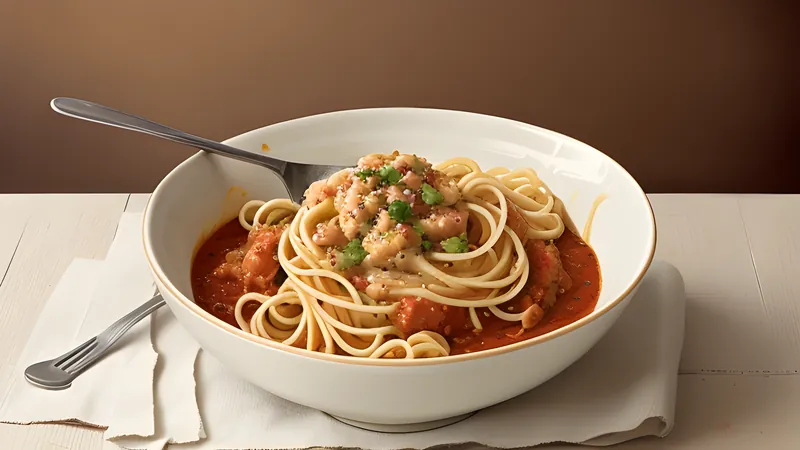
The American way with spaghetti runs from the reverent to the cheerfully unrepentant. Some cooks keep to a Neapolitan simplicity — good tomatoes, garlic, basil, olive oil — while others reach for long-simmered meat ragùs, garlicky aglio e olio, creamy carbonara or sauces piled with clams and prawns. The one principle most Italian cooks would insist on is finishing the pasta in the sauce rather than drowning a separate heap of noodles, so that the starchy water clinging to the strands binds everything into a single glossy whole. The pasta is also pulled from the pot a shade before it is fully soft, al dente, both for the pleasure of the bite and because it will keep cooking in the hot sauce. The traditional Italian rule is that long pasta is twirled against the bowl with a fork alone, the spoon being regarded in Italy as a crutch for children; American diners have largely ignored the instruction and twirl as they please. The convivial, low-fuss nature of the meal is much of its appeal, the kind of shared table that turns up across the calendar, ending as often as not with something cold and sweet of the sort marked on National Ice Cream Day.
The same noodle, reinvented everywhere
Because spaghetti is nothing more than wheat and water, it absorbs the flavours of wherever it lands. The Philippines makes a famously sweet version, sauced with banana ketchup and sliced hot dogs, beloved at children’s parties — a taste that took hold partly because cane sugar was cheap and local while tomatoes were not. Japan invented wafu pasta, dressing spaghetti with soy sauce, butter, mushrooms, cod roe or strips of nori, and Tokyo even has dishes like napolitan, a ketchup-based spaghetti born in a Yokohama hotel after the Second World War. In the United States itself, Cincinnati layers thin spaghetti with a cinnamon-and-cocoa-spiced chilli to make its singular “Cincinnati chili,” served in precise configurations its devotees number “three-way” to “five-way.” None of these would be recognised in Naples, and all of them are unmistakably spaghetti — the proof of a food generous enough to be made local anywhere it travels.
Fun facts
- On 1 April 1957 the BBC current-affairs programme Panorama broadcast a three-minute report, narrated by the trusted broadcaster Richard Dimbleby, showing a Swiss family in Ticino harvesting spaghetti from trees after the near-disappearance of the “spaghetti weevil.” With pasta still unfamiliar in 1950s Britain, an estimated eight million viewers watched, and many telephoned the next day to ask how to grow their own; the BBC advised them to place a sprig in a tin of tomato sauce and hope for the best.
- The “Marco Polo brought pasta from China” story is traceable to a 1929 piece in an American trade publication, The Macaroni Journal, and has no basis in Polo’s own account, which already treats pasta as Italian.
- Spaghetti and meatballs is essentially an American invention; in Italy meatballs are usually served as a separate course, not heaped on pasta.
- The word spaghetti is the diminutive plural of spago, “string” or “twine,” so the name means, almost exactly, “little strings.”
- Whether it is acceptable to snap dry spaghetti in half before cooking remains a genuine point of contention; the late chef and broadcaster Antonio Carluccio counted it among the cardinal sins of the Italian kitchen.
A closing reflection
There is a quiet lesson in a food this widely loved having no single homeland and no inventor anyone can name. The dried strings of Arab Sicily, the drying yards of Naples, the immigrants who swapped vegetables for meatballs, the Filipino party table and the Japanese diner all have an equal claim, and none of them owns it. To cook a pot of spaghetti on 4 January is to take part, without ceremony, in something that has been crossing borders and changing its mind for the better part of a millennium — and to discover that the most travelled food in the world still tastes like home.
Related Content