US National Pecan Torte Day
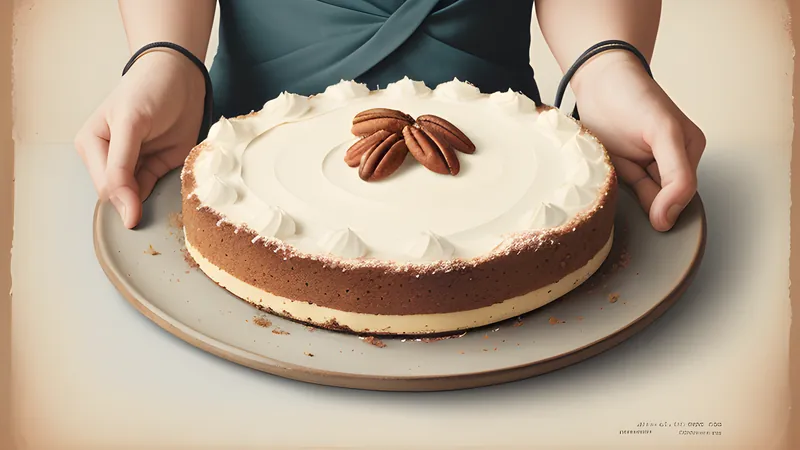
In 1832, a sixteen-year-old apprentice named Franz Sacher was left to improvise a dessert for Prince Klemens von Metternich’s guests in Vienna when the head chef fell ill, and the chocolate cake he produced became the Sachertorte. That moment sits at the head of a long European lineage of dense, nut-rich cakes, and US National Pecan Torte Day, observed each 22 August, marks what happens when that Old World craft is built around a nut the Old World never had: the North American pecan.
What a torte actually is
The distinction between a torte and an ordinary cake is the whole point of the day, and it is precise rather than vague. The word entered English around 1748, from the German Torte, which traces back to Late Latin torta, a flat, round loaf. A torte uses ground nuts, or sometimes breadcrumbs, in place of much or all of the flour, which gives it a dense, moist, flatter profile that rises little in the oven and is usually built up in layers with jam, buttercream or ganache. Where a sponge depends on flour and air, a torte depends on nuts and eggs.
The European pedigree
The torte is a creature of the Austro-Hungarian Empire and its neighbours, refined between the seventeenth and early twentieth centuries. The oldest documented cake recipe in the world is generally held to be the Linzer torte, with four recipes appearing in a 1653 manuscript attributed to Countess Anna Margarita Sagramosa, now held in the museum at Linz; its lattice of ground-almond pastry over jam is, in effect, a torte several decades older than the city it is named for can prove. The Sachertorte followed in Vienna in 1832. The Dobos torte was created by the Budapest delicatessen owner József Dobos (1847–1924) and unveiled in 1885 at the National General Exhibition in Budapest, where he showed it from an elaborate pavilion. He had wanted a cake that would keep for days in an age before domestic refrigeration, and his answer, thin sponge layered with chocolate buttercream and sealed under a lid of hard caramel, did exactly that. Emperor Franz Joseph I and Empress Elisabeth were among the first to taste it, and Dobos was duly appointed a purveyor to the imperial court. Its sides were finished with ground hazelnuts, chestnuts, walnuts or almonds. These were the templates: layered, nut-bound, unmistakably Central European.
How the pecan entered the picture
The pecan is native to the south-central United States and northern Mexico, an Indigenous staple long before Europeans arrived; the name comes from the Algonquian pakani, a word for a nut that needs a stone to crack. It became a viable orchard crop only after Antoine, an enslaved gardener at the Oak Alley plantation in Louisiana, successfully grafted a superior wild variety onto seedlings in 1846. The resulting tree, later named “Centennial”, won recognition at the 1876 Philadelphia Centennial Exposition, and grafting at last allowed growers to reproduce a good pecan reliably rather than gambling on seedlings.
When Central European immigrants brought their nut-torte traditions to America and met this abundant local nut, the substitution was obvious. The great waves of German, Austrian and Hungarian migration through the nineteenth and early twentieth centuries carried Torte recipes into the bakeries of cities such as Milwaukee, Cincinnati and New York, and the cooks who held them found ground almonds and hazelnuts expensive and imported while pecans were cheap and local. Recipes that had called for ground almonds could be made instead with ground pecans, whose high oil content, the highest of any major nut, suited the dense, moist torte crumb beautifully and gave it a buttery depth the original lacked. The pecan torte is therefore a genuine fusion: a Viennese technique rebuilt around an American ingredient, and a tidy illustration of how immigrant baking adapts to whatever the new country grows.
Why the day matters
The day’s real value is that it honours a process rather than a single recipe. A pecan torte cannot exist without both halves of its story, the European method and the American nut, and celebrating it is a small acknowledgement of how cuisines actually evolve through migration and substitution rather than through invention from nothing. There is a practical side too: tortes built almost entirely on ground pecans contain little or no flour, which makes them naturally suited to those avoiding wheat, long before “gluten-free” became a marketing category.
How it is celebrated
On 22 August, ambitious home bakers take on a multi-layered torte, grinding pecans into the batter and finishing the cake with buttercream, ganache or a simple dusting of icing sugar, while less ambitious celebrants seek one out from a bakery. Because a torte is rich and meant for sharing, the day lends itself to coffee mornings and afternoon teas, and elegant photographs of finished cakes circulate online.
The Central European ritual around such cakes is worth borrowing for the day. In Vienna and Budapest the torte belongs to the café rather than the home: it is ordered by the slice with a strong coffee in the afternoon, eaten slowly, and treated as an occasion in itself rather than the end of a meal. Grinding the pecans is the one step that rewards care, because a torte made with nuts ground too coarsely turns heavy and damp while over-ground nuts release their oil and clog into a paste; the texture wanted is closer to fine meal than to flour. Many cooks toast the pecans lightly first to deepen the flavour, then cool them fully before grinding so the heat does not turn them oily. Finished plainly with a dusting of icing sugar or richly with a chocolate glaze, the cake is meant to be admired, sliced thin and lingered over, which makes a late-summer afternoon a fitting time to make one.
A baker’s note on structure
The technique that makes a torte work is the handling of eggs. Many recipes whip the whites separately and fold them in to provide lift where flour would normally do the job, while butter and sugar carry the richness and finely ground pecans give body and flavour. The result is a crumb that is dense and faintly fudgy rather than springy. A torte forgives a less confident hand than a delicate sponge does, but it punishes overmixing once the whites are in, so a gentle fold is the one piece of discipline the cake demands.
Anyone drawn to this kind of nut baking will find natural companions in National Pecan Pie Day and National Pecan Cookie Day, which take the same crop in completely different directions, and a useful contrast in National Coconut Torte Day, where a different ingredient sits inside the same European framework.
The torte as a keeping cake
One quality the pecan torte inherits from its Central European parents is durability, and it is easy to miss. Dobos built his cake to survive days without refrigeration, and a nut torte shares that virtue: the oil in the ground pecans keeps the crumb moist long after a flour sponge would have gone dry, and the dense structure actually improves over a day or two as the flavours settle and any soaking syrup or liqueur works through. This made the torte a natural celebration cake in households that baked ahead for a Sunday, a name day or a holiday, and it explains why so many pecan-torte recipes are family heirlooms passed down with a note to make it the day before. A cake that tastes better for waiting is a rare and useful thing, and it is one of the quieter reasons the form endured the crossing to America at all.
Fun facts
- The oldest documented cake recipe in the world is widely held to be the Linzer torte, recorded in a 1653 manuscript attributed to Countess Anna Margarita Sagramosa.
- The Sachertorte was improvised in 1832 by a sixteen-year-old apprentice, Franz Sacher, when the senior chef fell ill before a dinner for Prince Metternich.
- A torte is defined by using ground nuts or breadcrumbs in place of much of the flour, which is why it stays dense and flat rather than rising like a sponge.
- The word “torte” derives, via German, from the Late Latin torta, meaning a flat, round loaf of bread.
- The pecan is the only major tree nut native to North America, making the pecan torte a true marriage of European method and American ingredient.
A closing reflection
A pecan torte is what happens when a recipe crosses an ocean and finds the nearest equivalent ingredient waiting on the other side. The cake is not a copy of its Viennese ancestors and not an American invention either, but something that could only have come from the meeting of the two. On 22 August, a dense, fragrant slice of it is a reminder that some of the best things on a table are the result of necessary improvisation rather than design.
Related Content


