Thai Songkran
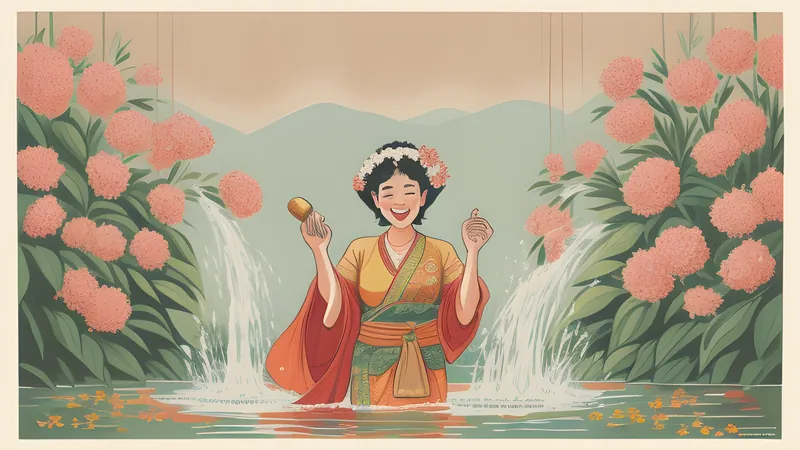
In December 2023, in the unlikely setting of Kasane, a town on the edge of the Okavango Delta in Botswana, a UNESCO committee added a new entry to its Representative List of the Intangible Cultural Heritage of Humanity: “Songkran in Thailand, traditional Thai New Year festival”. The listing was the formal world recognising what April in Thailand has always made obvious. Beginning each year on 13 April, as the hottest stretch of the Thai calendar arrives, the country answers the heat with water — poured reverently over Buddha images and the hands of elders in the temples, and hurled with buckets, hoses and pump-action water guns in what has become the largest water fight on earth.
What the name means
The word Songkran comes from the Sanskrit saṃkrānti, meaning a “passage” or “movement” — specifically the sun’s transit from one sign of the zodiac to the next. Songkran marks the moment the sun moves into Mesha, the constellation the Western tradition calls Aries, the start of the solar new year in a reckoning shared across South and Southeast Asia. This astrological root is why the festival falls in mid-April rather than at the Western New Year, and why its closest cousins are found in the new-year water festivals of neighbouring countries. Water itself does triple duty: it cleanses, it offers real relief from the April heat, and it carries away the misfortune of the year just ended.
From the Khmer Empire to the modern calendar
Songkran’s lineage is long and tangled. The astrological new-year reckoning was adopted into the region by the Khmer Empire, which ruled much of present-day Thailand around the eleventh century, and the festival was woven into Thai Buddhist practice over the centuries that followed. For most of that history it was the Thai New Year in the full civic sense. That changed under modernisation: King Chulalongkorn, Rama V, shifted the official new year to 1 April in 1889, and in 1941 the government of Field Marshal Plaek Phibunsongkhram moved it again to 1 January to align Thailand with the Gregorian calendar used abroad. Songkran lost its status as the formal start of the year but kept its emotional one. It remained the festival families actually observed, the true turning of the seasons, which is why it endures as a national holiday while 1 January passes with comparatively little ceremony.
Why it matters
Songkran is the most important holiday in the Thai calendar, the occasion when ordinary life pauses and the country comes home. Workers who have migrated to Bangkok and other cities return in their millions to their home provinces, making the days around 13 April among the busiest travel periods of the year. Beneath the spectacle, the festival is built on respect and renewal: paying homage to the Buddha, showing gratitude to parents and grandparents, and entering the new year with a clean slate. The pouring of water, whether a few ceremonial drops or a full bucket, is at heart a single gesture repeated endlessly — a wish for someone else’s blessing.
It also functions, in a society where deference to age and seniority is deeply embedded, as a rare licensed inversion. For a few days the ordinary rules relax: a junior may soak a senior, a stranger may drench a stranger, and the elaborate social hierarchy that governs everyday Thai life is suspended in the egalitarian chaos of the street. That this release sits directly alongside the festival’s most formal gesture of respect — the careful pouring of water over an elder’s hands — is not a contradiction so much as the whole point. Songkran lets a culture express reverence and irreverence in the same breath, and trusts its people to know which is which.
How it is celebrated
The day moves between temple and street. In the mornings, people bring food to monks and visit temples to bathe Buddha statues in fragrant water. A tender custom called rod nam dam hua sees the young pour scented water over the upturned palms of their elders while offering good wishes and receiving blessings in return. Once these observances are honoured, the streets take over. Revellers of every age arm themselves with water guns and buckets, and no passer-by, monk or tourist is reliably safe. A chalky white paste, din sor pong, is smeared on faces and shoulders as a further mark of blessing, and music carries the soaking, laughing crowds late into the day.
The water itself is meant to be gentle. In its original form, Songkran water was lightly scented with jasmine or other fragrant flowers, sometimes mixed with a little Thai perfume called nam ob, and poured rather than thrown — a delicate gesture, not a deluge. The modern arms race of high-pressure water cannons and ice-cold buckets is a relatively recent escalation, and one that older Thais and the authorities regard with some ambivalence. In recent years the festival has acquired a darker statistic: the days around Songkran are consistently among the deadliest on Thai roads, as the combination of mass travel, alcohol and slippery, water-soaked streets pushes the accident toll sharply upward, prompting annual safety campaigns under the grim nickname “the seven dangerous days”.
This holding-together of the sacred and the joyful is not unique to Thailand, but Songkran does it at extraordinary scale, and it shares with festivals like International Mother Language Day a determination to keep cultural inheritance alive in living practice rather than in museums — a determination the UNESCO World Radio Day tradition of safeguarding shared heritage echoes from a different angle.
Symbols and quieter customs
Beyond the water, Songkran carries a set of gentler rituals. Houses are scrubbed clean before the new year to clear out the old and make room for fortune. Releasing captive fish or birds is regarded as merit-making. At temples, people build small sand pagodas decorated with colourful flags, a way of symbolically returning the earth carried away on the soles of their feet over the past year. Garlands of jasmine and marigold scent the air. Each of these customs reinforces the festival’s underlying logic of renewal, the same logic that turns the splash of a water gun into something more than mischief.
The sand-pagoda custom repays a closer look, because it captures the festival’s quietly practical morality. Over a year of visits, worshippers were thought to carry away grains of temple sand on their feet, a small but real loss to the monastery grounds. Building pagodas of fresh sand at Songkran, and decorating them with little coloured flags and offerings, repays that debt and earns merit at the same time — an act of accounting dressed as devotion. Likewise the bathing of Buddha images is not mere cleaning: the scented water, once poured, is sometimes collected and gently applied by worshippers to themselves or their families, transferring the blessing from the sacred figure outward. The logic that runs through all of it is reciprocity, the sense that a blessing received should be passed on.
Regional and global variations
The new-year water festival is shared across mainland Southeast Asia in related forms. Cambodia celebrates Choul Chnam Thmey, Laos has Pi Mai, and Myanmar marks Thingyan, each with its own name, customs and emphases, all descended from the same astrological reckoning of the sun’s passage. This shared inheritance is also a source of friction: when Thailand secured its UNESCO listing in 2023, the question of who could claim the tradition surfaced again, and Cambodia later pursued its own inscription, with both governments at pains to stress the heritage need not belong to any single country. Within Thailand, Chiang Mai in the north stages the most famous and prolonged celebrations, its old city moat becoming an enormous reservoir of ammunition for days on end, with festivities that routinely run well beyond the official three days. Wherever sizeable Thai communities have settled abroad, from Los Angeles to London, Songkran water festivals have followed, and the image of a street awash with water and laughter has become one of Thailand’s most recognisable cultural exports — and, for the tourism industry, one of its most valuable.
Fun facts
- Songkran was inscribed on UNESCO’s Representative List of the Intangible Cultural Heritage of Humanity on 6 December 2023, at a committee session held in Kasane, Botswana.
- Songkran was Thailand’s official New Year until 1889, when King Chulalongkorn moved the date to 1 April; it shifted again to 1 January in 1941.
- The name derives from the Sanskrit saṃkrānti, the “passage” of the sun into a new zodiac sign, and the festival was absorbed into the region via the Khmer Empire around the eleventh century.
- April is the hottest month of the Thai year, which makes a nationwide water fight not just festive but genuinely cooling relief.
- The white paste smeared on faces, din sor pong, is the same chalky clay traditionally used as a protective and cosmetic powder, repurposed here as a blessing.
A closing reflection
There is a quiet wisdom in a culture that meets its most punishing weather not with complaint but with a national game of soaking one another. Songkran holds two impulses in the same open hand — the solemn drop of water poured over a grandparent’s palms, and the gleeful bucketful flung from the back of a passing pickup — and insists they are the same gesture. To pour water on someone is to wish them well. Repeated millions of times across a few sun-bright April days, that small act becomes something larger: an entire country, dripping and grinning, agreeing to begin again.
Related Content