Swedish Lucia Day
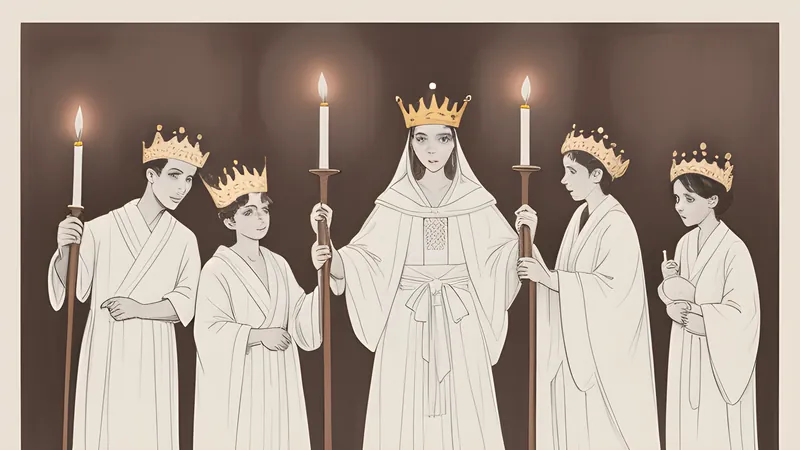
On a December morning in central Stockholm in 1928, a young woman named Solveig Hedengran was crowned the city’s Lucia, the first to hold the title, having won a competition run by the newspaper Stockholms Dagblad against some two hundred other entrants. That contest, more than any saint or any medieval custom, gave Sweden the Lucia it celebrates today. Each year on 13 December, in the dark heart of the Nordic winter when daylight in much of the country lasts only a few pale hours, a procession of figures in white glides through schools, churches and offices, led by a young woman wearing a crown of living flame. The soft singing, the scent of saffron buns and warm glögg, and the flicker of candlelight against the black morning give the day a quiet, almost reverent beauty.
Where the day comes from
The day takes its name from Saint Lucia of Syracuse, a Christian martyr who, according to tradition, died in Sicily in the early fourth century, around the year 304. Her name derives from the Latin lux, meaning light, which made her an apt patron for a festival of brightness. How a Sicilian saint came to be honoured so warmly in Lutheran Scandinavia is not a clean, single story, and historians are honest about the gaps. What is certain is that her feast day fell, under the old Julian calendar, very close to the winter solstice, on what was then reckoned the longest night of the year, so the association with light had a real astronomical anchor before it ever acquired a candlelit crown.
There were also older, darker Swedish traditions clustered around this date. Folklore spoke of Lussinatt, Lucy’s Night, a night when supernatural beings were thought to roam abroad and when it was prudent to stay awake, eat well and keep the fires lit until dawn. The wakeful, food-laden, light-against-darkness character of the modern celebration owes at least as much to these pre-Christian midwinter anxieties as to the Sicilian martyr whose name it borrows.
How the modern ritual was made
The Lucia procession most Swedes would recognise is surprisingly young. The white-clad bringer of light took its organised, public shape only gradually, with documented processions appearing first in grander households and then spilling into public life across the nineteenth and early twentieth centuries. The decisive moment was commercial and journalistic rather than religious. Inspired by a Lucia procession staged by Stockholm’s merchant street associations in 1927, the newspaper Stockholms Dagblad decided to crown a Lucia for the capital, and in 1928 it ran the competition that Solveig Hedengran won. The following year the paper introduced reader voting, and Gudrun Jern was chosen.
From that single newspaper stunt the standardised celebration spread with remarkable speed. By the middle of the twentieth century the procession had reached, in one form or another, virtually every Swedish school, workplace, church, hospital and retirement home. A folk observance with patchy and contested origins had been given a fixed, repeatable shape by a media competition, and the nation adopted it wholesale.
Why it matters
For most Swedes, Lucia is less a strictly religious observance than a shared cultural moment that binds communities at the bleakest point of the year. It marks the slow turning toward the festive season, a collective decision to meet the darkness with warmth rather than retreat from it. The image of one light leading others through the night carries a gentle symbolic weight that reaches well beyond any single faith. That instinct, to answer winter with brightness and shared food, runs through the whole Swedish calendar, surfacing again in the candle-and-cake gatherings of Swedish National Cinnamon Bun Day and the chocolate comfort of Swedish National Mud Cake Day, each a small ritual of fika built against the cold.
How it is celebrated
The classic procession is led by a girl chosen to portray Lucia, wearing a white gown tied with a red sash and a crown of candles, increasingly electric ones for the obvious safety reasons. Behind her walk her attendants: more white-gowned figures, the tärnor, each carrying a single candle; stjärngossar, or star boys, in tall conical hats decorated with stars; and, for the youngest, children dressed as gingerbread figures or small tomtar, the household elves of Swedish folklore. They sing the Lucia song, set to a Neapolitan melody, along with other carols. Processions begin in the early morning while it is still pitch dark outside, which is precisely the point, since the whole composition is built to be seen against blackness.
The celebration is also a public competition in many towns, with a regional or national Lucia chosen and the larger processions televised. Becoming the local Lucia is a genuine honour, and the contests, descended directly from that first 1928 vote, keep the day faintly competitive even now. In recent decades those contests have also become a quiet arena for debate about who may represent Lucia, as schools and broadcasters have moved away from the old expectation of a fair-haired girl and opened the role to children of any appearance, and sometimes to boys, a shift that says as much about modern Sweden as the candlelit procession itself says about the old one.
The song that crossed a continent
The melody the processions sing is, improbably, a Neapolitan boat song. The tune now known across Scandinavia as Sankta Lucia began as Santa Lucia, a barcarolle that Teodoro Cottrau published in Naples in 1849, its original words celebrating not a martyr but a fisherman admiring the beauty of the Santa Lucia waterfront. The Swedish education minister, poet and composer Gunnar Wennerberg heard the melody on a visit to Italy in the mid-nineteenth century and carried it home, and in 1919 Sigrid Elmblad fitted Swedish lyrics to Cottrau’s tune. From that grafting came the Luciasången that schoolchildren still sing. Several Swedish versions now coexist, including the older Natten går tunga fjät, “the night walks with heavy steps”, and a gentler 1970s nursery version, Ute är mörkt och kallt, “outside it is dark and cold”, written for the very youngest singers.
That a song about a sunlit southern harbour should become the anthem of the darkest Nordic morning is a small marvel of cultural transplantation, and almost nobody singing it on 13 December gives the Bay of Naples a thought.
Food and symbols
Food is central. Saffron-rich lussekatter, the golden S-shaped buns studded with a raisin in the eye of each spiral, are baked in great quantity, alongside the spiced gingerbread biscuits known as pepparkakor. The saffron is no accident: it tints the dough the colour of light itself, a small edible echo of the day’s whole theme, and that symbolism runs deeper than mere prettiness. The buns are thought to have been modelled on a curled, sleeping cat, an animal once linked in folklore to the devil, and an older, blunter name for them was djävulskatter, devil’s cats. The golden saffron, associated with the sun, was believed to keep the light-fearing devil at bay, so the polite modern name, lussekatter, Lucia’s cats, papers over a frankly apotropaic origin. The buns are shared with glögg, mulled and spiced wine, for adults, and warm drinks for children. The candle crown remains the defining emblem, while white and red signify purity and the saint’s martyrdom. Every element is arranged to be legible in darkness, so that the light itself becomes the message.
Around the Nordic world and beyond
Although most associated with Sweden, Lucia is kept across the Nordic region, in Norway, Denmark and Finland, and the saint’s cult endures in parts of Italy, above all in her native Syracuse, where the celebration is older and more overtly religious than its Scandinavian cousin. Swedish communities abroad carry the day with them, exporting the saffron buns and candlelit songs to far warmer climates where the symbolism of light against winter must be taken on trust. Each place inflects the day with its own emphasis, but the essential gesture, lighting a path through the dark, travels everywhere intact.
Fun facts
- The modern Swedish Lucia tradition was effectively launched by a newspaper, Stockholms Dagblad, which crowned the first Stockholm Lucia, Solveig Hedengran, in 1928 after a contest involving around two hundred girls.
- Saint Lucia’s name comes from the Latin lux, light, and her feast once fell on what the old Julian calendar reckoned as the longest night of the year.
- An older Swedish tradition called the date Lussinatt and held it to be a night when supernatural beings roamed, when one should stay awake and keep the fires burning.
- Lussekatter are coloured with saffron not only for flavour but so the buns themselves glow gold, mirroring the day’s theme of light.
- Real candle crowns are now usually replaced by electric ones in crowded halls, a sensible concession that purists still quietly mourn.
A closing reflection
It is faintly remarkable that a tradition Swedes treat as ancient and almost sacred was, in its current form, set in motion by a newspaper competition fewer than a hundred years ago. But that is no diminishment. The day works because it answers something real, the human impulse to kindle light precisely when the world feels darkest, and it scarcely matters whether the impulse was inherited from a Sicilian martyr, a pagan midwinter dread, or a clever editor in 1928. In a single candlelit figure moving slowly through a shadowed room, all three meet.
Related Content