Samhain
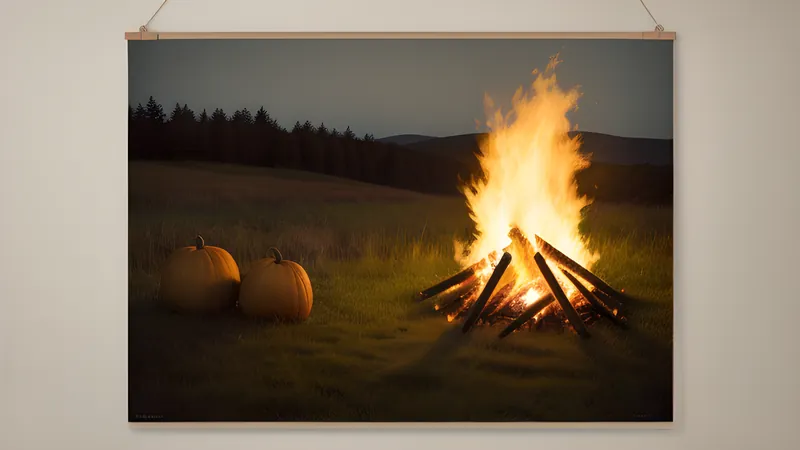
At the Hill of Tlachtga in County Meath, archaeologists have excavated a vast circular enclosure — over 150 metres across, built in overlapping phases from the late Iron Age onward — that local tradition and a body of early Irish literature link to a great fire assembly held each year as summer gave way to winter. The medieval texts call that turning point Samhain, and place a royal gathering and ritual bonfire there under the authority of the kings of Munster and later the High Kings at nearby Tara. Whatever the precise ceremonies performed on that hilltop two thousand years ago, the date they were tied to — 1 November, with the festival beginning at sunset on 31 October — has never gone out of use. It descends, by a long and well-documented route through medieval Ireland, the Christian calendar and nineteenth-century Irish emigration to America, into the Halloween kept across the world today.
The End of the Gaelic Summer
Samhain (from Old Irish, pronounced roughly “SOW-in”) is one of the four great quarter-day festivals of the medieval Gaelic year, alongside Imbolc on 1 February, Beltane on 1 May and Lughnasadh on 1 August, each marking a turning point in the pastoral calendar rather than an astronomical solstice or equinox. The word itself is generally taken to mean “summer’s end,” and the earliest Irish sources treat it as exactly that: the day cattle were brought down from summer pasture and either slaughtered for winter stores or sheltered for the cold months, the point at which the agricultural year’s accounts were settled and the harvest work was declared finished. The ninth-century tale Tochmarc Emire lists Samhain among the four festivals the hero Cú Chulainn must observe, describing it as a time when “the summer goes to its rest.” Unlike Christmas or Easter, Samhain’s date was never fixed by astronomical calculation; it simply marked the practical, lived boundary between one season’s work and the next.
A Day Outside Ordinary Time
What distinguishes Samhain most sharply in the medieval Irish sources is the belief that on this one night the boundary between the human world and the Otherworld grew unusually thin. Early texts describe the sídhe, the mounds and hills believed to be doorways into the realm of the Aos Sí — supernatural beings sometimes glossed as fairies, sometimes as the old gods reduced in status by Christian retelling — as standing open at Samhain, allowing traffic in both directions. The great early Irish saga cycle repeatedly sets its strangest and most dangerous episodes at Samhain: in the Ulster Cycle, warriors undertake supernatural quests specifically because the normal rules are suspended on this date; in the story of the Cath Maige Tuired, the second battle between the Tuatha Dé Danann and the Fomorians is fought around Samhain. Fires were built and, in some accounts, all household hearths extinguished and relit from a shared communal flame, a custom that both marked the day symbolically and served the very practical purpose of giving every household a fresh, ritually significant fire to carry into the dark months.
From Samhain to All Hallows
The Christian Church did not invent a rival festival from nothing so much as arrive at a date already thick with significance and reshape it. Pope Gregory III, in the early eighth century, is credited with dedicating an oratory in Rome to all the saints and fixing its commemoration on 1 November; his successor Gregory IV formally extended All Saints’ Day (or All Hallows) to the entire Church around 835. Historians disagree, sometimes sharply, over how deliberate a move this was against the existing Celtic festival — the earlier Christian dating of a similar feast in May, later shifted to November, suggests practical Roman calendar politics as much as any calculated absorption of a pagan rite — but whatever Rome’s original reasoning, the effect in Ireland, Scotland, Wales and Brittany was to layer a churchly feast of the dead directly onto the older turning point, and popular customs around the thinning veil and the wandering dead persisted underneath the Christian observance for a further thousand years. The night before All Hallows became All Hallows’ Eve, contracted over time into Hallowe’en, and the association with All Souls’ Day, kept on 2 November for prayers for the dead, reinforced the season’s identity as a time when the living turned their attention toward those who had died.
Guising, Souling and the Turnip Lantern
Many of the customs now associated with Halloween have a documented pre-modern pedigree distinct from any single ancient ritual, drawing on both the Samhain material and later medieval Christian practice. “Souling,” recorded in England from at least the medieval period, involved poor people and children going door to door on All Souls’ Eve offering prayers for the dead in exchange for “soul cakes,” a small spiced bread. In Scotland and Ireland, “guising” — dressing in disguise and performing a trick, verse or song in exchange for food or coins — is documented from the eighteenth and nineteenth centuries, and carried an older folk logic that disguise offered protection from the roaming spirits believed to be abroad on the night the veil was thin. Carved lanterns, too, predate the pumpkin: Irish and Scottish tradition carved turnips and mangel-wurzels into grotesque faces, lit with embers, to ward off malevolent spirits, a custom transplanted wholesale to North America by nineteenth-century Irish emigrants who found the local pumpkin a far easier vegetable to hollow and carve than the turnips of home.
Divination Games for the Longest Night
Because Samhain was held to be a night when the future as well as the dead could be glimpsed, an entire genre of household divination games grew up around it, many recorded by Scottish and Irish folklorists well before Halloween became a children’s holiday. Apple bobbing, still played today largely as amusement, descended from courtship divination: the first person to bite an apple bobbing in a tub was held to be the next to marry. Nut-burning, once common enough in Scotland to give Robert Burns his 1785 poem “Halloween,” involved pairs of hazelnuts placed together on the fire and named for a courting couple — if they burned quietly side by side the match was blessed, if they popped and sprang apart the couple was doomed. Barmbrack, an Irish fruit loaf still baked every October, traditionally had small objects folded into the dough before baking — a ring, a coin, a pea, a rag — each slice’s find held to forecast the finder’s year, a domestic fortune-telling custom documented in Irish households since at least the nineteenth century and still sold ready-made in Irish supermarkets every autumn.
Samhain’s Modern Pagan Revival
The Samhain kept today by Wiccans and other modern Pagans is, like the rest of the eightfold “Wheel of the Year,” substantially a twentieth-century synthesis, assembled chiefly by Gerald Gardner and his contemporaries in the 1950s from genuine older folkloric and literary fragments rather than transmitted as an unbroken single ritual. Modern Pagan Samhain observance typically treats the festival as the year’s most solemn point, a time for honouring ancestors, reflecting on mortality, and marking the “Pagan new year,” a framing found in some contemporary Pagan writing though absent from the medieval sources themselves, which never describe Samhain in those terms. In Ireland, the archaeological and folkloric significance of sites like the Hill of Tlachtga has itself become the basis of a modern revival: the Púca festival, a large contemporary Samhain celebration centred on County Meath, draws on the Tlachtga excavations and medieval textual record to stage a public fire festival intended to recover the pre-Christian occasion in its own right, distinct from its Halloween descendant.
Fun Facts
The excavated enclosure at the Hill of Tlachtga shows evidence of intense, repeated burning across multiple archaeological phases, consistent with the literary tradition of a recurring great fire; the site remained a place of assembly and ritual well into the medieval period, long after its original construction. Jack-o’-lanterns take their name from an Irish folktale about a trickster called Stingy Jack, condemned to wander the earth with only a hollowed turnip and a burning coal for light after being turned away from both Heaven and Hell — a story recorded in Irish and English folklore collections well before the custom crossed the Atlantic. The word “trick-or-treat” itself is a twentieth-century American coinage, first documented in print in the 1920s and popularised through the 1930s and 1940s, considerably younger than the guising and souling customs it repackaged. Wales kept its own name for the same turning point, Calan Gaeaf, complete with a parallel set of divination customs and a fireside spirit, the Hwch Ddu Gwta or “tailless black sow,” said to chase stragglers home from the bonfire. Halloween is now estimated to be one of the largest commercial holidays in the United States and Britain, a striking transformation for a date whose earliest documented form was a cattle-herding deadline recorded in an Irish law tract.
A Closing Reflection
Few dates in the calendar show as clearly how a festival can keep the same slot on the year’s wheel while completely changing costume. The Iron Age herder settling accounts at Tlachtga, the medieval Christian praying for souls at All Hallows, the nineteenth-century Scottish child guising door to door, and the child trick-or-treating in a plastic mask this week are separated by language, religion and an ocean, yet all of them are marking the same instinct: that the year’s darkest turn deserves to be met with fire, disguise and a story about who, exactly, might be walking abroad tonight. Samhain’s descendants keep multiplying — from Halloween’s global commercial reach to the deliberately archaeological Púca revival at Tlachtga, and from Wales’s tailless black sow to the shared vocabulary of Imbolc on the far side of winter — precisely because the underlying unease it names, the sense of a boundary grown thin, has never gone out of season.
Related Content