Saint Lucy's Day
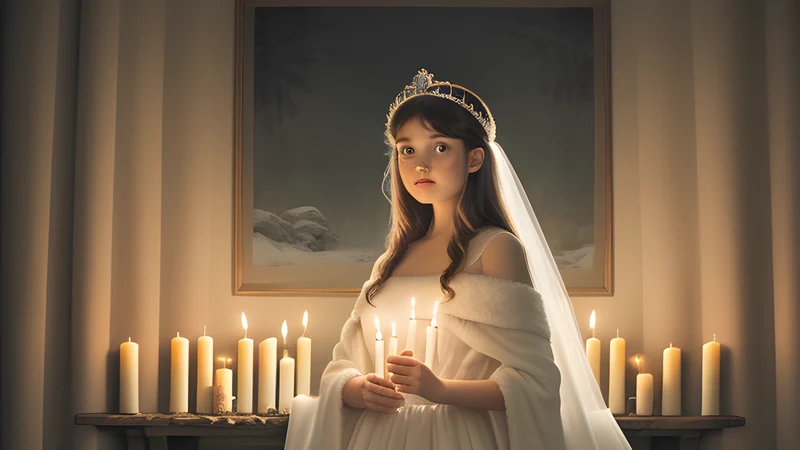
Before dawn on 13 December each year, in thousands of Swedish homes, schools and churches, the eldest daughter of the house — or an elected girl in a white gown and a crimson sash — walks into a darkened room wearing a crown of lit candles on her head, carrying a tray of saffron buns and coffee, while a procession behind her sings a slow Neapolitan melody. It is one of the most striking rituals in northern Europe, and its subject is a young woman who lived and died some 1,700 years earlier and 3,000 kilometres to the south, in the Sicilian city of Syracuse. Saint Lucy’s Day binds a Mediterranean martyr to the darkest days of the Scandinavian winter, and the thread that ties them together is her name: Lucia, from the Latin lux, light.
The Martyr of Syracuse
Lucy, or Lucia, is believed to have died around the year 304, during the persecution of Christians under the emperor Diocletian, the last and most severe of the Roman persecutions. According to the traditional account, she was a young Christian woman of Syracuse who had vowed her virginity to God and given her dowry to the poor, angering a pagan suitor to whom she had been betrothed. He denounced her to the authorities, and when she refused to renounce her faith she was condemned. The legends of her death are lurid — that guards could not move her even with a team of oxen, that she survived being set alight — and one strand holds that her eyes were gouged out, or that she tore them out herself, which is why she is so often depicted in art carrying her own eyes on a plate. She became the patron saint of the blind and of those with eye trouble, and her cult spread early and widely; she is one of very few saints named in the ancient Canon of the Roman Mass.
Why Her Day Falls at the Solstice
The reason a Sicilian saint came to preside over the northern midwinter lies in the calendar. Under the old Julian calendar, before the Gregorian reform of 1582, 13 December fell on or very near the winter solstice — the shortest day and longest night of the year. A martyr whose very name meant light was the natural patron of the year’s darkest point, and the association was cemented across medieval Europe. The English poet John Donne caught the mood in “A Nocturnal upon St. Lucy’s Day”, calling it “the year’s midnight”, and an old English almanac rhyme ran, “Lucy light, the shortest day and the longest night.” When the calendars were reformed the solstice drifted to around 21 December, but the feast stayed put on the thirteenth, keeping its ancient claim to be the turning point of the dark. This places it in the same family of winter-light observances as Candlemas, which marks the strengthening sun of early February.
How the Nordic Lucia Came to Be
Quite how the Sicilian martyr became the queen of the Swedish winter is only partly documented, but the outlines are clear. The cult of Saint Lucy reached Scandinavia in the Middle Ages, and her feast at the solstice fused with older Norse midwinter customs surrounding the longest night, a time hedged about with beliefs concerning spirits and the need to keep vigil until morning. The figure of a white-robed girl bringing food and light on the morning of the thirteenth appears in western Sweden by the eighteenth century. The tradition as it is now known — the candle crown, the specific songs, the national scale — largely took its modern form in the early twentieth century. A Stockholm newspaper organised a public Lucia competition and procession in 1927, the idea spread rapidly through the press, and within a generation the election of a local and national Lucia had become a fixture of the Swedish December. There was resistance along the way: some churchmen were uneasy about a young woman parading with fire on her head in a Lutheran country that had, at the Reformation, been sceptical of the whole apparatus of saints, and the candle crowns were long a genuine hazard before electric substitutes became common. Yet the festival’s appeal proved irresistible, precisely because it filled the emotional gap left when the Protestant north stripped away most of the medieval saints’ calendar: here was a single luminous figure who could carry the accumulated longing for light at midwinter without much doctrinal freight. Finland, Norway and Denmark adopted their own versions, and the Swedish-speaking minority in Finland keeps a national Lucia of its own to this day.
The Procession and Its Music
The heart of the celebration is the procession. The Lucia, chosen for the honour, wears a white full-length gown tied with a red sash — the red recalling the martyr’s blood — and a wreath of candles or lights on her head. Behind her come her attendants, also in white, some as “star boys” (stjärngossar) in tall conical hats, and children dressed as gingerbread figures or Christmas elves. They sing as they walk, and the tune is unmistakable: the Neapolitan boat song “Santa Lucia”, given Swedish lyrics that turn the Bay of Naples into a hymn about light piercing the winter dark. The processions are performed in workplaces, hospitals, schools and, most famously, in great churches and concert halls, broadcast on national television.
What Is Eaten
Saint Lucy’s Day has its own foods, and they are among the best-loved of the Swedish year. The essential item is the lussekatt, or “Lucia cat” — a saffron bun coiled into an S-shape, deep gold from the saffron and studded with raisins in its curls. Saffron, the most expensive spice in the world, turns an ordinary sweet dough into something ceremonial, and its golden colour carries the theme of light into the food itself. Alongside come pepparkakor, thin crisp gingerbread biscuits, and glögg, the spiced and fortified mulled wine of the Nordic Christmas. The buns and coffee carried in by the morning Lucia make the day, at its most domestic, a particularly beautiful kind of breakfast in bed.
Lucia in Italy and Beyond
In her Sicilian homeland and in pockets of northern Italy, Saint Lucy keeps a quite different character. In Syracuse, her relics and her feast are the occasion of major processions, and the traditional dish of the day is cuccìa, a dish of boiled whole wheat berries, sometimes sweetened with ricotta or honey. It commemorates a famine, said to have struck in 1646, that broke when a ship laden with grain arrived in the harbour on Saint Lucy’s Day; the starving people, too hungry to wait for it to be milled into flour, simply boiled the wheat and ate it — and Sicilians still avoid bread and pasta on the thirteenth in memory of the deliverance. In parts of northern Italy, including Bergamo, Brescia and Verona, it is Santa Lucia rather than Father Christmas who brings presents to children, arriving in the night with a donkey; children leave out hay and milk for the animal and wake to find gifts. The day is also widely marked in Croatia, Hungary and other central European countries, and by Scandinavian communities around the world.
Traditions and Symbols
Light is the governing symbol of the day, in the candle crown, the saffron gold of the buns and the very meaning of Lucy’s name. The eyes on a plate identify her instantly in painting and sculpture and connect her to the care of the blind. Wheat, from the Sicilian famine legend, and the colour red, from her martyrdom, run through the food and dress. In older Swedish folk belief, “Lussi Night” was a dangerous vigil, when supernatural beings were abroad and all the year’s threshing and spinning had to be finished; some households would stay awake and eat through the long night, and it was considered unwise for children to be out. The modern festival has softened that old dread into a gentle celebration of light returning, but the sense of keeping watch until the dawn survives in the pre-dawn timing of the procession.
Fun Facts
The saffron for a single large batch of lussekatter can cost more than the flour, butter and sugar combined, which is part of why the buns were historically a once-a-year treat. The Swedish Lucia song is set to the same tune Italian sailors sang about the Naples waterfront, meaning millions of Scandinavian children learn a Neapolitan barcarolle without ever knowing it describes a Mediterranean harbour glittering under a warm southern sky. Saint Lucy is invoked against eye diseases so consistently that ophthalmology wards and opticians in Catholic countries sometimes still keep her image. And the “year’s midnight” reputation of 13 December was accurate enough under the Julian calendar that pre-Reformation Europe genuinely treated it as the solstice — the ten-day gap between the old date and the true astronomical shortest day is a fossil of the 1582 calendar reform.
A Closing Reflection
There is something quietly astonishing in the idea that the deepest, darkest morning of the Scandinavian year is presided over by a teenage martyr from sun-drenched Sicily, sung to a tune about the Bay of Naples. Saint Lucy’s Day is a reminder of how far and how strangely traditions travel, and of how a single idea — light held up against the dark — can gather to itself a candle crown, a saffron bun, a boat song and a boiled dish of wheat, and carry them across seventeen centuries and a continent. Whether it is kept in a Syracuse procession or a pre-dawn Stockholm kitchen, the day makes the same promise as the returning sun: that the longest night has a morning on the other side of it, and that light, as related celebrations such as Walpurgis Night also insist, is worth carrying into the dark.
Related Content