Norwegian Constitution Day
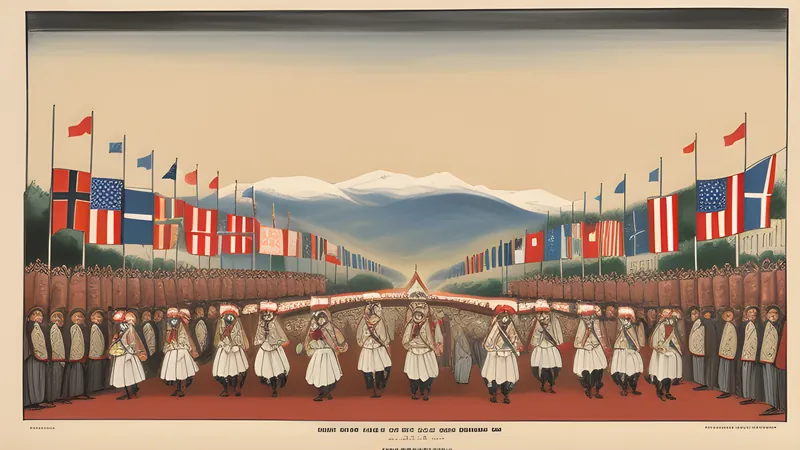
At Eidsvoll Manor, a country house north of what was then Christiania, 112 men gathered in the spring of 1814 and finished writing a constitution in a little over five weeks. They passed it unanimously on 16 May and signed it the following day. That second date, 17 May, is the one Norway now floods with flags, brass bands and tens of thousands of children every year. Norwegian Constitution Day, known to everyone as syttende mai, is the national day, but it looks almost nothing like the martial pageants other countries stage. There are no tanks and no marching soldiers. Instead the streets belong to schoolchildren in their best clothes, to families in hand-stitched folk costume, and to an unguarded, almost familial joy.
The constitution of 1814
The road to Eidsvoll ran through the wreckage of the Napoleonic Wars. Norway had been tied to Denmark for over four centuries, but Denmark had backed the losing side, and the 1814 Treaty of Kiel handed Norway over to the king of Sweden like a transferred asset. The Norwegians declined to be transferred. A constituent assembly convened at Eidsvoll, elected the Danish crown prince Christian Frederik as king, and drafted a founding document drawing openly on the United States Constitution of 1787 and the principles of the French Revolution.
The result was strikingly liberal for its moment. It established the separation of powers, vested legislative authority in an elected parliament, the Storting, and granted the vote to a wider share of the population than almost any other European state of the day. The Eidsvoll constitution is now among the oldest written national constitutions still in force. Independence in the fullest sense did not last; later in 1814 Norway was pressed into a union with Sweden under a shared crown. But the constitution itself survived that union largely intact, and it became the spine of Norwegian political identity.
From banned celebration to children’s parade
For decades, celebrating 17 May was a delicate, sometimes forbidden act. King Charles John, the Swedish monarch, regarded the festivities as a provocation, and tensions came to a head in 1829 with the so-called Battle of the Square in Christiania, when troops dispersed a crowd marking the day. The poet Henrik Wergeland became the day’s great public champion; he delivered influential commemorative speeches in the 1830s and pushed the idea that 17 May should belong to the people rather than the crown.
The most consequential innovation came in 1870, when the writer Bjørnstjerne Bjørnson, who also wrote the lyrics of the national anthem, organised the first children’s parade through the capital. Placing children at the centre, rather than militia or dignitaries, gave the day its enduring character. When Norway peacefully dissolved the union with Sweden in 1905 and became fully independent, 17 May carried even greater weight. During the German occupation of 1940 to 1945 the celebration was banned outright, and that suppression only deepened its meaning; the first free syttende mai in 1945 was an outpouring of relief.
The barnetog and how the day unfolds
The heart of syttende mai is the barnetog, the children’s procession. School by school, pupils march behind their own banners, waving small paper flags, while crowds line the pavements and cheer. In Oslo the parade winds up Karl Johans gate to the Royal Palace, where the royal family stands on the balcony and waves back at the passing children for hours. The greeting exchanged everywhere is gratulerer med dagen, roughly “congratulations on the day”.
The mood is deliberately civic rather than military, and deliberately indulgent. Children are traditionally allowed as much ice cream, hot dogs and cake as they can manage, and the standard tally of treats consumed is a point of cheerful national pride. Overlapping the public celebration is the russefeiring, the riotous weeks-long graduation custom of secondary-school leavers who dress in coloured overalls and ride decorated buses, their festivities peaking around the same date.
A national day built on the home, not the army
What makes 17 May worth pausing over is the choice it embodies. Most national days were shaped to project strength outward; Norway’s was shaped to gather a community inward. By putting children and families at the centre, the day frames the nation around its future and its households rather than its borders or its forces. It is a striking statement of values for a state that only secured full independence in 1905.
The day also reaches well beyond Norway’s coastline. Norwegian communities in Minnesota, in Seattle, in London and elsewhere stage their own parades and bunad-clad gatherings, exporting the ritual through diaspora rather than spectacle. In this it sits alongside other northern national days that emphasise civic founding over military might, most obviously Danish Constitution Day, which marks the 1849 charter that ended absolute monarchy in Denmark, the very kingdom Norway had broken from. The pride in language, folk dress and song that animates syttende mai also echoes the cultural self-assertion celebrated on International Mother Language Day, a reminder that nationhood is carried as much in words and costume as in constitutions.
The russ in their coloured overalls
If the barnetog gives the day its tenderness, the russ give it its noise. The russefeiring is the graduation ritual of secondary-school leavers, and it has deeper roots than its rowdy modern form suggests. The red caps that define it, the russelue, were introduced in 1905, inspired by German students who had visited Norway the previous year wearing red caps of their own. Today the russ spend weeks in coloured boiler-suits — most famously red — completing daft challenges, decorating buses and vans into rolling sound systems, and partying their way through a celebration that traditionally begins around 20 April and climaxes on 17 May itself. The collision of the dignified children’s parade and the chaotic graduates is one of the day’s odder and more endearing features: the very youngest and the newly grown sharing the same streets and the same date. Researchers at Norwegian universities have noted that the custom both bonds a graduating cohort and quietly divides it, since the increasingly elaborate buses and their costs have made it a marker of who can afford to take part — a reminder that even the most exuberant national ritual carries its own social undertow.
The bunad and the colours of the day
No symbol is more central than the bunad, the regional folk costume. There are something like 450 distinct designs, and the embroidery, silver brooches and colours of each identify the wearer’s home district — sometimes a specific valley or village. A good one is often made by hand over many months, then kept and altered across a lifetime or handed down through a family; roughly seventy per cent of Norwegian women and a fifth of men own one. Tellingly, the word bunad itself is a twentieth-century coinage, and the costumes belong to the wave of nineteenth-century national romanticism that, across Europe, reinvented “traditional” dress as a badge of nationhood. To wear it on 17 May is an act of belonging and quiet pride. The national colours of red, white and blue spill over everything else, from hair ribbons to bunting strung across the streets, while the flag is carried in miniature by every child in the parade.
Fun facts
- Norway’s 1814 constitution is the second-oldest single-document national constitution still in continuous use, after that of the United States.
- The Eidsvoll Assembly drafted, debated and adopted the entire constitution in roughly five weeks, between 10 April and 17 May 1814.
- Henrik Wergeland is so bound up with the day that, on 17 May, schoolchildren and choirs lay wreaths and gather at his grave in Oslo to honour him.
- An original bunad with its silver ornaments can cost the equivalent of several thousand pounds, which is part of why so many are inherited rather than bought new.
- The 17 May parade in Seattle is among the largest syttende mai celebrations held outside Norway, a legacy of Scandinavian emigration to the American Pacific Northwest.
- There are roughly 450 distinct bunad designs, each tied to a particular region and many to a single valley or village, so a Norwegian crowd on 17 May is in effect a map of the country in cloth and silver.
- The russ graduates’ red caps date to 1905 and were copied from German students who wore red caps on a visit to Norway the year before.
- The word bunad is a modern, twentieth-century invention; the costumes themselves grew out of nineteenth-century national romanticism, the same movement that reinvented folk dress across much of Europe.
A closing reflection
A country that chooses to mark its founding with a river of waving schoolchildren, rather than a column of soldiers, is telling you what it thinks freedom is for. The men at Eidsvoll wrote a constitution in the shadow of a war they had no part in starting, and the generations since have answered that solemn document with something almost the opposite of solemn: ice cream, paper flags and the noise of brass bands. The gentleness is not a softening of the achievement. It is the achievement, worn lightly, handed each spring to the people most likely to inherit it.
Related Content