National Wine and Cheese Day
In a limestone cave at Roquefort-sur-Soulzon, in the south of France, blue-veined cheeses have been left to ripen in cool, damp draughts for the better part of a thousand years, and somewhere in that long stretch of time a shepherd surely reached for whatever rough wine was to hand and discovered, by accident, one of the most agreeable matches the table has ever produced. National Wine and Cheese Day, observed each year on 25 July, celebrates exactly that kind of discovery: the moment when two foods, each remarkable on its own, turn out to be greater in each other’s company. It is a day for the loaded board and the slowly poured glass, for noticing how a wine changes when a wedge of something ripe and salty meets it on the palate.
Two of the oldest crafted foods
Both wine and cheese belong to a small family of foods that human beings make rather than merely gather, and both are products of the same patient trick: taking a perishable raw material and persuading microbes and time to turn it into something richer and longer-lived. Wine was being fermented deliberately in the Caucasus and the Near East several thousand years before the common era, where wild grapes were first coaxed into something drinkable and keepable. Cheese arose wherever animals were milked and the milk was found to curdle and set, a transformation almost certainly stumbled upon rather than designed.
The two crafts grew up alongside one another around the Mediterranean and across Europe, and the habit of taking them together is very nearly as old as both. What is not old is the observance itself. Like most modern food days, National Wine and Cheese Day has no documented founder and no inaugural year that can be reliably named; it surfaced through the same loose web of online calendars and trade promotion that produced so many neighbouring dates, including National Wine Day and the more specific National White Wine Day. What can be said with confidence is that 25 July has become its settled home in the high days of summer.
The chemistry of a good match
For a long time the received wisdom held that red wine was the proper partner for any cheese, the reasoning being that the tannins and alcohol in red would cut cleanly through the fat. There is real chemistry beneath the cliché, but it is more interesting than the cliché allows. Tannins, the astringent compounds drawn from grape skins, normally bind to proteins in the saliva and strip the mouth of its slipperiness, which is the puckering sensation a young red leaves behind. The fat and protein in cheese intervene, coating the palate and softening that astringency, so that a tannic wine can feel rounder and more generous when eaten with something rich.
The trouble is that the same tannins can also bind to casein, the principal protein in milk, and the result is sometimes not harmony but a flat, faintly bitter clash. This is why so many cheeses sit more happily with white wine, whose brightness and acidity scour the fat without the tannic risk, or with sparkling and sweet wines. The old rule about red is not wrong so much as half a truth, and part of the pleasure of the day lies in proving it wrong at your own table: a crisp Sancerre against a fresh goat’s cheese, a sweet Sauternes against a salty blue, each match the louder for upsetting the expectation.
Names protected by law
The most prized European cheeses and wines are not merely traditional; many are protected by law, allowed to carry their names only when made in a defined place by recognised methods. Roquefort led the way. In 1925 it became the first French cheese to be granted an appellation of its own, and the rules are exacting to this day: only cheese ripened in the natural Combalou caves at Roquefort-sur-Soulzon may bear the name. The wider European system of Protected Designation of Origin, established in 1992, extended that logic across the continent, so that Comté, Parmigiano Reggiano and Champagne are all guarded against imitation in the same way.
This is more than legal pedantry. A protected name is a promise that the soil and weather of a particular vineyard, or the pasture and breed behind a particular milk, are present in the glass and on the board. To pay attention to wine and cheese is to pay attention to place, to season and to the slow arts of fermentation and ageing, and the law simply puts a fence around what the palate already senses.
How the day is kept
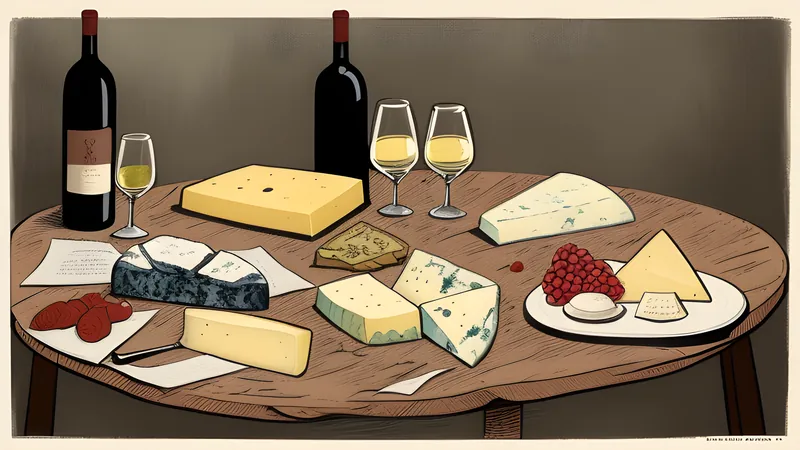
Celebration tends to be congenial and unhurried, which suits both subjects. The commonest way to mark it is to set out a board of several cheeses with bread, fruit, nuts and a few bottles to compare, and to let the evening drift. Wine merchants and cheesemongers sometimes offer tastings or paired flights, and the more adventurous treat the date as licence to range beyond the familiar, seeking a grape variety or a cheese they have never met. It rewards small numbers and good conversation more than crowds, and it is firmly an evening pursuit, undertaken without a clock.
A good board is varied by milk, texture and strength, the idea being contrast rather than uniformity: perhaps a soft bloomy-rinded round, a firm aged wedge, a tangy blue and a fresh goat’s cheese, arranged so the palate moves from mild to assertive. The glass, swirled and sniffed before sipping, is its companion, and the loose folk wisdom of pairing supplies a starting point rather than a rulebook.
Regional canons
Wine and cheese cultures are deeply local, and the day looks different depending on where it is kept. France offers perhaps the broadest repertoire, from Camembert and Brie in the north to Roquefort and Comté further south, each with its customary regional wines. Italy answers with Parmigiano, Gorgonzola and Pecorino; Spain with Manchego and its sherries; Switzerland with Gruyère; Britain with Cheddar, Stilton and a growing roll of artisan makers. The newer wine countries have built their own traditions in turn, so that a Californian Cabernet or a South African Chenin Blanc now has cheeses chosen to flatter it. The combination travels easily because its logic is the same everywhere: fat against acid, salt against sweetness, richness against a clean edge.
The terroir on the board
The reason a particular cheese and a particular wine so often suit one another is rarely accidental, because both grew out of the same patch of ground. Comté and the firm, nutty wines of the Jura mature in the same cool eastern French uplands; Roquefort and the sweet wines of the south have shared a table since long before anyone could explain the chemistry; Stilton found its English companion in port not by deduction but by centuries of habit at the same Christmas tables. Where a cheese and a wine come from the same soil, weather and culinary tradition, the match has usually been tested by generations who never needed a sommelier to tell them it worked. The fashionable phrase is “what grows together goes together”, and while it is not an iron law, it is a reliable place to begin when the printed pairing charts run out.
This is also why the day rewards a little geography. Choosing an Alpine Gruyère beside a dry Swiss white, or a Manchego against a glass of fino sherry, is not merely a safe bet; it is a way of tasting a single region twice over, hearing the same landscape in two registers at once.
Fun facts
- Roquefort was the first French cheese to receive a legal appellation, granted in 1925; only cheese aged in the natural caves at Roquefort-sur-Soulzon may use the name.
- The belief that red wine is always cheese’s best partner is misleading: tannins can bind to casein, the main milk protein, producing a bitter clash that a crisp white or sparkling wine avoids entirely.
- The fat and protein in cheese physically coat the tongue, which is why a harsh young red can taste noticeably smoother eaten alongside it.
- Both crafts predate the wheel in some regions; wine was being deliberately fermented in the Caucasus thousands of years before the common era, and cheese-making arose independently wherever milk was found to curdle.
- The European Protected Designation of Origin scheme, set up in 1992, polices the names of Comté, Champagne and Parmigiano Reggiano alike, treating a place name as a guarantee of method.
A closing reflection
What this day really asks for is attention rather than expertise. Anyone can lay out a board, but the small revelation comes in tasting deliberately, noticing how a wine retreats or blooms when a particular cheese meets it, and how both seem better for the meeting. There is a quiet democracy to the pleasure, too: the same chemistry that elevates a grand cru and a protected blue works just as faithfully on a supermarket Cheddar and an honest bottle of red. To set out a few cheeses and open a wine on the twenty-fifth of July is to take part in a habit older than almost any other at the table, and to grant an ordinary summer evening the unhurried grace it deserves.
Related Content