National Toast Day
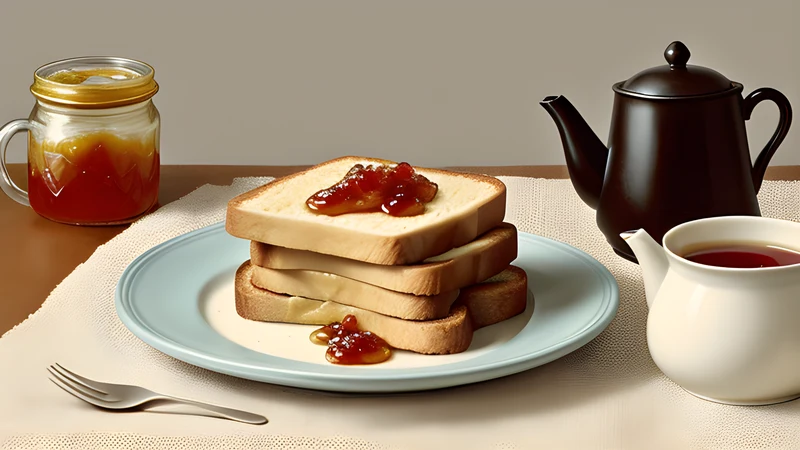
On the last Thursday of every February, Britain pauses to celebrate a slice of scorched bread. National Toast Day was founded in 2014 by the organisers of the Tiptree World Bread Awards to shine a light on the loaf at its most everyday, and after a couple of years on the last Tuesday of the month it settled, from 2017, on the last Thursday. It is a modern, cheerfully commercial observance, yet it sits on top of one of the oldest cooking techniques humans possess: holding bread near fire until it changes.
The oldest way to improve bread
Toasting is almost as old as bread itself. The word descends from the Latin tostum, the past participle of torrere, meaning to scorch or parch, and the Romans toasted bread to make it keep longer and travel better, since dried-out bread resists mould. For most of history toast was made by holding bread on a fork or a metal frame close to an open fire or a bed of embers, a slow and slightly perilous business that produced the uneven, smoky char still prized by anyone who has made toast over a campfire.
What actually happens when bread toasts is a piece of everyday chemistry named after the French chemist Louis-Camille Maillard, who described it in 1912. The Maillard reaction is the browning that occurs when heat drives amino acids and sugars to react, producing hundreds of new aromatic compounds and the characteristic golden colour, nutty smell and crisp surface. It is the same reaction that browns a steak, a roast potato and the crust of the loaf itself, and it is the entire reason toast tastes of more than warm bread.
From hearth to pop-up toaster
The electric toaster is younger than the light bulb. Early attempts in the 1890s, including the Eclipse toaster made by Crompton and Company in Britain and General Electric’s D-12 of 1909 in the United States, browned only one side at a time and required the cook to watch and turn each slice by hand. The breakthrough came in 1919, when Charles Strite, a factory mechanic in Minnesota irritated by the burnt toast served in his works canteen, patented a spring-loaded, timer-controlled machine that browned both sides and popped the slice up automatically. The Toastmaster, the first pop-up toaster sold for the home, followed in 1926 and turned toast from a fireside chore into a push-button certainty.
Toast’s rise was sealed by another American invention. In 1928, Otto Frederick Rohwedder of Iowa finally perfected a machine that sliced and wrapped a whole loaf, first used commercially in Chillicothe, Missouri. Pre-sliced bread was such an obvious improvement that it gave the English language its highest measure of praise, “the greatest thing since sliced bread”, and a uniform slice was exactly what the pop-up toaster needed to work reliably.
Why we drink a “toast”
The most curious thing about toast is that raising a glass to someone’s health has the same name, and the two really are connected. In sixteenth and seventeenth-century England it was common to drop a piece of spiced or charred toast into a cup of wine or ale, both to improve a rough drink and to soak up sediment. The essayist Richard Steele, writing in The Tatler in 1709, recorded a story from the spa town of Bath in which a celebrated beauty was standing in the waters, and an admirer scooped up a glass of the water she stood in and drank her health, whereupon a wit declared he would rather have the “toast”, meaning the lady, than the liquor. The lady’s health became a “toast”, and from there the word spread to any person or thing honoured with a raised glass. A “toast of the town” is, quite literally, a piece of flavoured bread.
How the day is marked
National Toast Day is unabashedly a food-marketing creation, and it works because toast is universal and cheap. Bakeries and cafés run toast specials, brands push their spreads and butters, and social media fills with the eternal British argument about the correct topping. That argument is the day’s real content: beans on toast, cheese on toast, Marmite spread thin by those who understand it and thick by those who do not, jam, honey, and the great national institution of a slice with butter and marmalade. The day pairs naturally with other breakfast-table observances such as World Porridge Day and National Cheese Lovers Day, each defending a different corner of the morning.
Charitable and community events have grown up around it too, with some cafés offering free toast in exchange for donations and schools using the day to teach the simple science of the Maillard reaction with a toaster and a stopwatch.
Traditions and symbols
Toast carries a surprising amount of cultural meaning for something eaten in a hurry. It is comfort food in its purest form, the thing made for the ill, the heartbroken and the very young, and “warm as toast” has meant cosy and safe since at least the eighteenth century. In Australia, buttered toast scattered with hundreds-and-thousands becomes fairy bread for children’s parties, though that is untoasted bread wearing toast’s clothes. Melba toast, the wafer-thin, twice-baked slice, was created by the chef Auguste Escoffier around 1897 in honour of the Australian soprano Dame Nellie Melba, who was recovering from illness and wanted her toast as thin as possible.
Surprising facts
The most valuable toast ever sold was a slice bearing what buyers believed to be the image of the Virgin Mary, which changed hands on an internet auction in 2004 for 28,000 US dollars. The Victorian cook Mrs Beeton published a recipe for a toast sandwich, a slice of buttered toast between two slices of plain buttered bread, which the Royal Society of Chemistry revived in 2011 as a cheap, filling snack. The optimal browning of toast has been studied by food scientists seeking the point of maximum flavour before acrylamide, a compound formed in over-browned starchy foods, becomes a concern, which is why modern advice is to aim for gold rather than brown. And the humble toast rack, that quintessentially British object designed to let slices cool and stay crisp rather than steam themselves soggy in a pile, is itself a small monument to the seriousness with which one nation takes its breakfast.
Toast around the world
Toast is one of those foods every culture claims in its own accent. France turns stale slices into pain perdu, “lost bread”, soaked in egg and milk and fried, the dish the English-speaking world confusingly calls French toast. Spain starts the day with pan con tomate, toasted bread rubbed with garlic and ripe tomato and finished with olive oil, a Catalan breakfast so simple it barely counts as a recipe and so good it needs no more. In Hong Kong the tea houses serve a decadent deep-fried French toast layered with peanut butter and drowned in condensed milk and syrup, a colonial hand-me-down reinvented into something entirely local.
India makes spiced masala toast and the grilled Bombay sandwich from the street griddles of Mumbai; Japan prizes thick, pillowy slices of shokupan toasted so the outside crisps while the centre stays custard-soft, often crowned with butter and a drift of sugar. Turkish and Middle Eastern kitchens press cheese-filled tost in a hot iron. Each of these treats toast as a canvas, and each argues, quietly, that its own version is the correct one. The global toast map turns out to be as varied as any cuisine, all of it descended from the same instinct to hold bread to a flame.
When toast became fashionable
For most of its history toast was too ordinary to be fashionable, which changed abruptly in the 2010s. Avocado toast, mashed ripe avocado on sourdough with chilli, lemon and salt, became the defining brunch dish of a generation and a lightning rod in arguments about the cost of living, after an Australian property developer suggested in 2017 that young people might afford homes if they stopped buying it. San Francisco cafés began charging striking sums for artisan toast made from naturally leavened bread, prompting a wave of bemused newspaper coverage about a city paying premium prices for the food of the nursery. The episode said less about toast than about the appetite for turning the humble into the aspirational, but it did confirm that the oldest way of improving bread could still, four thousand years on, feel new.
A closing reflection
Toast is the least pretentious food imaginable, which is exactly why a day for it feels earned. Almost everyone can make it, almost everyone has an opinion about it, and it asks for nothing more elaborate than heat, bread and a few minutes’ attention. National Toast Day catches something true about the pleasures that actually fill our mornings, which are rarely grand. A warm slice, a good spread and a pot of tea have consoled more bad days than any banquet, and there is a quiet wisdom in setting aside one Thursday in the grey end of winter to raise, if not a glass, then at least a buttered slice, to the simplest comfort in the kitchen.
Related Content