National Spinach Day
Of all the foods to be rescued from obscurity by a cartoon, spinach has the strangest case. A leaf that had grown quietly in kitchens for some seventeen centuries found its modern fame in 1929, when a squinting, pipe-smoking sailor named Popeye began squeezing tins of it down his throat and developing the strength to flatten anyone in his way. National Spinach Day, marked each 26 March, celebrates this dark, tender, faintly mineral green — but the leaf’s real history, full of Persian gardens, a homesick Italian queen and one of science’s most persistent myths, is considerably richer than the cartoon ever let on.
Out of Persia
Spinach is thought to have originated in ancient Persia, in the region of modern Iran, where it was cultivated long before it reached the wider world; its very name traces back to a Persian root. From there it travelled the trade routes that carried so much of the world’s food. The record sharpens around the seventh century, when spinach was introduced to China — Chinese sources describe it as the “Persian vegetable” and credit it as a gift from the king of Nepal around 647. By roughly the eleventh century it had reached Europe.
The dates for these journeys are inevitably hazy, as they are for most ancient crops, but the broad direction is well established: spinach moved steadily westward, carried by Arab traders into the Mediterranean and into Spain under the Moors, who were skilled cultivators of it. From there it spread across the rest of Europe. The twelfth-century Andalusian agronomist Ibn al-‘Awwam, who farmed near Seville and wrote the Kitāb al-Filāḥa, the most comprehensive agricultural treatise of the medieval Arabic world, included spinach among the hundreds of plants he described how to cultivate — evidence that the leaf was already an established crop in Moorish Spain centuries before it became fashionable in the courts of the north.
A Lenten leaf and a Florentine queen
Spinach earned an early reputation in medieval Europe as a Lenten food, valued because it grew in the lean weeks of early spring when little else was ready and could be eaten during the long fasts of the Christian calendar. Its rise in the kitchens of the European elite is bound up with one famous, much-repeated story. When Catherine de’ Medici of Florence married the future King Henry II of France in 1533, she is said to have brought Italian cooks who could prepare spinach to her taste, and so fond was she of the leaf that any dish served on a bed of spinach has since been called à la Florentine, in honour of her native city.
It is a charming attribution and, like most such culinary origin stories, one to hold loosely. What is not in doubt is that spinach had become a thoroughly established and welcome green across European cooking by the Renaissance.
The leaf, the sailor and the decimal point
No food has a stranger relationship with its own reputation. Spinach is genuinely nutritious — rich in folate, vitamins A, C and K, and a respectable source of iron — and that pedigree was famously amplified in the twentieth century by Popeye, who first appeared in E. C. Segar’s comic strip Thimble Theatre in 1929 and was hauling on tins of spinach for super-strength by the early 1930s. The character was credited with measurable real-world effects: American spinach consumption is widely reported to have risen sharply during his heyday, and a Texas town even erected a statue in his honour out of gratitude.
What almost everyone gets wrong is why Popeye ate it. The popular explanation — that a nineteenth-century German chemist misplaced a decimal point and overstated spinach’s iron content tenfold, fooling generations into eating it — is itself a myth, and a doubly ironic one. The Norwegian criminologist Ole Bjørn Rekdal investigated the tale in 2014 and found no evidence of any such decimal error; the story of the error appears to have been invented and then repeated as fact, a myth about a myth. And Segar, by the accounts of his contemporaries, had Popeye eat spinach not for iron at all but for its vitamin A. The strongest food fact most people “know” about spinach is wrong twice over.
Why it matters at the table
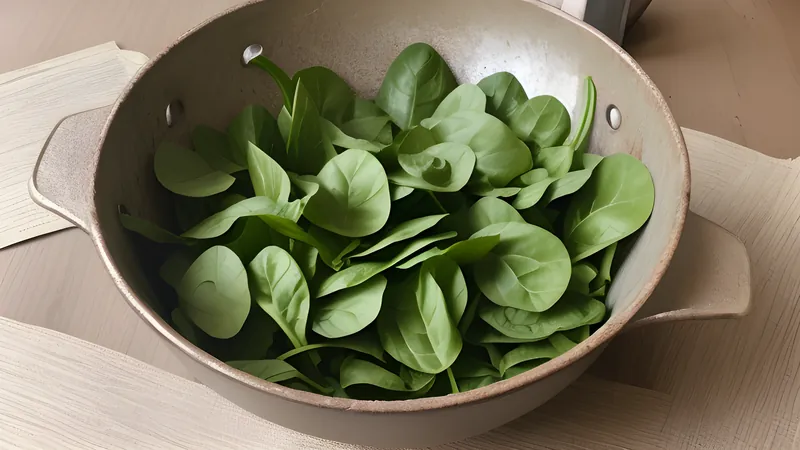
Stripped of the folklore, spinach earns its place on real merits. It is one of the most adaptable of all greens, and its defining trick is dramatic shrinkage: a heaped pan of raw leaves collapses to a modest handful when cooked, its volume vanishing as the cell walls give way. Young leaves make a soft, sweet salad raw; mature leaves wilt into soups, curries and pies. It has a particular affinity for dairy — the creamed spinach of the steakhouse, the saag paneer of the Indian kitchen — and for eggs, nutmeg and strong cheese.
Good cooks learn its quirks. Spinach holds a great deal of water, so it must be drained well or it floods a dish; it should be added late to anything hot so it keeps its colour; and frozen spinach, blanched and frozen at its peak, is an honest and often superior staple for cooked dishes. It is the kind of unfussy, reliable vegetable that rewards a little knowledge and asks very little in return.
The curious furry sensation spinach can leave on the teeth has a chemical cause rather than anything to do with freshness. The leaves are high in oxalic acid — the same compound that gives rhubarb and beetroot leaves their sharp edge — which is commonly held to form tiny crystals of calcium oxalate that coat the enamel. More importantly for the cook, those oxalates bind some of the iron and calcium spinach contains, so the body absorbs rather less of those minerals than the raw numbers on a nutrition label suggest. Cooking the leaves reduces the oxalate content somewhat, and pairing spinach with a squeeze of lemon or another source of vitamin C helps the body take up what iron there is — a small piece of kitchen chemistry that quietly undercuts the old image of spinach as a near-magical iron tonic.
A green that travelled everywhere
Spinach turns up across the world’s cuisines under many guises, a measure of how thoroughly this Persian native naturalised itself. In Greece it is the heart of spanakopita, layered with feta in crisp filo; in the Middle East it fills fatayer pastries and stews; in South Asia it forms the base of fragrant saag curries; and in East Asia it is blanched and dressed with sesame and soy. In Italy spinach turns up bound into gnudi and folded through fresh pasta, where it lends both colour and an earthy backbone; in the American South it is stewed long and slow in the company of other greens. Each tradition found its own way to honour the leaf, which is perhaps the truest tribute any vegetable can earn. That a single plant could anchor a Greek pie, a Punjabi curry, a Japanese side dish and a French à la Florentine sauce, while remaining recognisably itself in each, is a quiet argument for spinach’s place among the genuine staples of the world’s cooking.
Spinach has more than one date in the calendar devoted to it — the United States marks a separate day for fresh spinach — a sign of how deep its hold on the kitchen runs. And as a quiet, everyday staple that rewards good handling rather than fanfare, it belongs in the same company as the other unshowy larder essentials that do the real work of cooking.
Fun facts
- The famous “decimal point error” said to have exaggerated spinach’s iron content is itself a fabrication: a 2014 investigation by criminologist Ole Bjørn Rekdal found no such mistake ever occurred.
- Popeye’s creator, E. C. Segar, reportedly had his sailor eat spinach for its vitamin A, not its iron — undercutting the whole iron legend.
- Chinese records of the seventh century call spinach the “Persian vegetable” and credit it as a gift from the king of Nepal around the year 647.
- The term à la Florentine for a spinach-bedded dish traces to Catherine de’ Medici, the Florentine queen who married into the French crown in 1533.
- Spinach loses so much volume when cooked that a large pan of fresh leaves reduces to a few spoonfuls — a single serving of cooked spinach starts as a startling heap of raw.
A closing reflection
Spinach is a case study in how stories attach themselves to food and refuse to let go — the misplaced decimal, the iron myth, the sailor who supposedly drank tins of it for strength he never really got that way. Strip all of it away and what remains is more impressive than the legend: a leaf that crossed continents and centuries on its own merits, naturalised into a dozen cuisines, and quietly nourishing without needing a cartoon to vouch for it. The most interesting thing about spinach was never that it made you strong. It is that it travelled so far, fed so many, and asked so little to be noticed at all.
Related Content