National S'mores Day
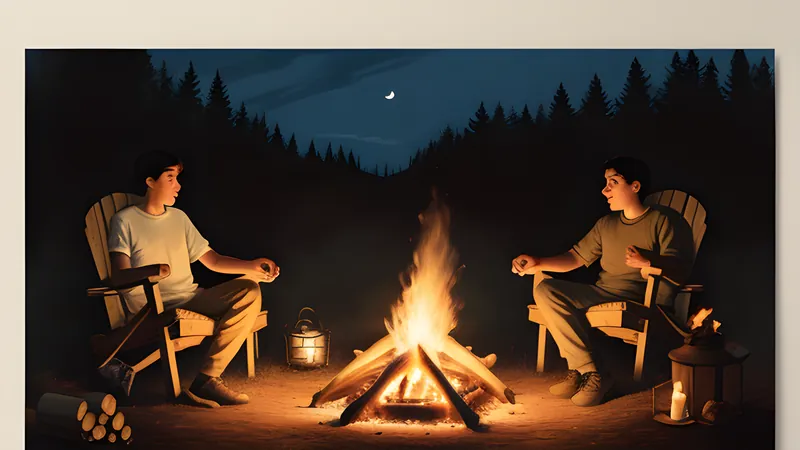
Somewhere in the chapter titled “The Larder”, tucked between instructions for sassafras tea and fish chowder, a 1927 Girl Scout handbook called Tramping and Trailing with the Girl Scouts set down a recipe so simple it barely qualified as one. Two marshmallows, toasted over coals to a “crispy, gooey state”, pressed against a square of plain chocolate, the whole thing clamped between two graham crackers until the heat did its work. The handbook called it “Some More”, and added, with a wink that has aged beautifully, that “though it tastes like ‘some more’ one is really enough.” It never is. National S’mores Day, observed each year on 10 August, takes that century-old campfire confection and gives it a date in the height of summer, when fire pits are lit, tents are pitched, and the dessert is at the peak of its natural habitat.
What the day marks
The s’more is, on paper, almost nothing: a toasted marshmallow and a piece of chocolate held between two biscuits until the warmth softens everything into a sticky, half-collapsed whole. The day set aside for it on 10 August is less about the recipe than about the ritual surrounding it, the patience of toasting, the inevitable mess on the fingers, and the pleasure of making something over open flame while other people wait their turn at the fire. It is one of the few foods that resists being eaten alone or in a hurry, and the observance leans into exactly that. The marvel of the s’more is that three industrially produced ingredients, none remarkable on its own, combine into something that feels handmade and seasonal every single time.
Origins of the recipe
The credit usually lands on Loretta Scott Crew, a Girl Scout troop leader whose “Some More” recipe is the one printed in the 1927 handbook and held up ever since as the first official version. That tidy attribution deserves a small asterisk, because the dessert was clearly already circulating before anyone wrote it down. The Memphis Commercial Appeal ran a near-identical recipe in August 1925, two years earlier, in a dispatch headed “News from Kamp Kiwani at Hardy”, a Girl Scout camp in Arkansas. So the 1927 handbook did not invent the s’more; it captured a custom that scouts were already practising around their fires and gave it a fixed form and a memorable name. That distinction matters, because it places the s’more firmly in oral camp culture first and print culture second.
The name itself is a contraction of “some more”, the predictable request of anyone who has just finished one. The spelling drifted for decades. Merriam-Webster records the first known use of the word “s’more” in 1974, though the underlying childish contraction “some more” turns up in print far earlier, which tells you the food outran its own spelling by half a century.
History: the three ingredients and their unlikely makers
The deeper history of National S’mores Day is really the history of three separate inventions that had no business ending up in the same hand. The graham cracker comes first, and from the unlikeliest source. Sylvester Graham, born in Suffield, Connecticut, in 1794, was a Presbyterian minister and a furious dietary reformer who preached temperance, vegetarianism, and a deep suspicion of refined flour. He believed white bread and rich food inflamed the appetites and corrupted the body, and around 1829 he promoted a coarse, unsifted wholewheat flour as the antidote. His 1837 Treatise on Bread and Bread-Making laid out the doctrine in full. The plain, virtuous biscuit named after him was conceived as an instrument of restraint. That the graham cracker now exists chiefly to deliver melted chocolate and toasted sugar to children at summer camp is one of the great ironies in the history of food. Graham died in 1851, well before his austere biscuit was conscripted into dessert.
The marshmallow has an even longer pedigree, and it begins not in a sweet shop but in a marsh. The confectionery takes its name from Althaea officinalis, the marsh-mallow plant, whose root yields a thick, soothing mucilage. Egyptians were combining that sap with honey and nuts as far back as 2000 BCE, producing a sweet reserved, by tradition, for royalty and the gods, and Greek and Roman physicians such as Dioscorides catalogued the plant for its medicinal use. The leap from medicine to confection happened in early nineteenth-century France, where confectioners whipped the root sap with egg whites and sugar into the airy pâte de guimauve. The plant did not survive industrialisation; as demand grew, cheaper and more reliable gelatine replaced the laborious marsh-mallow extract, and the modern marshmallow became a foam of sugar, water, and gelatine with no botanical connection to its own name. The final shift came in the United States, where Alex Doumakes patented an extrusion process in 1948 that forced aerated marshmallow through a die into a continuous rope, dusted it in starch, and sliced it into identical pillows. That machine turned the marshmallow from a fussy small-batch sweet into the bagged commodity that camping made famous.
Chocolate is the third leg, and the one the day’s home country most readily supplies. The flat, snappable milk-chocolate bar, divided into squares that align neatly with a graham cracker, was exactly the format American manufacturers were turning out by the early twentieth century. It is no coincidence that the dessert is built around a bar that breaks into portions; the geometry of the s’more is industrial design as much as folk cooking. Decades later the marketing caught up: a 1957 Hershey print advertisement urged readers to “Make S’mores Easy as Pie!”, helping cement both the spelling and the assembly in the public mind.
Why it matters
The s’more is one of those foods whose value lies almost entirely outside the plate. It cannot be made quickly, it cannot really be made indoors without losing something, and it cannot be made well alone, since toasting marshmallows over embers is fundamentally a shared, turn-taking activity. A day given over to it is therefore a quiet defence of unhurried, hands-on eating in a food culture that prizes speed and uniformity. The treat also carries an enormous amount of memory for very little money; for anyone raised on summer camp the smell of woodsmoke and scorched sugar is inseparable from childhood holidays, and the s’more is the edible trigger for all of it. That emotional payload, far more than the flavour, is what a dedicated date honours.
How it is made and celebrated
The method rewards a small amount of restraint. A marshmallow is speared on a long stick or skewer and held over glowing embers rather than open flame, then turned slowly so the surface browns evenly and the interior melts to a slump. The impatient cook sets it alight and pulls off a blackened crust; the patient one earns an even, golden, caramelised shell. The hot marshmallow is laid on a square of chocolate atop one graham cracker, capped with a second, and pressed just enough that the residual heat begins to soften the chocolate beneath. It is eaten immediately, while everything is still warm and yielding. On 10 August the celebration runs from backyard fire pits and beach bonfires to campsite gatherings, with sweet shops and chocolate brands marking the date through promotions, kits, and the steady churn of social-media photographs of marshmallows mid-char.
Variations beyond the campfire
The dessert is most at home in North America, where camping culture and scouting carried it across the continent, but the underlying idea travels with almost no resistance, because every component has a local substitute. Where graham crackers are hard to find, cooks reach for digestive biscuits, rich tea, or shortbread; where milk chocolate feels too sweet, dark chocolate or a hazelnut spread steps in. Flavoured and toasted marshmallows, peanut butter, fruit, and biscuit variants have all been folded in, and the indoor s’more, assembled under a grill or finished with a kitchen blowtorch, frees the treat from the fire altogether at the cost of a little romance. The s’more sits comfortably alongside the other unpretentious American treats that have earned their own observances, the cone of soft-serve marked by National Ice Cream Day or the bright orange snack honoured on National Cheese Doodle Day; all three share the same logic, that an everyday indulgence is worth a date on the calendar precisely because it asks so little and gives back so much.
Symbols and small rituals
The defining image of the day is the marshmallow glowing on the end of a stick against a dark sky, and the defining sensation is the smear of chocolate that ends up somewhere it shouldn’t. Those sticky fingers are not a failure of the method; they are part of the contract. So is the long-running and entirely unwinnable argument over the correct degree of toasting, the golden-brown faction against the flambé crowd, a dispute that flares up around every fire and is never settled because both sides are, in their way, correct. The s’more has accumulated this small body of lore not despite its simplicity but because of it; with so few moving parts, the only room for personality is in the technique and the squabbling.
Fun facts
- The graham cracker was invented as health food by a temperance preacher who wanted to suppress appetite, the opposite of its current job. Sylvester Graham died in 1851, never knowing his austere biscuit would end up cradling melted chocolate.
- The word “marshmallow” comes from a real plant, the marsh-mallow (Althaea officinalis), and the original confection used its root sap, used medicinally since ancient Egypt around 2000 BCE, long before gelatine took over.
- The first printed s’more recipe (1927) predates the first dictionary entry for the word “s’more”, which Merriam-Webster dates to 1974, a gap of nearly half a century between the dessert and its name being formally recognised.
- A near-identical recipe ran in the Memphis Commercial Appeal in August 1925, two years before the famous Girl Scout handbook, proving the scouts recorded the s’more rather than invented it.
- The uniform, bag-ready marshmallow exists thanks to an extrusion process patented by Alex Doumakes in 1948, which squeezed aerated foam through a die like toothpaste and sliced it into identical pieces.
A closing reflection
There is something quietly satisfying about a dessert whose three ingredients each began as something else entirely, a reformer’s penance, a swamp plant’s medicine, a factory’s chocolate bar, only to find their purpose by being held over a fire together. None of the people responsible for the parts could have predicted the whole. The s’more is an accident of convergence, assembled by children at camp and only later explained by historians, and that order of events feels exactly right. We did not design it so much as stumble into it, and marking 10 August is less an act of invention than of noticing, after a hundred summers, how much pleasure can be coaxed out of three things that were never meant to meet.
Related Content