National Quesadilla Day
Ask for a quesadilla in a market in Mexico City and you may be asked, with complete seriousness, whether you want one con queso — with cheese. The question is not a joke at the tourist’s expense. In the capital and much of central Mexico, a quesadilla is any folded tortilla with a filling, and cheese is merely one option among squash blossom, mushrooms, potato or chicharrón. Travel a few hundred kilometres north, or anywhere abroad, and that same request becomes nonsensical: of course there is cheese, the word says cheese. National Quesadilla Day, marked each 25 September, lands squarely in the middle of one of the most genuinely heated debates in Mexican food, and it celebrates a dish that manages to be street snack, home supper and national argument all at once.
What the word actually means
The name is a small piece of evidence in itself. Quesadilla comes from the Spanish queso, cheese, with the diminutive suffix -illa — roughly “little cheesy thing”. That etymology is the strongest argument the cheese loyalists have, and it points to the dish’s hybrid birth. The tortilla is ancient and indigenous; the Nahuatl word for it is tlaxcalli. Cheese is not. There were no milk-producing farm animals in Mesoamerica before the Spanish brought cattle, goats and sheep across the Atlantic in the sixteenth century. A quesadilla, by definition, could not have existed before contact, because half of its defining pairing arrived with the conquistadors.
What grew up instead was a genuinely mestizo food: the maize flatbread that the Mexica cooked on a comal — the flat earthenware or metal griddle still central to Mexican kitchens — folded around the new dairy the colonists introduced. The dish is therefore a near-perfect edible record of the collision of two food cultures, and one of the happier outcomes of it.
Where the day comes from
The origins of National Quesadilla Day as a calendar fixture are, like most modern food days, undocumented and almost certainly commercial rather than ceremonial. No founding decree survives, no committee claims it; it spread through the lists of “national days” that proliferated online in the 2010s. This is worth being honest about. The day is recent and a little contrived. The thing it celebrates is neither.
A dish older than the argument about it
The quesadilla’s deeper history is the history of maize itself. Mesoamerican cooks were making tortillas on the comal for centuries before the Spanish arrived, often folding them around beans, vegetables and the occasional meat — the half-moon shape and the griddle technique were already in place. What the colonial encounter did was add the ingredient that would eventually lend the dish its name and, in much of the country, its identity.
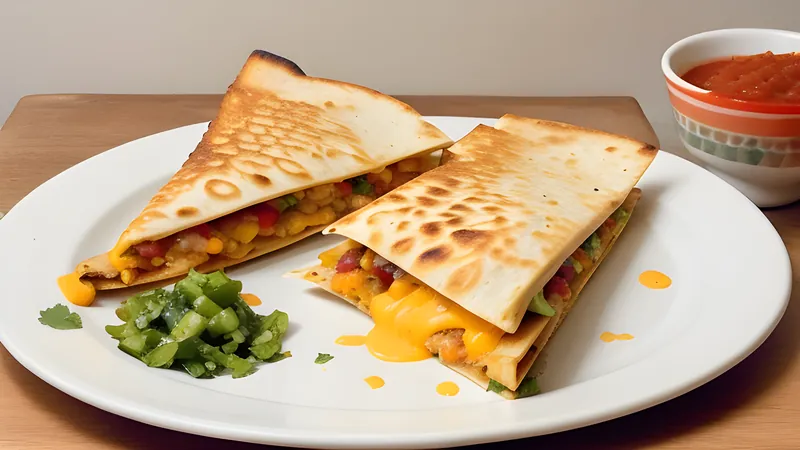
The split between the two camps is real and regional. In the cooking of central Mexico, the quesadilla remained a category — a filled, folded tortilla — and cheese stayed optional, which is why the capital’s vendors still ask. The corn-masa version, pressed fresh and sometimes deep-fried until the edges blister and puff, is the older and arguably more authentic form. The sturdy flour-tortilla quesadilla familiar across northern Mexico and abroad came later. Wheat thrived in the cooler, drier north in a way it never did in the maize heartland, and the flour tortilla there grew large and pliable, well suited to a heavy hand with the cheese and a fast turn on a hot plancha. The version most non-Mexicans picture — a flour tortilla folded over a generous layer of melted cheese, griddled flat and cut into triangles — is essentially the northern style that travelled.
Why a humble fold matters
There is a case to be made that the quesadilla is the purest expression of everyday Mexican cooking, precisely because it asks for so little. It is the dish you make from what is already in the kitchen: the end of a piece of cheese, a spoonful of leftover stewed meat, a handful of mushrooms gone soft. It demands no recipe and no occasion. That domestic, improvisational quality is easy to undervalue in a cuisine that the wider world tends to encounter through its more elaborate dishes — the moles, the tamales, the festival foods. The quesadilla is what people actually eat on an ordinary Tuesday, and a food culture is built far more from its Tuesdays than its feast days.
It also captures something about how good ideas travel. The maize tortilla is one of humanity’s great staple inventions, the product of nixtamalisation — the ancient Mesoamerican technique of soaking and cooking maize in an alkaline solution of lime or wood ash, which softens the grain, transforms its flavour and, crucially, unlocks the niacin in the corn so it can be absorbed by the body. Cultures that later adopted maize without this step suffered epidemics of the deficiency disease pellagra; the Mexica had solved the problem centuries before anyone understood the chemistry. Fold one of those tortillas, fill it, griddle it, and you have a meal that is portable, cheap, nutritionally sound and endlessly variable. That logic is so sound it has been reinvented independently and adopted everywhere.
How it is eaten and observed
On 25 September the celebration is, sensibly, mostly eating. People make quesadillas at home or seek out a favourite taquería or street stand; cooks try fillings they have been meaning to attempt; restaurants run specials, and social media fills with the obligatory photograph of the cheese pull, that strand of melted cheese stretching as a wedge is lifted away.
The classic accompaniments are nearly non-negotiable. A salsa — verde with tomatillo and chilli, or a smoky red — does the essential work of cutting the richness. Guacamole, crema, a wedge of lime and pickled chillies round it out. The best results come from cheeses bred to stretch: Oaxaca, the soft, stringy cheese wound into balls and pulled apart by hand, and asadero, both of which behave on the griddle far better than a hard cheese ever will.
There is also a close cousin worth knowing, the quesadilla frita or quesadilla de comal depending on region, where the masa is folded raw around the filling and either pressed onto the dry griddle or dropped into hot fat until the shell crisps and the inside steams. The fried version, sold from baskets and stands across central Mexico filled with flor de calabaza, huitlacoche — the prized corn fungus — potato or tinga, is for many Mexicans the truest quesadilla of all, and a world away from the flat, cheese-stuffed disc that the word conjures abroad. The variety is the point: a single name covers a snack griddled dry, a snack deep-fried, a thing with cheese and a thing emphatically without.
How the rest of the world reinterpreted it
Beyond Mexico, the quesadilla became a blank canvas, sometimes to the despair of purists. In the United States it is a fixture of casual dining, frequently overstuffed and served with sour cream, and the dessert quesadilla — filled with chocolate, fruit and sweet cheese — exists, for better or worse. Cooks elsewhere fold in whatever the local pantry offers, treating the tortilla as a container rather than a tradition. Through all of it the core idea survives intact: warm bread, melted cheese, something savoury within, cooked hot and eaten with the hands.
That adaptability puts the quesadilla in good company among foods that crossed cultures and were happily remade. The same human appetite for melted cheese in an easy, hand-held form runs through the story of the cheese-dusted snacks of the supermarket aisle, and the way a single ingredient can spread across the world’s kitchens echoes the journey of olive oil from the Mediterranean outward.
Fun facts
- In central Mexico a quesadilla con queso — a quesadilla with cheese — is a perfectly logical order, because the word alone does not guarantee any cheese at all.
- The dish predates one of its two defining ingredients: cheese only reached the Americas with Spanish livestock in the sixteenth century, so no quesadilla could have existed in pre-Hispanic Mexico.
- The Nahuatl word for the tortilla, the quesadilla’s ancient half, is tlaxcalli; the Spanish word tortilla originally meant “little cake”.
- Oaxaca cheese, the prized melting cheese for quesadillas, is produced as long ribbons that are wound into balls and unspooled by hand, a technique brought to Mexico by way of southern Italian pasta filata methods.
- The flour-tortilla quesadilla most familiar abroad is essentially a northern Mexican regional style; the older central-Mexican version uses corn masa and is often fried.
A closing reflection
The argument over whether a quesadilla must contain cheese is, on the surface, faintly absurd — a country debating the contents of a folded tortilla. But it is also a small lesson in how food carries history. The disagreement exists because the dish itself is a record of two cuisines meeting, with the central highlands keeping the older indigenous logic and the north embracing the imported one. Most national dishes smooth over their origins into a single agreed story. The quesadilla refuses to, and is more interesting for it. To fold one over a griddle is to take part, however unknowingly, in a five-hundred-year-old conversation about what belongs inside.
Related Content