National Pumpkin Cheesecake Day
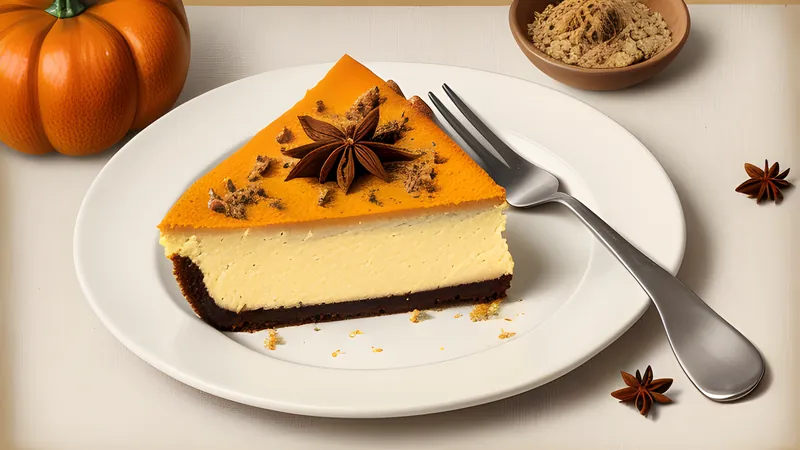
In 1570, the papal cook Bartolomeo Scappi published Opera, a monumental six-volume work of Renaissance cookery, and tucked into its fifth book was a recipe that would startle anyone who thinks pumpkin cheesecake is a modern American invention. Scappi instructed the cook to pound pumpkin in a mortar, and for every two pounds of it to add a pound of fresh ricotta and a pound of mild creamy cheese, then ten beaten eggs, a pound of sugar, an ounce of cinnamon, milk, butter and ginger, before baking the lot into a tourte. Strip away the antique phrasing and that is, unmistakably, a spiced pumpkin cheesecake, set down in print more than four and a half centuries ago. National Pumpkin Cheesecake Day, observed each year on 21 October, celebrates a dessert whose two halves each carry far longer histories than its recent popularity suggests.
Where the day comes from
The day itself has no formal origin. It belongs to the broad family of single-dessert observances that home bakers, food writers and the wider culinary community have built up over recent decades, and no founding body or specific year can honestly be attached to it. Its timing, though, is no accident. Late October is the peak of pumpkin season in the northern hemisphere, the moment when the gourd is most abundant, most affordable and most in demand, with Halloween at the end of the month and the American harvest festivals close behind. A dessert that yokes pumpkin to cheesecake is a natural product of that abundance, and 21 October sits squarely within it.
Two ancient ancestors
Both halves of the dish are far older than their union. Cheesecake in some form reaches back to classical antiquity; the Greeks and Romans made baked cheese confections, and a version was reportedly served to athletes at the early Olympic Games. The dessert evolved across Europe over centuries, but the style most people picture today, dense and silken, owes its character to a specifically American accident. In 1872 a dairy farmer named William Lawrence, working in Chester, New York, was trying to reproduce the soft French cheese Neufchâtel and instead stumbled onto a richer, smoother product: cream cheese. That happy mistake gave New York cheesecake its defining ingredient, and in the early twentieth century a restaurateur named Arnold Reuben, better known for the sandwich that bears his name, is credited with popularising the cream-cheese cheesecake that became a New York institution.
Pumpkin, meanwhile, is native to the Americas, where indigenous peoples domesticated it at least seven thousand years ago and prized it for its flesh, its seeds and its long keeping qualities. Carried back to Europe after the Columbian exchange, it entered Old World kitchens, which is precisely how Scappi came to have it on hand in sixteenth-century Italy. The marriage of pumpkin and baked cheese, then, was not a wild leap but a recombination of two ingredients that had already crossed paths centuries earlier, drawing on the same affection for pumpkin that gives North America its beloved autumn pie. What changed in the twentieth century was not the idea but the texture: Lawrence’s cream cheese gave the dish a smoothness and tang that Scappi’s ricotta-based version, fine as it was, could never quite match, and it is that creamy modern profile, rather than any genuine novelty, that the contemporary dessert celebrates.
Why it matters
The day’s value lies in what it says about seasonality and comfort. It encourages bakers to use the autumn harvest at its peak and to lean into the flavours, pumpkin, cinnamon, nutmeg, ginger and clove, that signal the turning of the year. More than that, it is an occasion for gathering: cheesecake is a dessert made to be shared in generous slices, and baking one is itself a slow, deliberate ritual that suits the darkening evenings. In honouring a single dessert, the day quietly celebrates the wider warmth of the autumn table, a sensibility it shares with US National Pumpkin Pie Day and with the broader appreciation of the gourd marked on National Pumpkin Day.
How it is made
A modern pumpkin cheesecake is built on a base, usually crushed digestive biscuits or graham crackers bound with melted butter and pressed firmly into a springform tin, then sometimes pre-baked briefly so it holds together under the heavy filling. Over this goes the custard: cream cheese beaten smooth with pumpkin purée, sugar, eggs and a generous measure of warm spice, the cinnamon, nutmeg, ginger and clove that announce the season. The mixture is poured in and baked gently, very often in a water bath, the bain-marie that surrounds the tin with steam and keeps the temperature even so the surface does not crack and the edges do not overcook before the centre sets. Patience does the rest. The cake must cool slowly, ideally in the switched-off oven with the door ajar to avoid a sudden temperature drop, then chill thoroughly overnight so the filling firms to a sliceable, velvety set. A finishing flourish, whipped cream, a thread of caramel or a dusting of cinnamon, completes each slice, though the discipline of the long, gentle bake matters far more than any garnish.
Variations and the wider pumpkin habit
Pumpkin desserts are most strongly associated with North America, where the autumn arrival of “pumpkin spice” flavouring has become a cultural event in its own right, spreading across coffees, biscuits, cereals and an improbable range of products each September. Yet the spice blend most closely tied to these desserts often contains no pumpkin at all, relying on cinnamon, nutmeg, ginger and clove to conjure the familiar flavour by association. Squash-based sweets are hardly unique to America, either: many cuisines prize pumpkin and related gourds in both savoury and sweet cooking, and the global spread of harvest celebrations gives the dessert a ready resonance wherever the season turns cool and cooks reach for warming spices. The contemporary trend toward no-bake and chilled cheesecakes has produced gelatine-set pumpkin versions that skip the oven entirely, trading the dense, custardy bite of the baked original for a lighter, mousse-like texture. Regional American variations abound, too: some bakers swirl pumpkin batter through a plain cheesecake to marble the two together, others layer pumpkin over a vanilla base, and a good many simply crown the finished cake with the bourbon-laced caramel and toasted pecans of the Southern dessert table.
What can go wrong, and why
For a dessert that looks so forgiving, pumpkin cheesecake is surprisingly easy to ruin, and the failures are instructive. The most common is the cracked surface, which happens because cheesecake is essentially a baked custard: the eggs set as they cook, and if the oven is too hot or the cake is overbaked, the proteins tighten too far, the structure shrinks, and the top splits as it cools. The water bath exists precisely to moderate this, surrounding the tin with gentle, even steam-heat so the edges do not race ahead of the centre. A second pitfall is a soggy or weeping filling, often caused by pumpkin purée that is too wet; experienced bakers drain or briefly cook down their purée to drive off excess moisture before it ever meets the cream cheese. The third is impatience. A cheesecake that looks set when it comes out of the oven is not: the centre should still wobble slightly, and the cake firms only as it cools and chills. Cut it warm and it slumps; chill it overnight and it slices clean. None of this is mysterious once you remember that you are not really baking a cake at all, but setting a custard, and treating it as such is the difference between a glossy success and a cracked, grainy disappointment.
Fun facts
- A recognisable spiced pumpkin cheesecake was recorded by the papal cook Bartolomeo Scappi in his 1570 cookbook Opera, centuries before it became an autumn fixture in the United States.
- The cream cheese that defines New York-style cheesecake was created by accident in 1872, when the New York dairy farmer William Lawrence tried and failed to copy the French cheese Neufchâtel.
- Pumpkin is, botanically, a fruit and a member of the squash family, despite being treated almost everywhere as a vegetable.
- The “pumpkin spice” blend at the heart of the autumn dessert craze frequently contains no pumpkin whatsoever; it is the spices, not the gourd, that carry the flavour people recognise.
- Indigenous peoples of the Americas domesticated pumpkin at least seven thousand years ago, making it one of the oldest cultivated crops to reach the modern dessert table.
A closing reflection
It is tempting to treat pumpkin cheesecake as a recent confection, a product of seasonal marketing and the modern appetite for novelty. Scappi’s 1570 recipe says otherwise. Long before pumpkin spice became a slogan, a Renaissance cook in Italy reached for the same gourd, the same soft cheese and the same warm spices, and arrived at almost exactly the dessert we bake today. There is a quiet pleasure in that continuity: the sense that some combinations are not invented so much as rediscovered, each generation convinced it thought of them first. On 21 October, a slice of pumpkin cheesecake is worth eating slowly, in the knowledge that you are tasting something far older than the season’s fashion for it.
Related Content