National Peppermint Bark Day
In 1998, after roughly twenty rounds of recipe testing, Chuck Williams and the test kitchen of the homeware company he had founded settled on a formula they were finally happy with: a slab of layered dark and white chocolate, dusted with crushed peppermint candy and snapped into rough shards. Williams had asked his team to recreate the sweets he remembered from the Christmas candy shops of his childhood, and the result, sold under the name The Original Peppermint Bark, sold out almost the moment it appeared. National Peppermint Bark Day, marked each year on 1 December, celebrates that confection and the wider family it belongs to — and it falls, fittingly, on the very threshold of the festive season it has come to flavour.
Where the day comes from
The observance has no single documented founder or founding year, which is the usual state of affairs for the modern crowd of food days. Its date, however, is anything but arbitrary. The first of December is the opening of the meteorological winter and, for many households, the day the festive decorations come out and the seasonal baking begins. Tying peppermint bark to that moment is shrewd: it makes the sweet a herald rather than just a treat, the edible equivalent of switching on the lights. Williams Sonoma, the company Chuck Williams built from a single cookware shop opened in Sonoma, California, in 1956, has leaned into the day enthusiastically, using it to mark anniversaries of its own bark — it celebrated the recipe’s twenty-fifth year in 2023 — which tells you how closely the celebration and the commercial product have grown together.
History
Peppermint bark did not begin in 1998, even if that is the year it became famous. It is a festive variation on the older and broader idea of chocolate “bark”, so named because the rough, uneven slabs resemble the bark of a tree. Chocolate bark itself descends from the French mendiants, traditional Christmas confections of chocolate discs studded with nuts and dried fruit, whose name nods to the begging friars whose robes the ingredients were said to echo in colour. The specific pairing of chocolate with peppermint is older than the Williams Sonoma version too: an advertisement in the St. Petersburg Times in 1966 offered peppermint bark for sale by the pound at $1.19, proof that American confectioners were selling the sweet under that name more than three decades before Chuck Williams ever tested his.
The deeper ancestry runs back further still. Mint and chocolate had been paired in the candy canes and seasonal sweets of the nineteenth century, and the candy cane itself — the red-and-white hooked stick whose crushed remains now top most barks — is usually traced to German confectioners, and its mass production was cracked at Bobs Candies of Albany, Georgia, founded by Bob McCormack in 1919, after his brother-in-law Father Gregory Keller invented a machine in the 1950s that twisted and bent the sticks automatically; by the end of that decade the firm was turning out 1.8 million candy sticks a day. Peppermint bark gathered up these older festive elements — the mint, the candy cane, the rough-broken chocolate slab — and bound them into a single sweet that read instantly as Christmas.
What the 1998 recipe did was raise the bar and fix the format in the popular imagination. Williams’s team used a custom blend of light and dark Guittard chocolate — Guittard being one of the oldest chocolate makers in the United States, founded in San Francisco in 1868 — layered and finished with triple-distilled peppermint oil rather than a cheaper flavouring. The product sold so fast in its first season that Williams put it on the cover of the company’s holiday catalogue the following year, and it became one of the brand’s signature seasonal items, selling in the millions of pound-sized tins over the decades that followed. A homemade sweet had become, in effect, a national festive institution with a corporate flagship.
Why it matters
Peppermint bark occupies a small but genuinely affectionate place in the December calendar because it is built for giving rather than hoarding. It packs neatly into tins and boxes, it survives a journey to a party, and it asks almost nothing of the cook — melt, layer, scatter, set, snap. That accessibility is the point. Plenty of festive confections demand tempering thermometers and steady nerves; peppermint bark forgives the novice and still looks handsome on a plate, which is why it has become a staple of the homemade-gift economy that springs up every winter among people who would never call themselves bakers. A day for it is really a day for that particular kind of generosity: the small, edible token handed across a doorstep.
How it is celebrated
The obvious way to mark the day is to eat some, whether bought from a confectioner or made at home, and home-making is half the fun. The method is forgiving: melt dark chocolate into a smooth base layer, let it firm slightly, pour a layer of white chocolate over the top, scatter crushed candy canes or peppermint sweets across the surface before it sets, then break the cooled slab into uneven shards. Home bakers across North America treat 1 December as the starting gun for festive baking in general, swapping recipes and posting photographs of their first batch. Because the bark keeps well once set, a quantity made on the day will happily last through the busy weeks that follow, which is partly why the date sits where it does.
Global variations and the wider mint family
Peppermint bark is most strongly identified with the North American festive table, where it is a fixture of sweet trays and gift tins from Thanksgiving onward. The underlying combination of chocolate and mint, though, travels easily, because the contrast of warm sweetness and cool freshness is close to universally pleasing — the same instinct that gives Britain its after-dinner mint chocolates and Australia its peppermint slice. As festive baking traditions cross-pollinate through cookbooks and the internet, the bark has appeared on seasonal tables well beyond its homeland, often adapted with local sweets standing in for American candy canes — crushed humbugs in Britain, or chopped peppermint crisp in South Africa, where the chocolate-and-mint combination already has a devoted following. The wider chocolate-bark format travels even more freely: in continental Europe the ancestral mendiant persists alongside its festive descendants, and in Australia the closely related peppermint slice — a no-bake biscuit-and-coconut base under a minty chocolate top — occupies much the same place on the Christmas table that bark does in North America. The bark sits within a whole calendar of confectionery celebrations — it shares its sweet-tooth spirit with frozen treats marked on National Ice Cream Day and with the run of grocery-aisle indulgences honoured on the likes of National Cheese Doodle Day, all of them small festivals of the everyday treat.
Symbols and traditions
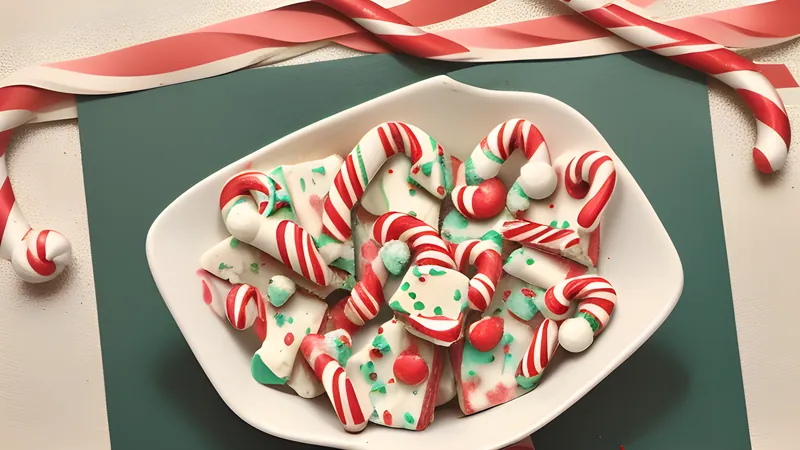
The look of peppermint bark is half its appeal. The red-and-white flecks of crushed peppermint echo the candy cane and the broader red-white-and-dark palette of the winter holidays, while the two contrasting chocolate layers give a clean visual stripe when a shard is snapped in two. The deliberate roughness matters as well: bark is broken, never cut, and the jagged, handmade edges signal abundance and informality rather than the precision of a chocolatier’s case. The cool flash of mint, meanwhile, comes from menthol, a compound that activates the same nerve receptors the body uses to sense cold, which is why a piece tastes refreshing even at room temperature — a small physiological trick that makes a December sweet feel like a breath of winter air.
Fun facts
- The cooling sensation of peppermint is a sensory illusion: menthol binds to the TRPM8 receptor, the same one triggered by genuine cold, so the brain registers chill where there is none.
- Williams Sonoma’s recipe reportedly took around twenty rounds of testing before Chuck Williams approved it, and the brand has sold the resulting bark by the millions of one-pound packages.
- Peppermint bark was being sold under that name in the United States by at least 1966, when a Florida newspaper advertised it at $1.19 a pound — over thirty years before the famous 1998 version.
- Chocolate bark descends from the French mendiants, festive chocolate discs whose name refers to mendicant friars, their colours said to echo the friars’ robes.
- The sweet is broken rather than sliced on purpose: the irregular shards are part of its identity, signalling a homemade rather than factory-made origin.
A closing reflection
There is a neat irony in a sweet so easy to make at home becoming famous chiefly through a luxury catalogue. Peppermint bark’s two histories — the anonymous home-kitchen version sold by the pound in 1966 and the carefully engineered Guittard-and-peppermint-oil slab of 1998 — sit side by side without much tension, because the appeal is the same in both: a cold, crisp, generous thing made to be snapped apart and shared. The day at the start of December asks only that you keep the snapping and the sharing, and worry rather less about which chocolate you used.
Related Content