National Pecan Day
In the winter of 1846, on the Oak Alley plantation in Louisiana, an enslaved gardener known only by the name Antoine succeeded at something the trained horticulturists of the day had failed to do. He grafted a pecan tree, taking cuttings from a parent that bore unusually thin-shelled nuts and joining them to a rootstock, and in doing so he fixed a desirable variety so it could be reproduced reliably rather than left to the lottery of seed. The nuts from his trees were so soft-shelled they could be cracked between two fingers, and the variety eventually became known as the Centennial. National Pecan Day, marked each year on 14 April, celebrates a nut whose entire cultivated existence rests on that single, largely uncredited achievement.
Where the day comes from
The observance itself has no documented founder or founding year, which is the usual state of affairs for national food days, but it is anchored to a food with one of the better-documented agricultural histories in North America. The pecan is native to the river valleys of the central and southern United States and northern Mexico, and the very word descends from an Algonquian term — rendered into French as pacane — for a nut hard enough to require a stone to crack. Long before any orchard existed, the indigenous peoples of these river systems gathered the wild nut each autumn, prizing it for the dense energy it stored through the cold months.
History
European arrivals recognised the nut’s worth quickly enough, but for a long time the pecan remained essentially a wild harvest. The problem was reproduction: a pecan grown from the seed of an excellent tree will not reliably resemble its parent, so there was no straightforward way to multiply a superior strain. The breakthrough was grafting, and the man who cracked it was Antoine. An 1848 inventory of the plantation’s enslaved people lists him as a Creole man of thirty-eight, and beyond his skill almost nothing of his life was recorded. His grafted trees survived, and decades later the variety was entered at the 1876 Centennial Exposition in Philadelphia, where it won recognition and acquired its name.
That single act of horticulture is the root of the modern industry. The grafting technique Antoine demonstrated made it possible to propagate named cultivars at scale, and over the following century more than a thousand recognised pecan varieties were developed from that foundation. Commercial pecan growing in the United States did not really begin until the 1880s, by which time growers in Louisiana and Texas had grasped what Antoine’s trees proved — that the best wild strains could be cloned for consistent quality rather than left to the chance of the seed. Orchards spread across Louisiana, Georgia, Texas and beyond. The tree itself is a member of the hickory family and known botanically as Carya illinoinensis: carya from the Greek for nut or walnut, and illinoinensis from Illinois, where the species was first formally described, a small geographical accident given how thoroughly the South has since claimed the nut as its own. The tree is long-lived and can grow to great height, and individual specimens of historical importance are still pointed out today.
A nut woven into Texas
Nowhere did the pecan acquire more civic weight than in Texas. The dying wish of former governor James Hogg, expressed in 1906, was that a pecan tree be planted at the head of his grave rather than a conventional headstone, and that its nuts be distributed among ordinary people so they might plant them and make Texas “a land of trees.” The state took the sentiment to heart. On 20 March 1919 Governor William Pettus Hobby signed the bill that made the pecan the official state tree, and decades later, on 16 June 2001, Governor Rick Perry signed a resolution naming it the official state health nut as well — a designation that gently underlines the nut’s nutritional reputation alongside its sentimental one. Few foods have been written into a state’s law twice, on grounds both botanical and dietary.
Why it matters
The pecan matters as food and as emblem at once. Nutritionally it is more than the sum of its richness: a single ounce supplies heart-healthy monounsaturated fats along with fibre, protein and a long roster of minerals — iron, calcium, phosphorus, zinc and potassium among them — plus vitamins A, B, C and E and a high antioxidant load, which is precisely the profile that earned it that Texan “health nut” label rather than empty civic flattery. Culturally it is bound up with the cooking and hospitality of the American South, most famously in pecan pie but also in pralines, candied nuts and a long list of baked goods. To celebrate the pecan honestly is to honour two histories at once: the orchard communities who tend the trees, and the indigenous peoples who first valued the wild nut — and, between them, the enslaved gardener whose name the wider public is only now beginning to learn.
How it is celebrated
On 14 April bakers reach for their favourite recipes, and kitchens fill with the smell of toasting nuts and caramelising sugar. Pecan pie, dense and syrupy beneath a glossy crown of nuts, is the natural centrepiece, but the day extends easily to pralines, butter pecan ice cream, candied pecans and savoury dishes that lean on the nut for crunch. Plenty of people mark it more simply, by toasting a handful and sharing them, while growers and producers sometimes use the occasion to draw attention to the harvest and the craft behind it.
The pecan’s strongest claim on the day is its pie, which connects it to a whole neighbourhood of dessert observances such as National Pecan Pie Day and the more specialised National Pecan Torte Day. Its role in butter pecan and praline ice creams also ties it to broader frozen-treat celebrations like National Ice Cream Day, where the toasted nut earns its place by adding warmth and texture to something cold and sweet.
Traditions and symbols
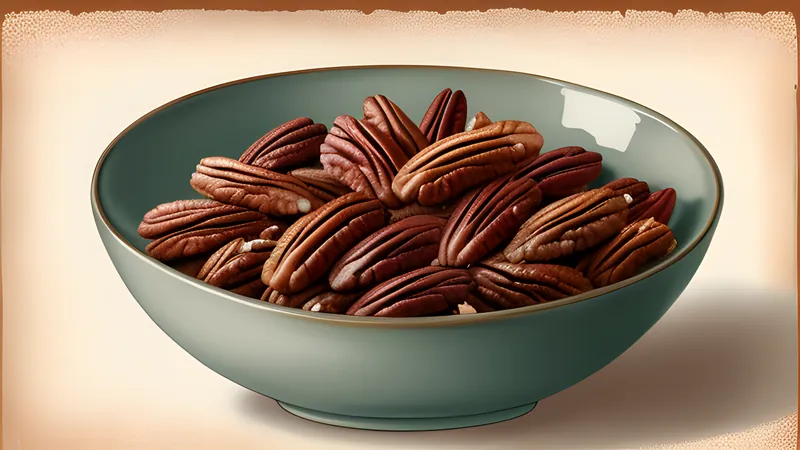
The pecan reads as a symbol of the South and of home baking: a branch heavy with nuts in autumn, a bowl of polished kernels beside a fresh pie, the smooth reddish-brown shell and the grooved two-lobed kernel inside it. As an ingredient it stands for hospitality and seasonal plenty, particularly at the autumn harvest, which makes a spring observance an interesting choice — a deliberate second moment to appreciate a nut most people associate with the closing of the year. The image of Governor Hogg’s grave tree, its nuts handed out to be planted onward, is perhaps the most resonant pecan symbol of all: a food that is also an inheritance.
Around the world
Though firmly North American in origin, the pecan has found growers far afield. Mexico is in fact the world’s second-largest producer after the United States, the two countries between them accounting for the overwhelming majority of the global crop, and orchards have since been established in South Africa, Australia, Peru and Argentina, where the reversed seasons of the southern hemisphere allow producers to supply fresh nuts when the northern harvest is months away. The nut now turns up in confectionery, baking and snacking traditions well beyond its homeland — China has become a major importer, driving up world prices in recent years as demand there surged. Its versatility, equally comfortable in a sweet pie or a savoury crust, has helped it travel, even as its deepest cultural identity stays rooted in the southern United States. Wherever it is eaten, it tends to be prized for the same pair of qualities: a rich, buttery flavour and a satisfying crunch.
Fun facts
- The pecan is the only major tree nut native to North America, setting it apart from almonds, walnuts and pistachios, which all originated elsewhere.
- The thin-shelled “paper-shell” pecan that made the nut commercially viable was first grafted in 1846 by Antoine, an enslaved gardener at Oak Alley, and the technique he proved underlies more than a thousand cultivars grown today.
- Pecans are famously prone to “alternate bearing” — a heavy crop one year followed by a light one — because the late-maturing nuts are rich in lipids that drain the tree’s stored energy.
- Texas governor James Hogg asked in 1906 for a pecan tree to mark his grave instead of a headstone, with the nuts given out to the public to plant.
- Toasting transforms a pecan, drawing out a warm, almost caramel-like depth that the raw nut only hints at — which is why so many recipes call for it.
A closing reflection
For most of its commercial life the pecan was celebrated while the man who made that commerce possible went unnamed, listed in an inventory beside a number rather than a story. A day given over to the nut is a small chance to redress that, to taste a praline or a slice of pie and remember that the soft shell yielding so easily between your fingers is the direct descendant of something one gardener achieved in a Louisiana winter without ever being credited for it. The pleasure in the nut is real; so is the debt behind it, and the two are worth holding together.
Related Content