National Peach Cobbler Day
The first published recipe for peach cobbler appeared in Lettice Bryan’s The Kentucky Housewife in 1839, a cookbook written for the kitchens of the American South, but the dish it described was already old by then — improvised for decades by cooks who had no proper oven and made do with a covered pot over hot coals. National Peach Cobbler Day, observed each year on 13 April, celebrates a dessert born entirely of necessity: ripe peaches bubbling beneath a rough, biscuity crust, the whole thing sweet, juicy and faintly caramelised at the edges. It is among the most unpretentious things ever to come out of a hot oven, and that is precisely the point of it.
Origins
National Peach Cobbler Day has no documented founder or official proclamation; like most single-food observances it simply settled into the calendar at some point in the later twentieth century. The dish, by contrast, has a clear and rather practical origin. Cobbler is a child of the colonial American hearth. European settlers arrived with a tradition of layered pastries and proper pies, but those required ovens and equipment they often did not have. So they improvised, stewing fruit in a deep pot and dropping a rough dough or biscuit batter over the top before covering it and cooking it over coals. The lumpy, uneven surface that resulted gave the dish its name: “cobbler” derives from the way the dough sat in pebble-like mounds, resembling a cobbled street.
That makeshift method is the whole genealogy of the dessert. It was never designed; it was the closest a displaced European pie tradition could get to itself with the wrong tools, and the happy accident stuck.
History
Peaches reached North America with Spanish explorers in the sixteenth century — Hernando de Soto’s expedition is often credited with introducing them around 1539 — and the fruit took to the warm southern climate with enthusiasm, though it was not until the early nineteenth century that peach growing truly flourished in states like Georgia and South Carolina. Georgia became so identified with the fruit that it took the nickname the Peach State, even though South Carolina now often grows more. The pairing of abundant southern peaches with the improvised cobbler method was almost inevitable, and peach cobbler became a fixture of country kitchens, church suppers and family gatherings.
The dish carries a particular weight in African American culinary history. Much of the cooking that shaped Southern food, peach cobbler included, was done by enslaved cooks and, after emancipation, by Black home cooks and domestic workers whose skill defined the regional table without their names being recorded. Recipes were rarely written down with precision; they passed between generations as gestures and approximations — a handful of this, a knob of that — which is part of why the dish feels less like a formula than an inheritance. Whenever the observance was first marked, it taps into that deep vein of domestic memory.
Why it matters
A dessert day can seem a trivial thing to mark, yet peach cobbler carries genuine cultural weight. It belongs to the tradition of soul food and plain home cooking, dishes valued less for refinement than for the comfort and generosity they represent. To make a cobbler is to take humble ingredients — fruit, flour, sugar, butter — and turn them into something to feed a crowded table. The day matters because it celebrates that ethos directly: the conviction, easy to lose in an age of elaborate restaurant cooking, that the best food is frequently the simplest, shared among many rather than plated for one.
There is dignity, too, in honouring a dish that grew out of constraint. Cobbler exists because people without the right equipment refused to go without something good, and that resourcefulness is worth remembering. The dessert is a small monument to making do, and making it well.
How it is made
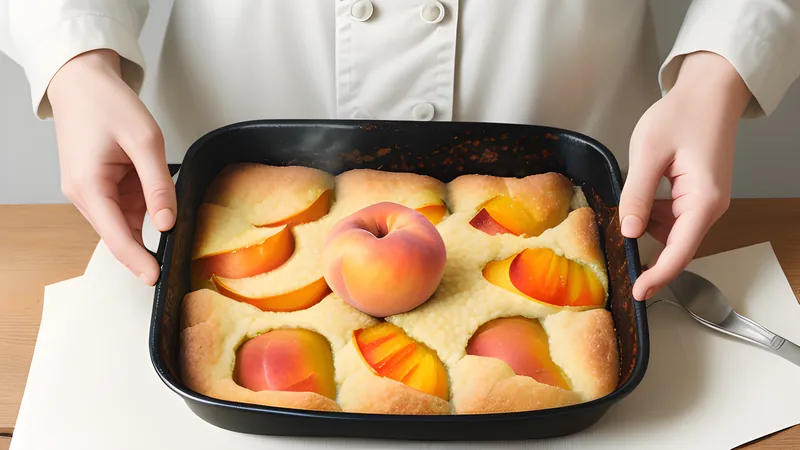
The beauty of cobbler is how forgiving it is. Peaches — fresh and ripe in season, or tinned and frozen out of it — are sliced and tossed with sugar, a little lemon and sometimes a whisper of cinnamon or nutmeg, then spread in a dish. The topping comes in several forms: a drop-biscuit dough scattered in rough mounds, a poured cake-like batter that rises up through the fruit as it bakes, or a rolled crust laid over the top. Into a hot oven it goes until the topping turns deep gold and the fruit beneath erupts into bubbling syrup. The entire pleasure of the thing lies in the contrast: tender, sweet, almost jammy peaches against a crisp, buttery crust.
Traditions and symbols
Cobbler is rarely a solitary indulgence. It belongs to the communal Sunday lunch, the summer cookout and the holiday spread, and its near-obligatory companion is a scoop of vanilla ice cream or a pour of cream, added while the dish is still warm so that it slumps and melts into the syrup. The cast-iron skillet and the well-worn baking dish are its quiet emblems, frequently handed down through families and seasoned by decades of use. More than most desserts, cobbler stands for plenty achieved without pretension — abundance you can put on the table without spending much or showing off.
Around the world
Peach cobbler is distinctly American, but the family of fruit-and-topping desserts spans many cultures. Britain has its crumbles, with a rubbed buttery topping, and its puddings of stewed fruit beneath sponge. France offers the clafoutis, fruit baked in a custardy batter. Across all these runs the same instinct: that ripe seasonal fruit, gently sweetened and crowned with something starchy and golden, makes one of the most satisfying ways to finish a meal. The cobbler belongs to this wider affection for the warm fruit pudding, and to the broader calendar of fruit-dessert observances that runs alongside related days such as National Peach Melba Day and the frozen indulgence of National Ice Cream Day — the very thing most often spooned over a cobbler.
The whole confusing family
Part of what makes cobbler endearing is that it belongs to a sprawling clan of homely fruit desserts whose names overlap, contradict each other and shift from one region of America to the next. A crisp or crumble has a streusel topping of flour, butter and often oats; a buckle is more of a cake, with the fruit folded through a batter that “buckles” as it rises; a Betty is layered with buttered breadcrumbs; a pandowdy has a pastry crust that is broken up and pressed back into the fruit partway through baking, a step charmingly known as “dowdying”. The cobbler proper, with its dropped biscuit topping, sits in the middle of this muddle.
The names get stranger still in New England. A grunt is a steamed or stovetop version, said to be named for the sound the fruit makes as it bubbles under the lid; a slump is the same idea, supposedly named because the dessert slumps and collapses when you spoon it out. In the Carolinas the deep-dish version with a lattice or rolled crust is called a sonker, a word found almost nowhere else. None of these distinctions is policed with any consistency, and the same dish may be a cobbler in Georgia, a grunt in Massachusetts and a slump in Vermont. The confusion is itself a kind of historical record — proof of how long these desserts were improvised in scattered home kitchens long before anyone tried to standardise them.
Fun facts
- The word “cobbler” comes from the cobbled, pebble-like appearance of its dropped-dough topping, not from any connection to shoemaking.
- The dessert exists because colonial cooks lacked ovens for proper pies and improvised with covered pots over coals — its rustic look is a record of that workaround.
- The first known printed peach cobbler recipe appeared in Lettice Bryan’s The Kentucky Housewife in 1839, long after the dish was already common.
- Peaches are not native to America; Spanish explorers introduced them in the sixteenth century, and they only became a major Southern crop in the 1800s.
- Cobbler has a whole family of oddly named cousins — grunts, slumps, buckles, pandowdies, Bettys and sonkers — the names varying by region, with a “grunt” said to be named for the sound the fruit makes as it stews.
A closing reflection
There is something quietly instructive in a dessert that began as a compromise and became a classic. Nobody set out to invent peach cobbler; it is what happened when cooks with the wrong equipment and the right fruit refused to do without. The lumpy crust that gave it its name was a flaw, not a feature, and yet that homely roughness is now the whole appeal. Perhaps the dishes that last longest are the ones that were never trying to impress anyone — made to feed people rather than to be admired, and loved precisely because they ask so little and give so much.
Related Content