National Oreo Day
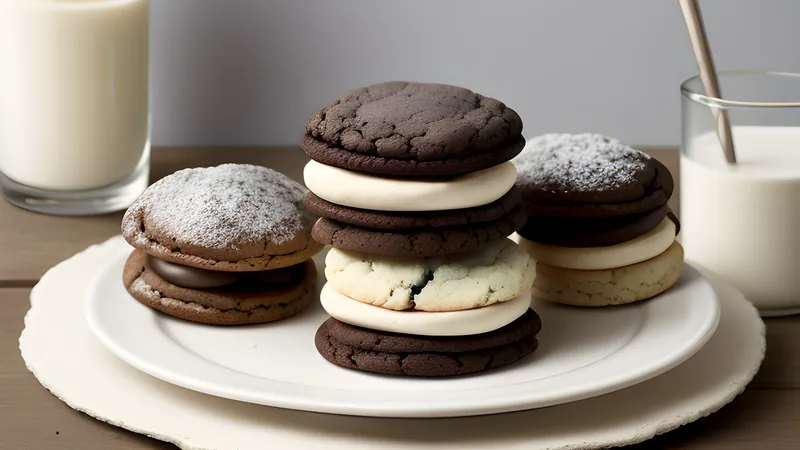
On 6 March 1912 a wholesale order of a new sandwich biscuit left the National Biscuit Company’s factory on Ninth Avenue in the Chelsea district of Manhattan and was delivered to a grocer in Hoboken, New Jersey. The biscuit was two dark, embossed wafers clasping a disc of white cream, sold by the pound from a tin canister with a clear glass lid for twenty-five cents. That delivery is why National Oreo Day falls on 6 March: it is a genuine, documented birthday rather than a vague culinary whim, and it now marks the anniversary of the world’s best-selling biscuit.
Origins
The Oreo was developed and first produced in 1912 by the National Biscuit Company — Nabisco — at its Chelsea factory, a building that survives today as the Chelsea Market food hall. The name was trademarked on 14 March 1912, just over a week after that first sale. What it means, however, nobody can say for certain. The leading theories trace it to the French or, meaning gold, because the original packaging tins were gold-coloured, or to the Greek oros, meaning mountain, though an early test version may have been mound-shaped. Nabisco itself has never settled the question, which leaves the company in the curious position of selling billions of a product whose name it cannot fully explain.
What is beyond dispute is that the Oreo was not first. It was launched as a direct imitation of the Hydrox biscuit, a near-identical chocolate sandwich introduced four years earlier in 1908 by the rival Sunshine company. The reversal of fortune is one of the great ironies of the biscuit aisle: the imitation comprehensively buried the original, and Hydrox is now remembered mainly as the answer to a trivia question while Oreo became a global icon.
History
The Oreo’s appearance has been refined but never fundamentally altered over more than a century. The intricate pattern stamped into each wafer — a wreath of laurels, a series of four-petalled florets and the central Nabisco emblem of an oval topped by a two-barred cross — was given its enduring form in a 1952 redesign credited to William Turnier, a Nabisco engineer. Most people who have eaten thousands of Oreos have never paused to read the design they are holding, yet it is among the most-reproduced pieces of food packaging ever pressed into dough.
The line then began to multiply. The Double Stuf Oreo, with roughly twice the cream filling, arrived in 1974 and proved so popular that it spawned its own debate about whether the extra was truly double (a question students have since tested with kitchen scales). From there came a vast and ever-expanding catalogue of limited editions and regional flavours, some elegant and some frankly experimental, released to keep the brand in the news. Through all of it the original three-part biscuit has remained the steady core, a design so resolved that a century of marketing has found almost nothing to improve.
Why it matters
A day for the Oreo celebrates, in part, the rare durability of a design that has scarcely needed to change since the Edwardian era. Most consumer products are reinvented every few years; the Oreo’s basic form has outlasted two world wars, the entire history of television and the arrival of the internet without meaningful revision. That kind of permanence is unusual enough to be worth noticing.
It also marks how thoroughly a manufactured food can embed itself in private ritual. The biscuit is bound up with childhood, with the specific motor memory of twisting one apart, and with the small domestic theatre of the milk glass. Few products inspire such fiercely held personal methods, and the day quietly acknowledges that a mass-produced item, sold by the billion, can still feel intimate and individual to the person eating it.
How it is celebrated
People mark the day in the obvious and pleasant way: by eating Oreos in whatever fashion they hold sacred. Some dunk, holding the biscuit in cold milk just long enough to soften it without surrendering it to the bottom of the glass. Some twist the wafers apart to get at the cream first. Bakers fold crushed Oreos into cheesecakes, ice creams and milkshakes, and the date brings a reliable wave of recipes and reminiscence. It is an undemanding observance, requiring no more than a packet and, for the purists, a cold glass of milk.
Because the day shares a calendar with countless other food observances, it tends to be celebrated in the same spirit as them — an excuse to indulge and to argue cheerfully about the right way to do so.
The “right way”, of course, is the part nobody agrees on. The single most divisive question is whether to eat the cream first, prising the two wafers apart and scraping the filling clean, or to treat the biscuit as an indivisible whole. The dunk has its own school of thought, with partisans of the brief, controlled dip warning against the catastrophe of a biscuit lost to the bottom of the glass. These debates are entirely trivial and entirely sincere, and they are a large part of why the day endures: the Oreo is one of the few mass-produced foods that people genuinely feel they have a personal technique for, and a day that invites them to defend it is bound to find takers.
A global biscuit, locally remade
The Oreo’s reach is now genuinely worldwide: it is sold in more than a hundred countries and marketed by its current owner, Mondelez, as the best-selling cookie on the planet, with the brand reporting figures in the tens of billions of biscuits sold each year. That scale was not achieved by exporting a single American product unchanged. The company learned, sometimes the hard way, that the original recipe did not travel automatically — when Oreos first arrived in China in the late 1990s they sold poorly, and the biscuit only took off there after the formula was made less sweet, the shape reworked into thin wafer versions and entirely new flavours introduced to suit local tastes.
The result is that the Oreo abroad is often unrecognisable to an American eater. China and Japan have had green-tea and matcha versions tailored to a culture where tea flavours are familiar and prized; other Asian markets have seen everything from wasabi to local fruit fillings. China is now among the brand’s largest markets in the world, a turnaround that came directly from abandoning the assumption that the home recipe was sacrosanct. The essential idea — two dark wafers around a creamy centre — stays constant, but almost everything else has proved negotiable, and that flexibility is a large part of how a single Manhattan biscuit became a global one.
A biscuit among the food days
The Oreo sits comfortably alongside the calendar’s other sweet and indulgent observances. Its near-inseparable companion, ice cream, ties it directly to National Ice Cream Day, since crushed Oreos have become one of the most common additions to scooped and churned desserts. It also belongs to the wider family of American snack-food days such as National Cheese Doodle Day, shelf-stable treats elevated by branding and nostalgia into something approaching cultural shorthand.
What distinguishes the Oreo from most of its neighbours on the calendar is the precision of its claim. Where many food days celebrate a generic foodstuff with murky origins, this one honours a specific product with a specific birthday, traceable to a single Manhattan factory and a single delivery in 1912.
Fun facts
- The Oreo was a copy. The Hydrox sandwich biscuit beat it to market by four years in 1908, yet the imitator so thoroughly eclipsed the original that many people now assume Hydrox was the knock-off.
- Nabisco does not know what “Oreo” means; the most-cited theories point to the French word for gold or the Greek word for mountain, but the company has never confirmed either.
- The elaborate pattern embossed on every wafer — laurel wreaths, florets and the Nabisco emblem — was set in its modern form by a company engineer, William Turnier, in 1952.
- The first Oreos were sold loose by the pound from tin canisters with glass lids, for twenty-five cents, rather than in the familiar packet.
- The Chelsea factory where the first Oreo was made in 1912 still stands and is now Chelsea Market, a popular New York food hall.
A closing reflection
It is telling that the world’s best-selling biscuit began as a deliberate copy of something else, and that its name means nothing anyone can prove. The Oreo’s success owes little to originality and almost everything to getting one simple form exactly right and then refusing to meddle with it. There is a quiet discipline in that — a willingness to leave a good thing alone for a hundred years while the world around it churned through endless reinvention. To twist one open on 6 March is to handle a small, edible piece of industrial history that has survived not by changing with the times but by being too well made to need to.
Related Content