National Milk Day
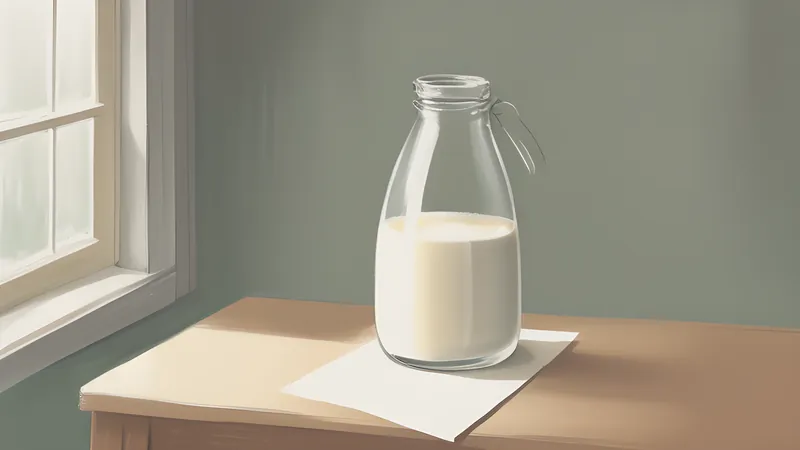
On 11 January 1878, a man named Alexander Campbell, working for the New York Dairy Company, sent out milk in sealed glass pint bottles to customers’ doors — and in doing so helped end a filthy, dangerous era. Before that, milk reached the city dweller by way of a dealer with an open churn, ladling out measures into whatever jug or bucket the household held up, with no seal, no traceable source and every opportunity for dirt, watering-down and disease to creep in. National Milk Day, observed each January on the anniversary of that delivery, honours not so much the drink as the unglamorous innovation — a clean bottle with a lid — that turned milk from a local gamble into a product you could trust.
The day and its founding moment
The 11 January date hangs on that 1878 delivery, and it is worth being honest about how firm the claim is. Campbell’s bottles, supplied by the Warren Glass Works and sealed with waxed paper, were not the very first attempt to put milk in glass; a few rural New York farmers had experimented earlier with jars whose fragile lids and gaskets let them down. What Campbell achieved was a workable, repeatable system of bottled home delivery, and that is the achievement the day commemorates. The significance was real even if the precise “first” is fuzzy: a sealed bottle meant fewer hands on the milk, a clear view of its cleanliness, and an end to the adulteration that had plagued the open-churn trade, when unscrupulous dealers stretched their stock with water and worse.
A drink older than civilisation
The bottle was a recent fix to a very old relationship. Humans have drunk the milk of other mammals for thousands of years, a habit that spread with dairying across Europe, the Near East, and parts of Africa and South Asia after the first cattle, sheep and goats were domesticated. The evidence is written into our own bodies: the genetic mutation that lets many adults digest lactose, rather than losing the ability after weaning, arose and spread precisely in those dairying populations over the last several thousand years — one of the clearest cases of culture reshaping human biology. For almost all of that long history milk was intensely local and quick to spoil, drunk within hours of milking and close to the animal that gave it. Only in the nineteenth and twentieth centuries did the combined arrival of refrigeration, Louis Pasteur’s heat-treatment process and reliable bottling turn milk into something that could travel, keep and be sold at industrial scale.
The safety revolution behind the bottle
It is easy to underestimate how dangerous milk once was. In the crowded nineteenth-century city, raw milk drawn from underfed, disease-ridden cows kept in filthy urban “swill dairies” was a notorious killer, spreading tuberculosis, typhoid and the diarrhoeal infections that carried off enormous numbers of infants. The sealed bottle was one prong of a broader public-health campaign; the other, more decisive, was pasteurisation. Louis Pasteur had shown in the 1860s that gentle heating killed the microbes responsible for spoilage and disease, and over the following decades reformers fought, against fierce resistance from parts of the dairy trade, to apply the same logic to milk. The combination of a clean, sealed, traceable bottle and heat-treated contents transformed a staple that had been quietly lethal to children into one of the safest foods in the shop. The doorstep bottle, in other words, was the visible face of an invisible scientific victory, which is part of what makes it a fitting emblem for the day.
Why a glass of milk earns a day
Milk sits in an unusual spot, at once nutritionally dense, culturally loaded and economically heavyweight. It delivers protein, calcium, fats and a range of vitamins in a single accessible form, which is why it has historically nourished both infants and the elderly. It also underpins entire rural economies. Dairy farming is among the most relentless forms of agriculture there is: cows must be milked twice or more a day, every day, holidays included, in a rhythm that does not pause for weather or weekends. A day set aside for milk is, in part, a nod to that unbroken round of labour and to the animals and farmers at the centre of it — the side of the carton that the carton itself never shows.
How people keep it
Observances of National Milk Day are domestic and low-key rather than festive. The commonest gesture is simply to drink a glass of cold milk, a milky coffee or a bowl of cereal with a little more attention than usual. Schools and dairies sometimes use the date to explain where milk comes from and how pasteurisation and bottling work. Home cooks turn to the wider dairy family — baking custards and rice puddings, whisking a béchamel, culturing yoghurt, or churning butter — as a way of marking the ingredient’s range. The tone is reflective: this is a day for noticing something usually overlooked rather than for any great celebration.
The midwinter placement of the day suits its subject. There is a long association between milk and cold-weather comfort — porridge thickened on the stove, a mug of warm milk before bed, the steam off a milky drink in a freezing kitchen — that a January date quietly honours. It also lands in the New Year, the very week of January resolutions and dietary stock-taking, when milk sits squarely in the middle of contemporary food debate. The rise of plant-based “milks” made from oats, almonds, soya and the rest has forced even the legal definition of the word into question in some countries, while concerns about animal welfare, methane emissions and lactose intolerance have complicated the wholesome image the dairy industry spent the twentieth century building. A day that began as a celebration of a public-health triumph now sits inside a far more contested conversation, which arguably makes the pause it invites more useful, not less.
The bottle as symbol
The clinking returnable glass bottle remains the defining image of the day, freighted with nostalgia for anyone who remembers, or has heard tell of, milk left on the step at dawn by a milkman doing his rounds before the household woke. The colour white, the dairy cow and the steady measure of a pint all serve as informal emblems. In an age of plastic and cartons, the refillable bottle has taken on a second meaning too, standing for a kind of low-waste thrift that some dairies and milk-round revivals have begun to champion again — the old technology recast as the sustainable one.
The same drink, different calendars
The 11 January date is rooted in an American anecdote, but milk’s importance is worldwide, and several countries hold dairy observances of their own at other times. India — now the largest milk producer on Earth, having overtaken the United States in 1998 — keeps its National Milk Day on 26 November, the birthday of Dr Verghese Kurien, the engineer who masterminded the country’s “White Revolution”. Through Operation Flood, launched in 1970, Kurien built a vast network of village dairy cooperatives on the “Anand pattern” pioneered in Gujarat, lifting India from milk shortage to global dominance in a few decades. Elsewhere the same liquid is reinterpreted endlessly: whisked into Indian chai and lassi, poured into French café au lait, set into countless cheeses and folded into festive and sacred foods from one culture to the next. Milk’s centrality places it among the staples honoured across the food calendar, in good company with sweeter relatives like National Milk Chocolate Day and the childhood favourite marked on National Chocolate Milk Day.
Fun facts
- A modern dairy cow can produce far more milk in a year than her own calf could ever drink — often several thousand litres — the result of generations of selective breeding rather than anything natural to the animal.
- The ability to digest milk into adulthood is not the human default but an evolutionary adaptation; most of the world’s adults are lactose intolerant to some degree, and persistent lactose tolerance is concentrated in populations with long dairying histories.
- Campbell’s pioneering 1878 bottles were sealed not with the familiar foil or cardboard cap but with waxed paper, an early solution to the problem of keeping the milk clean once it left the dairy.
- The cream that rises to the top of unhomogenised milk was historically the prized part, skimmed off for butter and leaving the thinner “skimmed” milk behind — a hierarchy now neatly inverted by shoppers who pay for the low-fat version.
A closing reflection
There is a quiet irony in giving a special day to milk, the most taken-for-granted thing in the fridge. Its very ordinariness is the point: the long chain of evolution, husbandry, chemistry and daily labour behind every glass has been engineered so thoroughly into the background that we no longer see it at all. The sealed bottle that Alexander Campbell sent out in 1878 was a marvel in its moment precisely because milk had been, until then, a risk. To raise a glass on 11 January is to remember that some of the greatest improvements to everyday life are the ones we eventually stop noticing.
Related Content