National Hot Chocolate Day
Long before it became a fireside comfort, the chocolate drink was bitter, frothed, often spiced with chilli, and valued so highly by the Aztecs that the cacao beans it was made from circulated as money. A turkey hen, sixteenth-century Spanish accounts record, could be bought for around a hundred beans. National Hot Chocolate Day, observed each year on 31 January, honours a drink with one of the strangest pedigrees in the kitchen: a sacred Mesoamerican beverage that crossed an ocean, picked up sugar and milk, was hoarded by Spanish courts, and eventually settled into the cosiest of everyday pleasures.
The date is well chosen. The last day of January falls in the cold, dark tail of midwinter, when a steaming mug of cocoa feels less like a treat than a small necessity. To mark the day is partly to enjoy the drink and partly to remember that the warm, sweet cup in your hands is the tamed descendant of something far older, more bitter, and considerably more valuable.
Origins in Mesoamerica
Cacao was first cultivated in the tropical lowlands of Central America, where the Olmec are thought to have used it as early as 1500 BCE. It was the Maya and later the Aztecs who turned the bean into a defining cultural drink, grinding roasted cacao and whisking it with water, maize, vanilla, chilli and other flavourings, then pouring it between vessels from a height to raise the prized foam. The Maya drank it warm; the Aztecs often took it cool. Crucially, it was unsweetened and bitter, closer to a stimulant tonic than a dessert, and it carried ceremonial and even sacred weight, appearing in marriage rites, religious offerings and the rations of warriors.
That the same beans served as currency tells you how prized cacao was. In the Aztec economy, cacao beans were a recognised medium of exchange, used to buy goods and pay tribute, which made a cup of chocolate, in a quite literal sense, a cup of money.
From Spanish secret to London chocolate house
Spanish conquistadors encountered the drink in the early sixteenth century, and it was carried back to Spain, where sugar and warmth transformed it from a bitter ceremonial beverage into a sweet luxury. For roughly a hundred years Spain kept chocolate largely to itself, a courtly indulgence guarded almost as a state secret. The drink began to spread more widely after dynastic marriage carried Spanish tastes north: the 1615 wedding of Anne of Austria to Louis XIII of France is often cited as a moment chocolate gained a foothold in the French court.
By the mid-seventeenth century it had reached England, and in 1657 the first chocolate house opened in London. These establishments became fashionable, faintly raffish gathering places, sitting alongside the new coffee houses as venues for gossip, politics and gambling among the well-off. Chocolate at this point remained expensive and labour-intensive, a drink of the leisured classes rather than the household cupboard.
The invention that democratised the cup
The decisive change came in 1828, when the Dutch chemist Coenraad van Houten patented a press that squeezed much of the fat, the cocoa butter, out of roasted cacao, leaving a solid cake that could be ground into a fine, easily dissolved powder. He also pioneered treating the powder with alkaline salts, the “Dutching” process still named after him, which mellowed the flavour and improved how it mixed with liquid. Cocoa powder made the drink cheaper, smoother and vastly more convenient, and what had been the preserve of courts and chocolate houses became a comfort available in ordinary kitchens. The marshmallow-topped mug owes its existence to that nineteenth-century press as much as to any ancient ritual.
Why it matters
Hot chocolate matters as much for what it represents as for how it tastes. It is woven into private memory: coming in from the snow, a mug at bedtime, the small consolation pressed on a child after a bad day. It is also a compact lesson in how the world’s tastes travel and change. A drink that began as bitter, sacred and exclusive ended up sweet, secular and universal, and the journey from cacao-bean currency to a sachet of powder is a clean illustration of how a rare delicacy becomes an everyday one. Few drinks carry their whole social history quite so legibly in a single cup.
How it is celebrated
Celebration is delightfully easy: one makes or buys a hot chocolate. Some favour the quick version, powder stirred into hot milk; others melt good dark chocolate into warm milk and cream for something close to the thick, almost spoonable drinking chocolate of continental Europe. Toppings invite indulgence, whether whipped cream, marshmallows, a dusting of cocoa, a curl of grated chocolate or a peppermint stick stirred through. Cafés and chocolate brands lean into the date with seasonal specials, and many people simply use it as an excuse to gather and share a pot.
The day also keeps good company in the wider calendar of cocoa-themed observances. The melted-chocolate method that produces the richest cups is the same craft celebrated on US National Milk Chocolate Day, and a mug of dark chocolate makes a natural partner to the indulgent pairing of fruit and cocoa marked on US National Chocolate-Covered Cherry Day.
Symbols and the marshmallow question
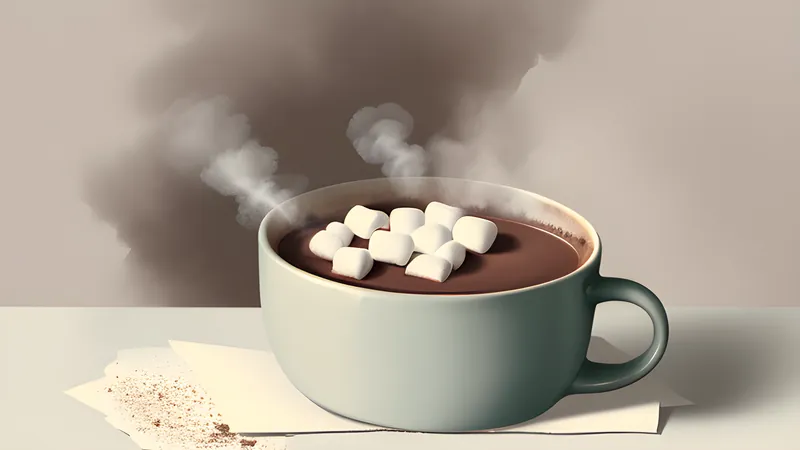
The image that has come to define the day, a steaming mug crowned with marshmallows, is a surprisingly recent and largely North American flourish. Marshmallow itself began as a French confection, pâte de guimauve, whisked from the sap of the marsh-mallow plant; the cheap, mass-produced versions that bob in a winter mug are a twentieth-century industrial descendant, set with gelatine and corn syrup rather than plant sap. They float because they are mostly aerated sugar, and they melt into the drink to give it a faint, silky sweetness, which is the whole point of dropping them in.
Other accompaniments carry their own quiet logic. A peppermint stick stirred through cuts the richness with a cool, sharp note; a dusting of cinnamon or a whisper of chilli is a direct nod to the Mesoamerican original, where spice, not sweetness, did the heavy lifting. The cocoa bean and the deep brown of chocolate serve as the day’s understated emblems, but the real symbol is the cradled cup itself, held in two hands against the cold, which is about as old a human gesture as the drink it contains.
Around the world
The drink takes strikingly different forms by country. Spanish chocolate a la taza and Italian cioccolata calda are famously thick, sometimes set with a little starch until they verge on a pudding, and in Spain they are served with churros for dipping. French chocolat chaud is rich and refined, often made from melted couverture rather than powder. In parts of Mexico and Central America the older spiced traditions persist, with cinnamon, chilli or vanilla whisked in using a wooden molinillo to raise foam much as the Aztecs once did. The further you travel, the more the same essential idea, warmed sweetened cacao, reveals where you are by how it is thickened, spiced and served.
Why it warms more than the hands
There is a reason hot chocolate feels like consolation and not merely calories. Cacao carries small amounts of theobromine, a mild stimulant chemically related to caffeine but gentler and longer-lasting, which lends the drink a faint lift without the jolt of coffee; the Aztecs, who treated it as invigorating, were not wrong about that. Milk and sugar add their own slow, steadying comfort, and the simple warmth of the cup does real physiological work, which is part of why the drink is bound up so tightly with rest, recovery and the end of a cold day.
The ritual matters as much as the chemistry. To stop, hold a warm mug in both hands and drink something slowly is a small act of self-tending, and hot chocolate has become the drink we reach for precisely when we need that. It is offered to children after a fright and to adults after a long walk in the rain, a beverage whose job is less to refresh than to reassure, which no amount of food science fully explains.
Fun facts
- Aztec cacao beans worked as actual currency: sixteenth-century records price everyday goods, including a turkey hen, in beans.
- For its first century in Europe, drinking chocolate was largely a Spanish secret, a courtly luxury kept from the rest of the continent.
- London’s first chocolate house opened in 1657, decades before chocolate became affordable, making it a venue for the wealthy and the fashionable.
- The cocoa powder behind everyday hot chocolate dates only to 1828, when Coenraad van Houten’s press removed most of the cocoa butter from the bean.
- “Hot cocoa” and “hot chocolate” are not strictly the same: the first is made from defatted cocoa powder, the second from melted chocolate, and the latter is noticeably richer and thicker on the spoon.
A closing reflection
There is something quietly remarkable in holding a drink that was once worth its weight in coin and is now made from a sachet for pennies. The whole arc of trade, conquest, invention and comfort sits inside a single mug, and we sip it without a thought for the Aztec markets or the Dutch chemist who made it ordinary. Perhaps the truest way to mark the last day of January is to taste it slowly enough to notice that the warmth in your hands has been five hundred years in the making.
Related Content