National Gumbo Day
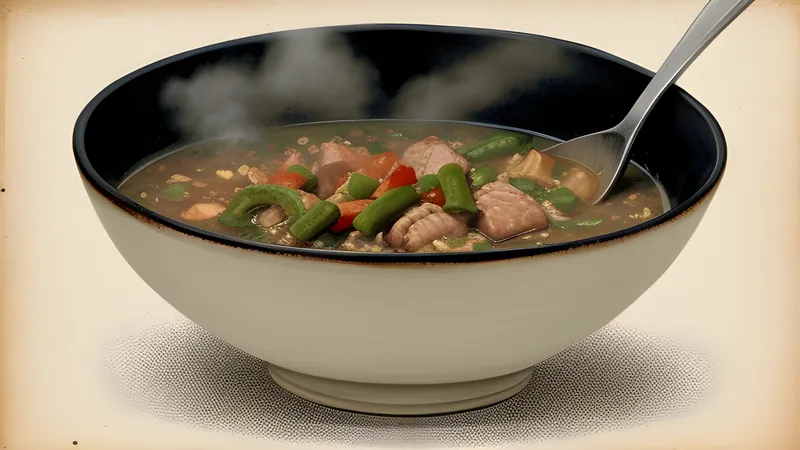
In 1803, at a gubernatorial reception in New Orleans, gumbo was set before the guests, and the following year, in 1804, it appeared at a Cajun gathering on the Acadian Coast. These are among the earliest documented references to the dish, and they tell you something important straight away: by the time anyone bothered to write gumbo down, it was already grand enough for governors and homely enough for a country gathering. On 12 October each year, National Gumbo Day honours that double life, a stew that can crown a banquet or fill a Tuesday pot with equal conviction.
Gumbo is the cooking of southern Louisiana distilled into a single bowl: dark, layered, slow, and impossible to attribute to any one people. It is a dish of patience and improvisation, and within its fragrant depths sit the intertwined histories of West Africa, France, Spain, Germany and the indigenous Choctaw. To eat it is to taste a conversation between continents.
A name from West Africa
The word itself points homeward. “Gumbo” derives from West African words for okra, gombo in the Bambara language and ki ngombo in Kimbundu, a Bantu tongue. That etymology is not incidental. Okra was a crop that enslaved Africans had introduced to the colonists of Louisiana, and it gives the okra-based versions of the dish both their body and their distinctive, faintly grassy thickness. The name encodes the people most responsible for the dish even as official histories of the region long overlooked them.
There is a second thickening agent with an entirely different lineage. The Choctaw, the indigenous people of the region, ground dried sassafras leaves into a powder called filé, which they used to thicken and season their own soups and stews. When the powder is stirred into gumbo, the dish carries a Native American technique that predates European arrival by centuries. So even before a pot is lit, two of gumbo’s defining ingredients announce its origins as African and Indigenous.
How the cultures met in one pot
The third great element is European, and French in particular: the roux, a base built by cooking flour slowly in fat until it darkens. French settlers brought this technique, the Spanish contributed seasoning sensibilities, and German immigrants, who settled along the so-called German Coast upriver from New Orleans, added their own influence to the colony’s larder. Caribbean cooking threaded through as well, carried by the movement of people around the Gulf.
As these populations mingled, so did their kitchens, and gumbo settled into the form recognised today. The earliest cookbooks confirm how varied it already was. A nineteenth-century recipe for “Oyster Gumbo Soup” used a filé base, while “Ochra Gumbo” and “Chicken Gumbo” used okra, and the 1885 Creole classic La Cuisine Creole, associated with the writer Lafcadio Hearn, documented eight different varieties. From the very beginning, then, there was never a single correct gumbo, only a method and a spirit shared across a hundred kitchens.
Creole versus Cajun: one dish, two cultures
Much of gumbo’s apparent contradiction dissolves once you separate its two parent traditions. Creole cooking grew up in New Orleans itself, urban, cosmopolitan and shaped by the city’s mix of French, Spanish, African and Caribbean households, often with easier access to ingredients like tomatoes and a wider larder. Cajun cooking belongs to the descendants of the Acadians, French settlers expelled from Nova Scotia by the British in the 1750s who resettled in the rural bayous and prairies of southern Louisiana. Their gumbo grew out of country resourcefulness, leaning on smoked andouille sausage, game and whatever the land and water provided.
That divide explains the famous arguments. Creole gumbo more often includes tomatoes and seafood; rural Cajun gumbo frequently omits tomatoes and favours a darker, more rustic roux built on chicken and sausage. Neither is the “authentic” version, because the dish was authentically two things at once almost from the start, a single name stretched across two distinct peoples who each made it their own.
Why it matters
Gumbo is more than a meal; it is a cultural document you can eat. Each pot records a place, a family, and a set of choices, and no two cooks make it quite the same. It anchors Sunday tables, festivals and family reunions across Louisiana, and it has become a proud emblem of both Creole and Cajun identity, two distinct cultures that the dish manages to span. To recognise gumbo is to recognise the resilience and inventiveness of communities that built something extraordinary, often from modest and hard-won ingredients.
There is a wider lesson in it too, one shared by the best of the world’s peasant cooking: that necessity and ingenuity, not luxury, tend to produce the dishes people love most fiercely and defend most loudly.
Gumbo also took on a renewed civic weight after Hurricane Katrina struck New Orleans in August 2005. In the long recovery, communal pots of gumbo became a small ritual of return, cooked at reopenings, fundraisers and homecomings as a way of declaring that the city’s kitchens, and its culture, had survived. A dish already built on resilience acquired one more layer of meaning, which is fitting for a food whose entire history is one of people rebuilding flavour from whatever remained to them.
How it is made
The heart of gumbo is the roux, and making it is an exercise in nerve. Flour is toasted in oil or fat over steady heat, stirred almost without pause, until it shifts from blond through peanut to a deep, glossy brown the colour of an old penny. The darker the roux, the more nutty and complex the flavour, but the higher the risk: a scorched roux is ruined and must be thrown out and begun again. To this base go the “holy trinity” of finely chopped onion, celery and green pepper, then the chosen protein.
From there the variations open out. Seafood gumbo brims with shrimp, crab and oysters; a Cajun country version leans on chicken and smoked andouille sausage; some pots hold all of these. Thickening comes from okra simmered into the body of the stew, from filé stirred in off the heat at the very end, or from the roux itself, and the result is ladled over a mound of steamed white rice. A pot of gumbo is, by its nature, communal: cooked in quantity, tended for hours, and shared.
The okra question deserves a word of its own, because it explains a quiet seasonal rhythm in Louisiana kitchens. Okra thickens by releasing a viscous mucilage when cut and cooked, the same property that makes it divisive elsewhere; in gumbo, that body is the whole point. Filé, the powdered sassafras, does a similar job by a different route, and it has the curious habit of turning the stew ropey and stringy if it boils, which is why it is stirred in only after the pot leaves the heat. Cooks who learned the dish from their grandmothers will often defend their thickener of choice as if it were a matter of family honour, which, in a sense, it is.
Around the world and across the table
Gumbo remains rooted in Louisiana, but its fame has carried it far. Restaurants across the United States and abroad offer their own interpretations, and the dish has become shorthand for Southern soul cooking. Its kinship with okra-thickened, rice-served stews echoes through the wider Gulf and Caribbean, a culinary thread running back, again, to West Africa.
It also sits comfortably within the broader calendar of food days that celebrate regional and homemade cooking. A cook who loves the slow craft of a dark roux will recognise the same care lavished on good pressing in extra virgin olive oil, where method and patience separate the sublime from the ordinary. And a bowl of seafood gumbo finds an easy companion in the kind of generous, crowd-pleasing dessert celebrated on National Ice Cream Day, the cool finish to a long, hot meal built for sharing.
Fun facts
- Gumbo is the official state cuisine of Louisiana, a rare honour granted to a single dish.
- Filé is added off the heat for a reason: boiling it makes the gumbo turn stringy and ropey, so it goes in only once the pot has come off the flame.
- The okra-versus-filé question is partly seasonal in origin; cooks reached for fresh okra in summer when it was plentiful and turned to dried filé in the cooler months when it was not.
- The choirboy rule of roux-making is absolute among Louisiana cooks: never stop stirring, and never try to rescue a burnt one, because a single scorched fleck taints the whole pot.
- Whether tomatoes belong in gumbo splits cooks along regional lines, with many New Orleans Creole versions including them and rural Cajun cooks often leaving them out entirely.
A closing reflection
Some of the finest food on earth was born not of plenty but of constraint, of people making something memorable from what they had and what they knew. A pot of gumbo holds the labour and memory of many hands and many cultures, simmered down into something larger than any single tradition could have made alone. Perhaps that is the quiet argument the dish makes every time it is shared: that hospitality, at its best, is mostly the act of making room at the table for one more.
Related Content