National Fried Clam Day
On the back of their wedding certificate, Lawrence and Bessie Woodman wrote a single proud line: “We fried the first fried clam — in the town of Essex, July 3, 1916.” That scrawled date is exactly why National Fried Clam Day falls on 3 July rather than on some arbitrary slot in the calendar. The day marks the anniversary of an experiment at a roadside stand on Main Street in Essex, Massachusetts, when a couple short on customers tipped a bucket of shellfish into a pot of hot lard and accidentally invented one of New England’s defining foods. It is a celebration with a verifiable birthday, a named inventor and a surviving restaurant — a rarity among the hundreds of food days that crowd the year with little more than a hashtag behind them.
The afternoon it was invented
In 1914, Lawrence Woodman — known to everyone as “Chubby” — and his wife Bessie opened a small concession on Main Street in Essex. At weekends they sold groceries, fresh-dug clams and homemade potato crisps fried on the spot. Chubby dug the clams himself from the tidal flats, and on a slow afternoon in the summer of 1916 he grumbled to a passing fisherman named Tarr that business was, in his phrase, “slower than a couple of snails headed uphill.”
Tarr, nibbling a handful of those homemade crisps, glanced at a nearby bucket of clams and made the joke that changed New England lunch forever: why not fry the clams the same way? Chubby and Bessie took the suggestion seriously. They shucked a batch, threw lard into the pot already hot for the crisps, and tried different coatings until they landed on the method Woodman’s still uses — the clams dipped first in milk, then in a mixture of finely ground cornmeal and flour before going into the fat. By the Fourth of July weekend they were selling them. The Woodmans were so certain of what they had done that they recorded it in writing, which is how a chance kitchen accident comes to have a documented date at all.
History
The story is unusually well attested, but it is not entirely uncontested. Other coastal communities have floated rival claims to the fried clam, and food historians enjoy poking at the edges of the Woodman legend. What is not in dispute is that Woodman’s of Essex, the descendant of that 1914 stand, is still trading on the same stretch of Route 133 more than a century later, and still markets itself as the home of the fried clam. The family carried the claim forward deliberately, turning a single hot afternoon into an institution.
The dish that made Woodman’s reputation, though, was not the version most Americans would eventually eat. That distinction belongs to a separate New England family. In Ipswich, a few miles down the coast, the Soffron brothers — Tom, George, Pete and Steve, the children of Greek immigrants who had come to work the town’s mills — ran a clam-processing business. Thomas Soffron was reportedly a fussy eater who disliked the soft belly of the clam, so he developed a product using only the firm foot of large hard-shell sea clams, sliced into uniform strips. He branded them “Tender-sweet” clams, and they had a quality the whole-belly clam lacked: they could be frozen and shipped long distances without falling apart.
That made them perfect for a man named Howard Johnson, whose orange-roofed restaurants were spreading across the eastern United States. The Soffron brothers became Howard Johnson’s exclusive clam supplier for 32 years, and Tom and George personally travelled the chain teaching kitchen staff how to bread and fry the strips correctly. Frozen Tender-sweet strips went from Maine to Florida; at its peak the chain ran more than a thousand restaurants, and the Soffrons built seven processing plants between Nova Scotia and Maryland to keep them stocked. The partnership ran until Howard Johnson’s ended the contract in 1966. By then a whole generation of Americans who had never set foot in a New England clam shack thought of “fried clams” as the mild, uniform strip — not the briny whole-belly article Chubby Woodman had fried by the sea. The two styles still divide eaters, and the argument is friendlier but no less real than the one over how to dress a lobster roll or a bowl of chowder.
Why the day is worth keeping
A food day is easy to dismiss as marketing, and many deserve the suspicion. This one earns its place because the thing it commemorates is genuinely particular. The whole-belly fried clam is tied to a specific geography — the cold, clean tidal flats of the North Shore of Massachusetts and the coast of Maine — in a way that resists imitation. The soft-shell clam favoured for it does not freeze and travel well, which is precisely why Howard Johnson’s needed the Soffrons’ strip instead. So the original remains stubbornly local: to eat the real thing, more or less, you still have to go to where it is made.
That is an increasingly unusual quality in food. Most regional dishes have been flattened into something shippable, frozen or franchised. The fried clam split early into two paths — one that conquered the interstate and one that stayed by the water — and both survive. Keeping a day for it is a way of remembering that a great deal of good cooking began not with a recipe but with someone trying to use up what was in front of them on a slow day.
How it is eaten
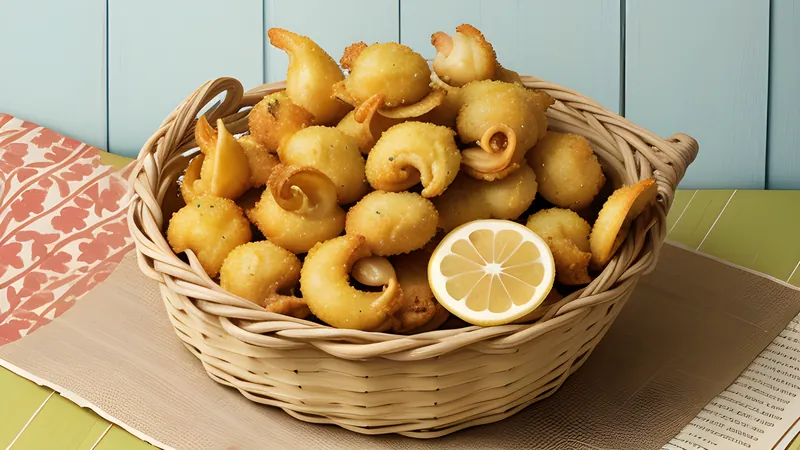
The day is observed the only sensible way, which is by eating fried clams. Along the New England coast the clam shack does brisk trade — the seasonal, unpretentious kind of place that may be little more than a serving window and a cluster of picnic tables, often open only from late spring to early autumn. The classic order arrives in a paper basket or cardboard tray: a heap of golden clams, a wedge of lemon, a pot of tartar sauce, and usually chips and coleslaw alongside to make up what is known locally as a shore dinner.
Cooking them at home is a matter of nerve and timing. The clams are shucked, dipped in milk or buttermilk, dredged in a coating built around cornmeal or corn flour for its sweet, sandy crunch, and dropped into oil hot enough to set the crust in seconds without toughening the meat inside. Whole-belly clams reward the cook with a burst of brine; strips are easier to handle and more forgiving. Either way the verdict is delivered fast, because a fried clam is at its peak for only a few minutes and turns rubbery if it waits.
A wider habit of the coast
Frying small shellfish is hardly unique to Essex. Italian kitchens have long served fritto misto, a tumble of squid, prawns and small fish flashed in hot oil; port towns from Cádiz to Tokyo have their own battered seafood eaten with the fingers near the water. The Japanese refined deep-fried seafood into tempura, and fish-and-chip shops along the British coast turned battered frying into a national habit of their own. The New England fried clam belongs to this family but keeps its accent — the cornmeal coating, the whole belly, the paper basket eaten with the sea in view.
Its nearest relatives sit on the same menus rather than across oceans. Fried oysters, lobster rolls and clam chowder make up the comforting canon of North Atlantic shore eating, and a basket of clams rarely travels alone. The same instinct that put clams in the fryer also keeps the day in good company with America’s other deep-fried enthusiasms; it is a short hop from a clam shack to the same love of hot oil that drives the national affection for fried chicken. The technique is shared; only the catch changes.
Symbols and small rituals
The whole-belly clam is the day’s emblem of authenticity — the dish in its truest form, defended by people who will tell you, unprompted, that a strip is not really a fried clam at all. The paper basket, the roadside shack and the view of the water are part of the symbolism too, inseparable from the food itself; the setting is treated as half the meal. Tartar sauce is near-obligatory and lemon is expected, while the chips and slaw complete the plate. There is even a vocabulary attached, much of it earthy, that marks an eater out as a local rather than a visitor.
Fun facts
- The soft-shell clam prized for whole-belly frying is commonly nicknamed the “steamer”, but along the coast it also goes by the blunter name “piss clam”, earned by the jet of water it squirts when disturbed in the sand.
- National Fried Clam Day is the literal anniversary of the dish: the Woodmans dated the first fried clam to 3 July 1916 and recorded it on the back of their own wedding certificate.
- The fried clam most Americans grew up with was the work of a fussy eater — Thomas Soffron disliked clam bellies, so he built the strip from the foot of the clam and sold it as “Tender-sweet”.
- For 32 years Howard Johnson’s served only Soffron clams, and the brothers ran seven processing plants from Nova Scotia to Maryland to feed a chain of over a thousand restaurants.
- Woodman’s of Essex, the original stand, has stayed on the same coastal road for more than a century and still advertises itself as the birthplace of the fried clam.
A closing reflection
There is a particular kind of luck in a food whose inventor bothered to write down the date. Most of what we eat arrived anonymously, perfected by thousands of unrecorded cooks, so that arguing about who made the first version is usually pointless. The fried clam is the rare exception — a dish with a signature, a place and an hour, born because two people short of customers decided a fisherman’s joke was worth testing. What followed split into the strip that crossed a continent and the whole-belly clam that refused to leave the shore, and the survival of both is the quiet argument this day makes: that an accident, taken seriously, can outlast the chain that made it famous. The clam strip travelled further, but the original stayed home and is still worth the drive.
Related Content