National English Toffee Day
In 1825 a new word slipped into the Oxford English Dictionary: toffee, set down in print for the first time, though the sticky sweet it described had been cooling on northern English slabs for decades before any lexicographer caught up with it. By 1828 the spelling had settled into the form we still use. National English Toffee Day, observed each 8 January, honours that confection of butter and sugar boiled to a fierce heat until it sets hard and glassy and snaps with a clean, satisfying crack. It is a sweet of cold weather and warm kitchens, and its place at the head of the year feels right — a small, deliberate indulgence for the long, dark stretch after Christmas.
Where the word came from
The etymology of “toffee” is genuinely contested, and the competing theories say something about how the sweet travelled. The likeliest ancestor is taffy, the older northern and Scots dialect name for a pulled sugar sweet; the two words shadow each other through the early nineteenth century. A second strand links it to tafia, a rough rum distilled from molasses — plausible, given that early toffee leaned heavily on treacle and dark sugar. A third proposal traces it to a Hindi term for a similar confection, a reminder that sugar itself reached Britain through a long imperial supply chain. What the dictionaries agree on is the date: the thing existed well before 1825, but the name is a child of the nineteenth century, arriving precisely when cheap refined sugar and cheap butter were landing in British kitchens together for the first time.
History
The clearest, most traceable history of English toffee runs through the north of England, and through a single, splendidly named regional sweet: bonfire toffee. Also called treacle toffee, plot toffee, cinder toffee or — best of all — Tom Trot, this dark, brittle, almost bitter slab was popular in Yorkshire from roughly 1830 to 1900, and by the 1890s the name “Tom Trot” was in common use there. Its association with Guy Fawkes Night on 5 November is one of those traditions nobody can fully explain; the Gunpowder Plot of 1605 gave the evening its bonfires, and over the following two centuries toffee and parkin attached themselves to the festivities until the trio became inseparable. “Plot toffee” still carries the memory of 1605 in its name.
Bonfire toffee stayed stubbornly domestic for a practical reason. Although confectionery had begun industrialising in the 1840s, the price of black treacle through the 1890s and into the early twentieth century often climbed above the price of plain sugar, which made shop-bought treacle toffee a poor bargain. Families made their own at the kitchen range, poured it onto greased trays, let it set, and shattered it with whatever was to hand. That hammer-and-slab ritual is the bedrock of the sweet’s nostalgia.
Then the name crossed the Atlantic and changed character entirely. The decisive figure is L. S. Heath, an Illinois schoolteacher who in 1913 bought a confectionery shop in the small town of Robinson as a venture for his sons. The Heath Brothers Confectionery began producing a buttery, almond-studded, chocolate-coated toffee, and by 1928 they were selling it as “Heath English Toffee” — soon shortened to the Heath bar and marketed, with characteristic American modesty, as “America’s Finest.” That bar fixed the meaning of “English toffee” for a whole continent: butter, brown sugar, almonds and a milk-chocolate coat, broken into rustic shards. Hershey acquired the brand late in 1996, and it is still on shelves today.
The result is a curious transatlantic muddle. In Britain there are dozens of toffees with no nuts at all, and the word covers everything from soft, chewy sweets to brittle bonfire slabs. In America, “English toffee” almost always means the almond-and-chocolate style, and there is a long-running argument — only half in jest — that any toffee with nuts has really become a kind of peanut or almond brittle. British toffee tends to use brown sugar and a generous hand with butter; the American “English” version leans on almonds and a chocolate finish. The name stuck to the style as a badge of pedigree even as the recipe drifted well away from anything a Yorkshire grandmother would recognise.
Why it matters
Toffee is a small lesson in physics disguised as a sweet. Everything depends on temperature. Heat a butter-and-sugar mixture to around 116°C and it sets soft and chewy, the realm of caramels and fudge; push on to roughly 150°C — the “hard crack” stage — and the cooling sugar turns brittle and glassy, the realm of toffee proper. The gap between a perfect batch and a scorched one is a matter of a few degrees and a moment’s distraction, because once sugar starts to caramelise it accelerates fast and burns faster. A day set aside for this confection is really a day for an exacting bit of domestic chemistry, and for the particular flavour that only deep caramelisation gives: sweet, yes, but with a darker, almost bitter edge that softer sweets never reach. It also honours something harder to bottle — the link between a hard amber sweet and the rituals of midwinter and bonfire season, the tin passed round, the slab broken among many hands.
How the day is kept
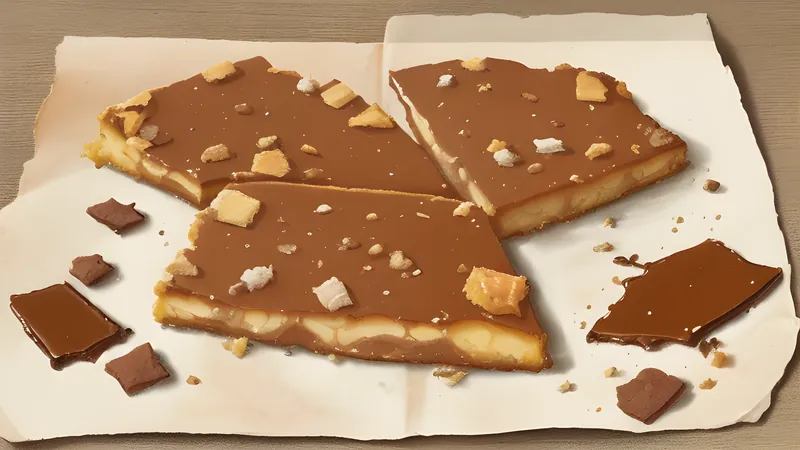
The eighth of January falls in the dead centre of the season toffee suits best, and the day rewards both the buyer and the maker. Sweet shops and chocolatiers push their toffee selections; supermarkets shift the leftover Christmas tins. The more ambitious treat it as a cooking challenge, melting butter and sugar in a heavy pan, watching the colour deepen from gold to amber, testing for the hard crack either by thermometer or by dropping a little into cold water to see whether it sets into a brittle thread, then pouring the molten sheet onto a lined tray and waiting, impatiently, for it to cool enough to crack. The almond-and-chocolate route — pour the toffee, let it firm, blanket it with melted chocolate, scatter crushed almonds — is the home version of the Heath bar, and it is the recipe most American kitchens reach for on the day.
Cultural variations
The same idea of butter and sugar cooked dark takes on a different accent in each place that adopts it. In Yorkshire and Lancashire, treacle toffee remains tied to 5 November, eaten alongside sticky, ginger-dark parkin while the bonfire burns down. The United States has its almond Heath bar and the wave of homemade chocolate-topped “English toffee” that appears at Christmas. Butterscotch — softer, made with brown sugar and often a splash of cream — is toffee’s gentler first cousin and has its own following, particularly in puddings and sauces. Cinder toffee, the aerated, honeycomb version puffed up with bicarbonate of soda, is the sweet inside a Crunchie bar and a fairground staple under names like honeycomb and hokey-pokey. Each is a variation on the same two ingredients pushed to slightly different heats and textures.
Symbols and traditions
The toffee hammer is the confection’s most charming emblem — the small mallet once supplied with slab toffee so that customers could break off a portion at the shop counter or the kitchen table. It survives mainly as a fond memory, proof of exactly how hard a proper toffee was meant to be. The other enduring symbol is the toffee tin itself, decorated and reusable, a fixture of the corner shop and the Christmas stocking that long outlived the sweets it held; empty toffee tins have furnished British households with sewing kits and button hoards for generations. And there is the glassy sheet of just-set toffee, caught at the moment before it is shattered, holding the light like dark amber — the single most photogenic stage in the whole patient process.
Fun facts
- The word “toffee” reached print in 1825, but the sweet had been made in northern England since at least the mid-eighteenth century — the food comfortably predates its own name by decades.
- Bonfire toffee’s gloomiest nickname, “plot toffee,” is a direct nod to the Gunpowder Plot of 1605, making it perhaps the only sweet named after an attempted act of terrorism.
- The Heath bar that defined “English toffee” for America was the creation of an Illinois schoolteacher, L. S. Heath, whose family firm launched it in 1928 and branded it “America’s Finest.”
- The line between toffee and brittle is so blurred that there is a serious culinary argument that American “English toffee,” once you add the almonds, has quietly turned into nut brittle.
- Treacle toffee stayed homemade for an economic reason: through the 1890s the price of black treacle frequently rose above the price of sugar, so a shop-bought version cost more than it was worth.
A closing reflection
There is a quiet defiance in toffee. It belongs to a kitchen culture that valued patience and a steady eye over speed — you cannot rush sugar to 150°C and you cannot save a burnt batch — and it survives in a confectionery world that mostly prizes the opposite. The British connoisseur of English language and its restless borrowings might enjoy that “toffee” itself is a contested loan-word, never quite pinned down, exactly like the sweet it names: is it Yorkshire treacle slab or Illinois almond bar? The honest answer is both, and the disagreement is part of the pleasure. Next to the cold theatre of a scoop of ice cream in high summer, toffee is the deep-winter opposite — warm-made, hard-set, meant to be cracked apart and shared by a fire. Eight days into a new year, when the festive excess has faded and the evenings are still long and dark, a shard of good toffee asks very little: good butter, careful heat, and the willingness to wait for it to cool before you break it.
Related Content