National Empanada Day
Carved into the Pórtico de la Gloria, the great Romanesque doorway of the cathedral at Santiago de Compostela completed around 1188, there is a small detail that pilgrims tend to walk straight past: among the prophets and the elders of the Apocalypse sits a figure with what scholars have long identified as a filled pastry. If they are right, it is one of the oldest images of an empanada anywhere — a parcel of dough and filling fixed in stone in Galicia eight centuries before anyone thought to give it a day on the calendar. That day is 8 May, National Empanada Day, an American food observance that has quietly become a peg on which to hang a far older and stranger story: how a single idea — wrap a meal in pastry, seal it, cook it — escaped one corner of north-west Spain and reappeared, transformed, on tables from Buenos Aires to Batac.
Where the name comes from
The word itself is plain about what it describes. Empanada derives from the Spanish verb empanar, to coat or wrap in bread, and so the thing is, literally, a “breaded” or “en-breaded” object — a filling given a crust to carry it. That bluntness is part of the charm. There is no poetry in the name, only function: here is something good to eat, and here is the shell that will keep your hands clean and your dinner warm on the road.
National Empanada Day, by contrast, has no such clear lineage. Unlike a few food holidays that can be traced to a trade association or a presidential proclamation, the empanada’s 8 May slot has no documented founder and no first year that any reliable source agrees on. It belongs to the large, slightly anarchic family of single-food calendar days that surfaced through restaurants, recipe blogs and social media in the United States, gathering momentum without anyone ever signing the paperwork. For a food that was never owned by a guild or a region in the first place, that anonymity feels oddly appropriate.
History
The earliest written recipe most historians point to appears in the Llibre del Coch, a Catalan cookbook printed in Barcelona in 1520 and attributed to Master Robert de Nola, who described himself as cook to Ferrante I, the fifteenth-century king of Naples. The book had circulated in manuscript before that, and it was successful enough to be translated into Castilian by 1525 and reprinted many times. Its empanadas are not the half-moons of the modern imagination; they tend toward larger baked pies, and several are filled with seafood — oysters, eel, shellfish — sealed in pastry, which makes sense for a recipe born on the Mediterranean coast.
Go back further than the printed page and the trail becomes a question of which filled pastry counts as an ancestor. Long before Galicia, cooks across Persia and the Arab world were making sanbusaj, a stuffed pastry whose name travelled almost as widely as the food: it became samosa in India, sambusa in parts of the Middle East, samsa among Turkic-speaking peoples and chamuça in Portuguese-speaking Goa and Mozambique. The Moorish presence in medieval Iberia, which lasted until 1492, carried these traditions of enclosing spiced fillings in dough into the kitchens of Andalusia and Galicia, where they met local bread-making. The Galician empanada that emerged from that meeting stayed loyal to its roots as a big, sliceable pie — often filled with tuna, cockles or pork — rather than an individual snack.
What turned a regional Spanish pie into a continent-spanning family was the crossing of the Atlantic. Spanish and Portuguese ships carried the form to the Americas in the sixteenth century, and there it shrank, multiplied and absorbed whatever grew nearby. In the Andes and the River Plate, the large pie became a single hand-sized half-moon. Indigenous ingredients rewrote the fillings, and indigenous languages even renamed them. The Chilean pino — the seasoned beef-and-onion mixture at the heart of that country’s empanada — takes its name from the Mapuche word pinu, meaning cooked, shredded meat. The empanada stopped being one recipe and became a method, capable of holding almost anything a household had to hand.
Why a folded pastry mattered
It is easy to treat the empanada as a snack and leave it there, but its real significance is logistical and social before it is culinary. A sealed pastry is portable, durable and self-contained: it needs no plate, no cutlery and no reheating, which made it the food of harvesters, miners, travellers and anyone working too far from a kitchen to come home for lunch. The same qualities made it ideal for feeding a crowd cheaply, which is why it anchors so many festivals and patriotic holidays rather than fine-dining menus.
There is a second, quieter argument for it. Because the technique is forgiving and the filling is open-ended, the empanada became a way of using up what was left — odd scraps of meat, yesterday’s stew, a handful of vegetables — without it reading as leftovers. That economy is part of why it took root in so many immigrant households: the form survives translation, accepting the ingredients of a new country while keeping the shape of the old one. To fold empanadas is usually to do it in company, dozens at a time, which makes the day in their honour less about a single pastry than about the kitchen-table labour that produces them.
How it is made, and why the crimp talks
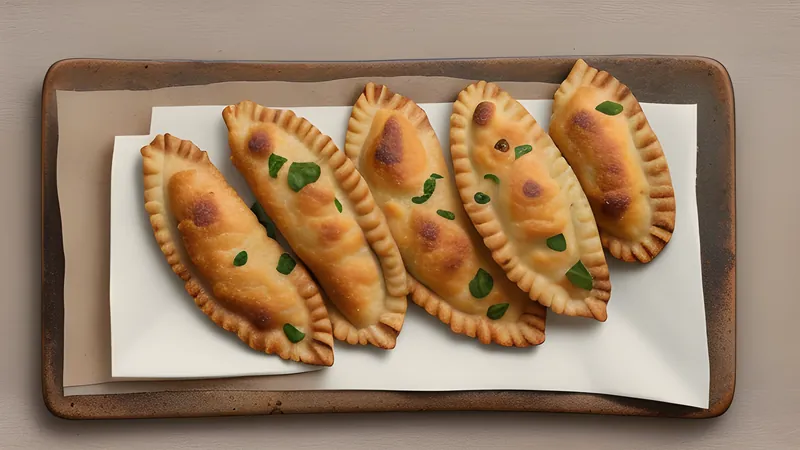
At its simplest the empanada is two things: a dough and a filling. The dough may be wheat enriched with butter or lard for a flaky, golden bake, or built on cornmeal for a sturdier, gluten-free shell that fries to a crackle. The cook rolls it thin, cuts discs, spoons in the filling, folds, and seals the edge — and it is that seal, the repulgue, where the craft shows. In Argentina the braid is not merely decorative; it functions as a code. A rope-like braided fold conventionally signals beef, broader crimps mark chicken, a fork-pressed edge means ham and cheese, and a small tortellini-like twist hides humita, a creamed-corn filling. A diner can read the batch before tasting a single one.
Nowhere is this more exacting than in Tucumán, in north-western Argentina, where tradition dictates exactly thirteen folds to a proper empanada — one for Jesus and one each for the twelve apostles. A correctly made tucumana can be identified by count alone, and locals will tell you, with some heat, that the neighbouring Salta style spoils things by adding potato to pad out the meat.
The same shape, a hundred kitchens
The geography of the empanada is what makes it remarkable. In Chile the empanada de pino — beef, onion, a wedge of hard-boiled egg, an olive and a scatter of raisins — is the undisputed centrepiece of the Fiestas Patrias on 18 September, eaten by the million as the country marks its independence. Colombia and Venezuela lean on maize doughs fried to a deep gold, often split open and dressed with ají. Bolivia has its juicy, slightly sweet salteña, eaten as a mid-morning bite and notorious for the soup-like filling that demands a careful first bite.
Cross the Pacific and the form turns up where Spanish ships once docked. The Ilocos region of the northern Philippines makes a vividly orange empanada — its colour from annatto seeds worked into a rice-flour shell — stuffed with grated green papaya, garlicky longganisa sausage and a whole egg cracked in raw before the pastry is sealed and deep-fried, then eaten dipped in spiced vinegar. The rival towns of Batac and Vigan argue over fillings and crispness with the seriousness elsewhere reserved for football. And the wider cousinhood stretches to the Cornish pasty, the Italian calzone and the Jamaican patty — all variations on the single instinct to wrap a good thing in dough. If you enjoy tracing one foodstuff across borders, the empanada rewards the same curiosity as a wedge of Extra Virgin Olive Oil Day, another Mediterranean export that changed character with every coastline it reached.
Fun facts
- The Tucumán empanada has a fixed liturgical fold count: thirteen pleats, said to stand for Christ and the twelve apostles, so the pastry doubles as a small piece of devotional arithmetic.
- “Pino”, the Chilean beef filling, is not Spanish at all — it descends from the Mapuche word pinu for cooked, chopped meat, a rare survival of an indigenous food term in everyday national cuisine.
- A figure on the 12th-century Pórtico de la Gloria at Santiago de Compostela is widely read as holding an empanada, which would make it one of the oldest depictions of the dish in existence.
- The first printed empanada recipes, in the 1520 Llibre del Coch, are seafood — oysters and shellfish baked in pastry — not the beef most people now picture.
- The Ilocos empanada gets its alarming orange glow from annatto and is one of the few in the world built on a rice-flour rather than a wheat or corn dough.
A closing reflection
The empanada is a reminder that some of the most durable ideas in cooking are also the least precious. No one patented the half-moon of dough; no single country can claim it, and the moment one tries, three others produce an older or stranger version. What survives is not a recipe but a principle — enclose, seal, cook — flexible enough to carry Galician cockles, Mapuche beef, annatto-stained papaya and a wedge of quince paste with equal ease. Marking 8 May is really a way of noticing that flexibility, the way a hard-working shape can pick up the accent of every kitchen it passes through and still be recognisably itself. The next time you crimp an edge, you are joining a line that runs from a Persian pastry cook through a cathedral carver and a Barcelona printer to a grandmother in Tucumán counting to thirteen. Few snacks come with such company. If the idea of celebrating a single food strikes you as faintly absurd, the empanada is in good company — the calendar finds room for National Ice Cream Day too, and both have earned their place by being shared rather than revered.
Related Content