National Croissant Day
In 1839, an Austrian artillery officer named August Zang opened a bakery at 92 rue de Richelieu in Paris and called it the Boulangerie Viennoise. He sold Viennese specialities the French had not seen before: a dense, dark Vienna loaf, and a crescent-shaped roll called the kipferl. Parisians queued for them, French bakers copied them, and within a few decades the borrowed crescent had been remade into something distinctly French. That bakery, more than any battlefield legend, is where the croissant we celebrate each 30 January truly begins. National Croissant Day honours a pastry built from flour, water, yeast and a great deal of butter, folded and chilled and folded again until it bakes into something shatteringly crisp without and tender within.
Where the day comes from
Like most single-food observances, National Croissant Day has no charter, founder or founding year that can honestly be named. It surfaced through food-calendar listings and the gentle promotion of bakeries, and the date of 30 January carries no recorded significance beyond its place on those lists. This is worth saying plainly, because the pastry it marks has a far better-documented history than the day itself, and that history needs no embellishment to hold attention.
From kipferl to croissant
The croissant’s ancestor is the kipferl, a crescent-shaped bread of Austrian origin that predates the modern pastry by centuries and was made from a plain or lightly enriched dough, not a laminated one. A much-loved legend ties the crescent shape to the 1683 Ottoman siege of Vienna, claiming bakers shaped the roll to mock the crescent on the Turkish standard. Historians treat this as charming folklore rather than fact; there is no contemporary evidence for it, and the kipferl appears in Austrian records before the siege.
The documented turning point is Zang’s Paris bakery of 1839. His success spawned imitators, and as French bakers reworked the kipferl over the following decades they introduced the decisive innovation: lamination. Instead of a simple dough, they began folding a sheet of cold butter into the dough and rolling it out repeatedly, building up dozens of paper-thin alternating layers. The modern viennoiserie croissant, leavened with yeast and laminated with butter, took its recognisable form only in the early twentieth century, by which time it had become a fixture of the French breakfast, sold fresh each morning from neighbourhood boulangeries. Its name survives as a memorial to that Austrian origin: in French, the whole family of butter-rich breakfast pastries is still called viennoiserie, “things from Vienna”.
How the layers are built
The technique that separates a croissant from an ordinary roll is lamination, and it rewards a closer look. The baker makes a basic yeasted dough, called the détrempe, then encloses a flat block of cold butter inside it and rolls the parcel out into a long rectangle. That rectangle is folded over on itself, chilled, rolled out and folded again, and the cycle is repeated several times with rests in the refrigerator between each turn. Each fold multiplies the count of butter layers: a dough given three sets of three-fold turns ends up with dozens of paper-thin sheets of butter separated by equally thin sheets of dough. The chilling between turns is not optional fussiness. If the butter warms, it soaks into the dough and the distinct layers are lost; if it grows too cold and hard, it cracks and tears through the dough rather than sliding flat. The baker is forever managing a narrow temperature window, which is why a single batch can occupy the better part of a day.
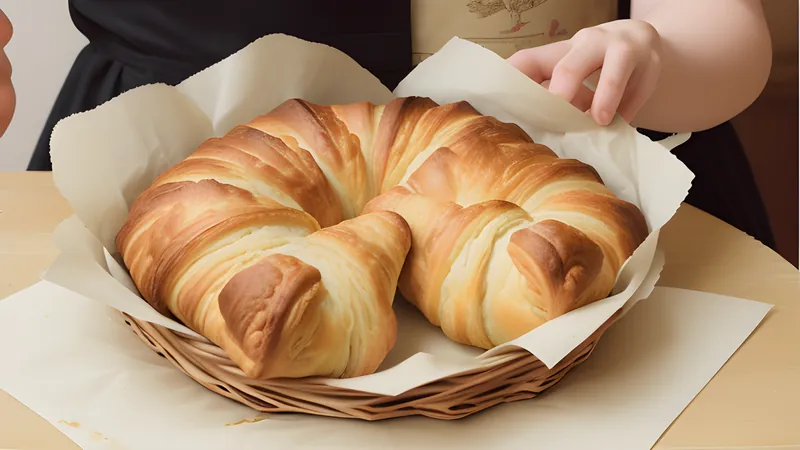
The payoff happens in the oven. As the heat hits, the water in the butter and dough turns to steam and forces the layers apart, while the yeast adds its own lift, and the butterfat fries the dough from within so that the surface crisps and lacquers to gold. The result is the honeycomb interior of a good croissant, all open air and shattering shell, with a crumb that pulls apart in buttery threads rather than tearing like bread.
Why it matters
A croissant is a quiet record of skill and patience. The lamination cannot be faked or hurried, and the difference between a great example and a mediocre one is visible in the cross-section: clean, distinct layers and a hollow, airy interior on one hand; a dense, bready, collapsed crumb on the other. Much of that quality also comes down to the butter itself, since high-fat European-style butter stays pliable when cold and produces the cleanest, most defined layers. Beyond the kitchen the croissant has become shorthand for a particular idea of pleasure, the leisurely breakfast and the civilised pause, the willingness to let a morning unfold slowly rather than rush through it. There is a small philosophy folded into it: that some pleasures are worth the time they take, both to make and to eat.
How it is celebrated
Celebration tends to be gentle and delicious. Most people simply buy a fresh croissant from a favourite bakery and pair it with strong coffee, often tearing rather than cutting it and dunking the torn end. The more ambitious attempt their own, embracing the long ritual of folding, chilling and resting the dough across a day or two. Others explore the croissant’s relatives: the pain au chocolat, made by wrapping the same laminated dough around batons of chocolate; the almond croissant glistening with frangipane, traditionally a clever way to revive yesterday’s stock; or savoury versions filled with ham and cheese. Bakers have pushed the laminated dough into new territory, too: the split croissant packed with a scoop of ice cream has become a fixture of summer counters and a natural companion to the cold sweets feted on National Ice Cream Day, while a simpler breakfast pairs the warm pastry with fruit, in the unfussy spirit of Eat a Red Apple Day. Cafés and chains often lean into the date with offers, and bakeries that take their lamination seriously sometimes use it to show off the cross-section of a properly built croissant, the honeycomb interior that no shortcut can produce. The day’s pleasures are deliberately modest: it asks for an hour, a good pastry and the patience to enjoy it slowly, ideally before the morning has fully started and the crumbs still warm.
Around the world
Though French at heart, the croissant has been embraced and reinterpreted far beyond France. In Argentina the medialuna, the “half-moon”, is a sweeter, smaller and denser cousin, usually brushed with a glaze of sugar syrup and eaten with coffee; the medialuna de manteca (of butter) is the richer version, and the form is widely credited to Italian immigrants who arrived in the late nineteenth century. Cafés from Tokyo to Buenos Aires keep their own house styles, and recent years have brought playful hybrids and ever more elaborate creations, from the cube-shaped croissant to the cronut, a croissant-doughnut crossing that drew queues around a New York bakery when it appeared in 2013. Bakers everywhere fold in flavours their predecessors never imagined, and laminated dough now turns up in forms a Parisian boulanger of 1900 would not recognise. Yet the plain, perfectly laminated croissant remains the benchmark against which every variation is measured; the novelties succeed or fail by how well they preserve the layers underneath the gimmick.
Traditions and symbols
The crescent form is the croissant’s defining symbol, instantly recognisable across continents, while its golden, lacquered crust and visible layers advertise the butter and labour within. In France a quiet etiquette surrounds the pastry: the all-butter croissant (au beurre) is traditionally shaped straight rather than curved, while the curved version may be made with other fats. The distinction is a baker’s code rather than a strict legal rule, but it lets a knowing customer tell at a glance, before the first bite, which kind they are buying.
Fun facts
- The croissant is not originally French at all; it descends from the Austrian kipferl, brought to Paris by August Zang’s Boulangerie Viennoise in 1839.
- The popular story that the crescent shape mocks the Ottoman flag after the 1683 siege of Vienna is folklore, with no contemporary evidence behind it.
- The French word viennoiserie, used for the whole family of breakfast pastries, literally means “things from Vienna”, a standing tribute to the croissant’s Austrian roots.
- In France the all-butter croissant is conventionally baked straight rather than curved, so its shape quietly signals the fat used inside before you taste it.
- A single croissant can carry dozens of distinct layers of dough and butter, all produced by repeatedly folding a single block of cold butter into the dough.
A closing reflection
There is a neat irony in the croissant’s fame: the most French of breakfasts is a foreign loaf, reshaped by hands that were not Austrian, named for a shape rather than a place. It is a reminder that culinary nationality is mostly a matter of who took the time to perfect a thing, not who first thought of it. To break open a warm croissant on 30 January is to taste a couple of centuries of borrowing and patient refinement, folded invisibly into the layers.
Related Content