National Cream Puff Day
In the kitchens of the early nineteenth century, a Parisian pastry chef named Marie-Antoine Carême, the man his admirers called the chef of kings and the king of chefs, took a centuries-old cooked dough and turned it into the backbone of French patisserie. Out of it he built towering croquembouches, glossy éclairs, and the airy, cream-filled puff that now has a day of its own. Observed each year on 2 January, National Cream Puff Day is a quiet, indulgent footnote to the festive season, a reminder that the new year need not begin with austerity. It honours one of the most elegant of everyday sweets: a crisp, hollow shell of golden choux, split open and filled with billowing cream, dusted with sugar, and gone in a few happy bites.
Origins of the pastry
At the heart of the cream puff lies pâte à choux, a dough whose story reaches back to the courts of Renaissance Europe. The most repeated origin tale credits a chef named Panterelli, said to have travelled to France in the entourage of Catherine de’ Medici when she left Italy in 1533 to marry the future King Henry II. He is supposed to have dried a dough over heat on the stovetop and named it after himself, pâte à Panterelli. Historians treat the precise account with caution; no first name is ever attached to the figure, and the story may be more legend than record. What is firmer is the dough’s evolution: it passed through a stage known as pâte à Popelini, named for the small cakes made from it, before two royal chefs, Jean Avice and Antonin Carême, refined it in the eighteenth and early nineteenth centuries into something very close to the modern article. The very name “pâte à choux” took hold only in the eighteenth century.
How the national day came about
The pastry has a documented lineage; the observance does not. Like most single-food days, National Cream Puff Day appears to have grown up through food calendars and the gentle marketing of bakeries rather than any official proclamation, and no founder or founding year can honestly be named. The date of 2 January seems to have been chosen for no reason grander than its availability at the start of the year. This is a common pattern, and it is no embarrassment: the dish carries more than enough history on its own. The croquembouche, the spectacular cone of cream puffs bound with spun caramel that Carême helped popularise, became the centrepiece of French weddings and christenings, and the humbler chou à la crème settled into patisserie windows across the country and far beyond.
The history of a single dough
What makes choux remarkable is how much it has produced from so little. The same paste yields the éclair, the profiterole, the religieuse, the Paris-Brest, and the savoury gougère studded with cheese. In France the cream-filled version is the chou à la crème; in Italy it is the bignè; in Germany and Austria it is the Windbeutel, the “wind bag”, named for the airy hollow inside. The pastry travelled with French culinary prestige through the nineteenth and twentieth centuries, becoming a fixture wherever European baking took root. Its spread was not merely a matter of taste but of technique: choux became one of the foundation doughs that any serious pastry training had to cover, which is partly why it turns up, in one guise or another, in so many national repertoires.
The men who refined it
The two names worth knowing are Jean Avice and Marie-Antoine Carême. Avice, a celebrated pastry chef working in Paris around the turn of the nineteenth century, is generally credited with refining the choux paste of his day into a lighter, more reliable dough and with developing the small puffs that would become the building blocks of grander constructions. Carême, who trained in part under Avice and went on to cook for diplomats and crowned heads across Europe, took those building blocks and turned them into spectacle. He was among the first chefs to treat dessert as architecture, and the croquembouche, the towering cone of cream puffs cemented with threads of caramel, is the most enduring of his showpieces. It became the standard centrepiece of French weddings and christenings and remains so today, which means a pastry first perfected two centuries ago still presides over the most important days in many French families’ lives. Carême’s wider influence, codifying techniques and sauces that professional kitchens still teach, is why he is so often called the first celebrity chef, and the cream puff sits squarely inside that legacy.
Why it matters
The cream puff is a small lesson in physics dressed as a treat. Its shell relies on no leavening beyond steam. Water and butter are heated, flour is beaten in to form a paste, eggs are worked in one at a time, and in the oven the trapped moisture turns to steam and inflates the dough into a hollow dome. There is no yeast, no baking powder, nothing but heat and timing. Marking a day in its honour quietly celebrates this bit of kitchen alchemy and the nerve it asks of the baker, who must resist the urge to open the oven door and watch the fragile structure collapse. A pastry this dependent on patience is a fitting thing to make at the start of a year.
How it is celebrated
Celebration is uncomplicated and delicious. Bakeries tend to push cream puffs forward on the counter, and home bakers take the day as a prompt to attempt choux themselves. The ritual is genuinely satisfying: piping neat mounds, watching them rise, and filling the cooled shells with whipped cream, crème pâtissière, or even ice cream. Those who would rather not turn on the oven simply seek out the best version they can find and pair it with strong coffee or tea. The croquembouche reappears at celebrations for the more ambitious, a reminder that a single small puff can also be a building block for something grand. Bakeries sometimes use the date to push their choux range forward on the counter, and the comparison between a freshly filled puff and a tired, pre-filled one is its own quiet argument for buying from somewhere that makes its own.
Around the world
Choux has adapted everywhere it has gone. France treasures the chou à la crème, Italy the bignè, Germany and Austria the Windbeutel. In Japan the shū kurīmu, its name a Japanese rendering of the French chou welded to the English “cream”, is enormously popular, sold fresh by the thousand in bakeries and convenience stores. Each tradition adjusts the filling and finish, lightening or enriching the cream, dipping the tops in chocolate, or adding the crackly craquelin lid that gives a marbled, crisp finish. The essential pleasure stays constant: a light shell yielding to a soft, sweet centre. A filled puff can even take a frozen turn, the shell split and packed with ice cream into the dessert profiterole, which is why the pastry sits so easily alongside the cold-sweet celebrations of National Ice Cream Day and the more particular National Coffee Ice Cream Day, a pairing French kitchens have long enjoyed in profiteroles drowned in chocolate sauce.
Symbols and traditions
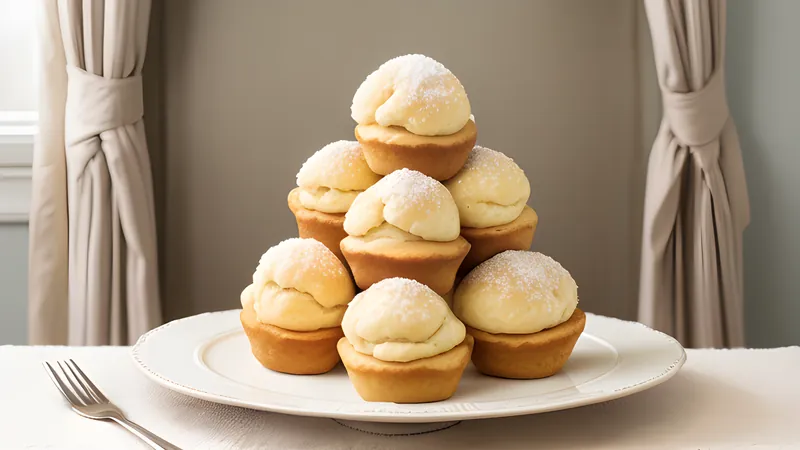
The defining image is the split, sugar-dusted dome with cream spilling from its centre. The pastry’s French name carries its own quiet symbol: choux means “cabbages”, a nod to the rounded, ruffled look of the baked puffs. The croquembouche, with its caramel threads and tiered cone, has become shorthand for celebration itself, a structure that is as much architecture as dessert. The fact that cream puffs sit at the indulgent, dairy-rich end of the dessert world places them in good company with treats like the strawberry cream pie, where the cream is the whole point rather than a garnish.
Fun facts
- The word choux literally means “cabbages” in French, chosen for the pastry’s rounded, ruffled shape once it puffs in the oven.
- The cream puff rises with no leavening at all: it is steam from the dough’s own moisture that inflates the shell, which is why bakers are warned never to open the oven too early.
- Antonin Carême, often called the first celebrity chef, helped turn choux into haute cuisine and is credited with popularising the towering croquembouche.
- Japan’s shū kurīmu is one of the country’s most popular everyday sweets, its name a hybrid of the French word for cabbage and the English word for cream.
- The same humble paste produces an astonishing spread of pastries, from the éclair and profiterole to the savoury, cheese-laced gougère.
A closing reflection
There is something quietly appropriate about beginning January with a cream puff rather than a resolution. The pastry asks for attention and a little courage, gives back something airy and generous, and then vanishes in moments, leaving only sugar on the fingers. It is a treat that resists hoarding and rewards the present tense. Perhaps that is the better lesson to carry into a new year: not grand declarations, but the willingness to take some care over a small, fleeting, well-made thing.
Related Content