National Coquilles St. Jacques Day
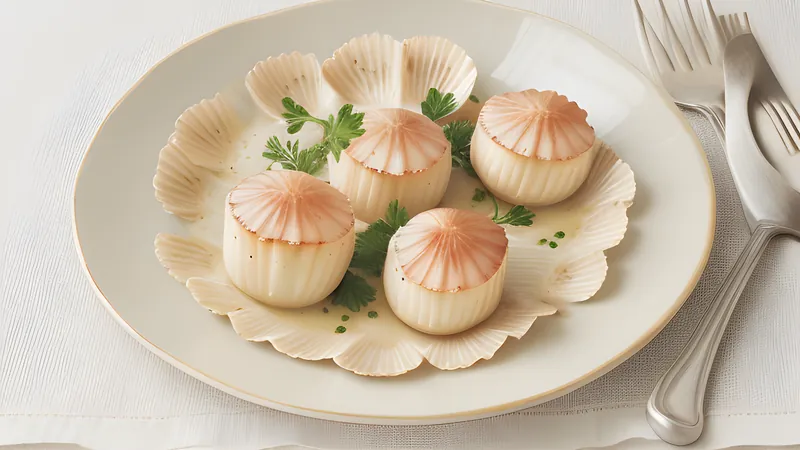
Walk any of the medieval routes that converge on the Spanish city of Santiago de Compostela and you will see the same emblem cut into milestones, painted on signposts and pinned to rucksacks: a fan-shaped scallop shell, ridges radiating from a single hinge. Pilgrims have worn it for the best part of a thousand years as proof they had reached the shrine of Saint James, and they used the hollow shell as a cup and a begging-bowl on the way. That shell gave its name to a dish — coquille Saint-Jacques, “shell of Saint James” — which is the French term both for the scallop itself and for the gratin of scallops in a creamy sauce served in the shell. National Coquilles St. Jacques Day, kept on 16 May, celebrates the moment a religious badge became a recipe.
The saint and the shell
The link between the apostle and the mollusc rests on legend rather than record, but the legend is old and remarkably consistent. According to Catholic tradition, the body of James the Greater was carried by ship from the Holy Land to the coast of Galicia in north-western Spain. In one version a storm wrecked the vessel and the body washed ashore unharmed, crusted with scallop shells; in another a knight on the shore, or his bolting horse, plunged into the sea as the ship passed and surfaced covered in the same shells, saved by the saint. Whichever telling you prefer, the scallop emerged as the sign of James, and his shrine at Santiago de Compostela became, alongside Rome and Jerusalem, one of the three great pilgrimage destinations of Christendom.
For medieval pilgrims the shell was practical as well as symbolic. Light and durable, it served as a scoop for drinking from streams and as a dish into which charitable households could ladle a measured portion of food. The custom even shaped almsgiving: a single shell’s worth became a recognised unit of generosity at monasteries and pilgrim hostels along the way. Wearing the shell on hat or cloak marked you as a pilgrim under the protection of the Church, and the symbol was so firmly fixed that the waymarked Camino routes still carry it today.
From badge to dish
The scallop is abundant in the cold Atlantic waters off northern France, and it is in the coastal regions of Normandy and Brittany — closely tied to the pilgrim traffic moving south — that the culinary coquille Saint-Jacques took shape. The dish in its classic form is unhurried French cookery: scallops poached gently, set in a sauce enriched with cream, white wine and often mushrooms and shallots, returned to the cleaned half-shell, topped with breadcrumbs or a piped collar of mashed potato, and browned under the grill until the surface blisters gold. French chefs refined it over generations from a simple way of cooking shellfish into a small set piece of bourgeois and restaurant cuisine, the kind of dish that looks like a feast and announces an occasion.
As with most food days, the dedicated date on the calendar has no traceable founder and appears to have grown up informally, an excuse rather than a decree. What is documented is the dish’s lineage, which is older and more interesting than any modern observance — a thread running from a shipwreck legend through the pilgrim economy of the Middle Ages to a Norman kitchen. That a single fine ingredient should carry centuries of cultural weight is not unusual in European food culture; the reverence the Mediterranean shows its pressed olives, marked on Extra Virgin Olive Oil Day, runs along the same lines, and the impulse to give an everyday pleasure its own moment on the calendar is the same one behind National Ice Cream Day.
A bay, a season, a guarded name
The scallop is not merely an idea in French cooking but a serious fishery, and Normandy guards it jealously. The Bay of Saint-Brieuc off the Breton coast and the waters of the Baie de Seine support some of Europe’s most prized scallop grounds, and the French dredging season runs only through the colder months, traditionally from autumn into spring, with strict limits on days and hours at sea to let the beds recover. The result is that the coquille Saint-Jacques is a winter delicacy at its source, landed fresh during exactly the season when a hot, creamy gratin is most welcome.
France takes the name itself seriously too. European labelling rules reserve the term noix de Saint-Jacques for true scallops of the genus Pecten, chiefly the great scallop Pecten maximus, distinguishing them from the cheaper pétoncle and from imported substitutes that had been sold under the prestigious name. It is a rare case of a culinary term being given the force of law, a measure of how much cultural weight the shell still carries in the country that turned it into a dish.
Why the dish endures
The appeal of coquilles Saint-Jacques is partly that it solves a real problem elegantly: the scallop is sweet and delicate but small, easily overcooked into rubber, and its own shell happens to be a perfect portion-sized, oven-proof dish. The technique exists to flatter the ingredient — the cream and wine cushion the flesh, the grill crisps the top without drying the centre, and the shell delivers it looking like something from a much grander menu. It is a lesson in how restraint and a good vessel can turn a modest shellfish into the high point of a meal, which is the quiet argument the day really makes. There is a frugality buried in the elegance, too: the dish was a way of stretching a small quantity of expensive scallop with cream, wine and breadcrumbs into something that filled a shell and satisfied a table, dressing thrift up as luxury in the way the best traditional cooking so often does.
The scallop, a stranger creature than it looks
It is easy to forget, eating one, that the scallop is among the more remarkable animals on a plate. Unlike most bivalves, which sit cemented in place, scallops swim: they clap their two valves together to jet water out and propel themselves through it, a flapping, erratic dart that lets them flee predators such as starfish. Stranger still, the live animal has dozens — sometimes up to two hundred — tiny eyes ringing the edge of its mantle, each a vivid blue and built on a curved mirror of crystal rather than a lens, giving the scallop the most acute vision of any bivalve. The part eaten is chiefly the adductor muscle, the powerful disc the creature uses to snap that shell shut.
How it reaches the table elsewhere
Scallops are prized far beyond France. Japanese cooks serve the sweetest specimens raw as hotate sushi and sashimi, or sear them quickly over high heat; in the United States the seared scallop is a restaurant staple, caramelised on its flat faces and left translucent within. Along the Mediterranean they are grilled simply with oil and lemon, and in Peru they appear in ceviche, “cooked” only by lime juice. The specifically French gratin, with its cream sauce and browned crust, is the version that travelled into international dinner-party repertoires, but every coast that lands scallops has found its own way to honour their flesh.
Fun facts
- The dish takes its name from a religious badge: medieval pilgrims to Santiago de Compostela wore a scallop shell as proof of their journey, and the waymarked Camino routes are still marked with the shell today.
- Pilgrims used the actual shell as a cup and a food bowl, and a “shell’s worth” became a recognised standard portion of charity handed out at monasteries along the route.
- Scallops can swim, jetting themselves through the water by rapidly clapping their shells — a rare talent among bivalves, most of which stay fixed in one spot.
- A living scallop has up to around two hundred eyes lining its mantle, each one bright blue and focused by a tiny mirror rather than a lens, giving it the sharpest sight of any bivalve.
- In French, à la coquille describes any dish served in a shell, a small linguistic legacy of this most photogenic of seafoods.
A closing reflection
There is a neat circularity to coquilles Saint-Jacques: the shell that once carried a pilgrim’s drinking water and a beggar’s ration of food now carries his dinner, dressed up and browned under the grill. The badge of austerity and long walking has become an emblem of small luxury, and the journey of meaning is almost as long as the journey to Santiago itself. To eat from the shell on 16 May is to hold, for a moment, an object that has stood for faith, endurance and hospitality far longer than it has stood for a good meal. The pilgrim who scooped streamwater from that same fluted shape would have understood the impulse exactly: the shell was always about sustenance and the road, and a plate of scallops gilded under the grill is only the most comfortable version of a very old idea — that the journey, and the meal at the end of it, are worth marking with the same simple emblem.
Related Content